
Commentary on 2 Corinthians 5:17
1. The Text
2 Corinthians 5:17 (King James Version):
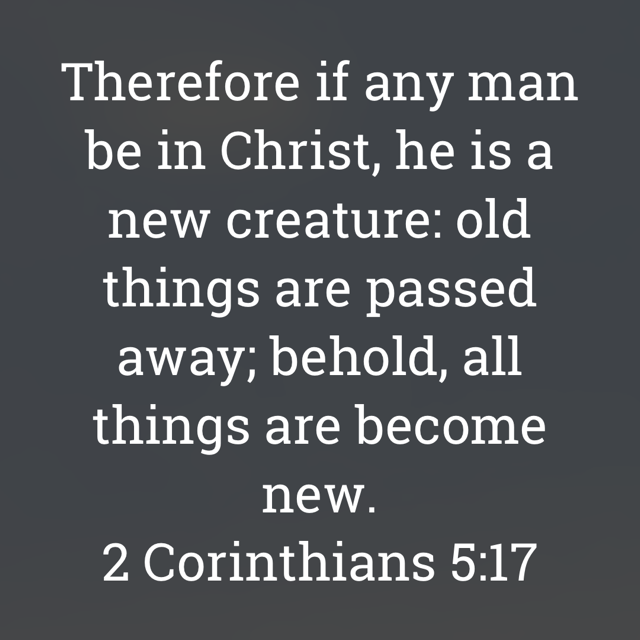
“Therefore if any man be in Christ, he is a new creature: old things are passed away; behold, all things are become new.”
This single verse stands as one of the most hope-filled declarations in the New Testament. It summarises the heart of the gospel: union with Jesus Christ brings about a real, Spirit-wrought transformation.
2. Context in 2 Corinthians Chapter 5
Paul’s argument in 2 Corinthians 5[i] builds toward this declaration. Several key themes shape the meaning of verse 17:
a. The hope of resurrection and eternal life
2 Corinthians 5:1 (King James Version):
“For we know that if our earthly house of this tabernacle were dissolved, we have a building of God, an house not made with hands, eternal in the heavens.”
Paul reminds believers that their identity is anchored not in the temporary but in the eternal. This eternal perspective shapes the newness described in verse 17.
b. Living to please Christ
2 Corinthians 5:9 (King James Version):
“Wherefore[ii] we labour, that, whether present or absent, we may be accepted of him.”
The new creation life is not passive. It is a life of Spirit-empowered obedience.
c. The love of Christ as the controlling force
2 Corinthians 5:14 (King James Version):
“For the love of Christ constraineth[iii] us…”
The new creation is motivated by Christ’s love, not human effort or moral striving.
d. The ministry of reconciliation
2 Corinthians 5:18 (King James Version):
“And all things are of God, who hath reconciled us to himself by Jesus Christ…”
The new creation is not merely personal renewal; it is participation in God’s reconciling work.
3. Exegetical Commentary on 2 Corinthians 5:17
“Therefore if any man be in Christ…”
Union with Christ is the foundation of salvation in Christian theology. To be “in Christ” is to be joined to him by faith through the Holy Spirit. This is not a metaphorical association but a real spiritual union.
Paul does not say “if any man imitate Christ” or “if any man try harder.” The new creation begins with God’s initiative, not human achievement.
“…he is a new creature…”
The Greek term kainē ktisis means “new creation,” not merely “improved version.” This echoes God’s creative power in Genesis. Salvation is not cosmetic; it is re-creative.
This new creation includes:
- A new heart (Ezekiel 36:26)
- A new identity (Galatians 2:20)
- A new purpose (Ephesians 2:10)
“…old things are passed away…”
This refers to the old life under sin’s dominion. The guilt, alienation, and spiritual deadness of the past no longer define the believer.
Paul is not saying the believer becomes sinless, but that the old regime has lost its ruling power.
“…behold, all things are become new.”
The word “behold” invites us to stop and marvel. The newness is comprehensive:
- New standing before God
- New desires
- New affections
- New community
- New mission
This is the fruit of regeneration, justification, and sanctification working together.
4. Theological Teaching
a. Regeneration is God’s work alone
The new creation is the result of the Holy Spirit’s sovereign work. This aligns with Christian teaching on monergistic regeneration.
b. Union with Christ is central to Christian identity
Everything believers receive—justification, adoption, sanctification, glorification—flows from being “in Christ.”
c. Sanctification is the lived expression of the new creation
The believer grows into what God has already declared them to be.
d. The new creation is both present and future
Believers experience real transformation now, but the fullness awaits the resurrection.
5. Application to Modern Christian Living
a. Identity: You are not defined by your past
Many Australians carry deep wounds, regrets, or shame. This verse speaks directly to that burden. In Christ, the past no longer has the final word.
b. Growth: The new creation life is ongoing
Christians should expect change. Not perfection, but progress. The Spirit is at work reshaping desires, habits, and relationships.
c. Mission: New creations become ambassadors
2 Corinthians 5:20 (King James Version):
“Now then we are ambassadors for Christ…”
The new creation is not a private spiritual upgrade. It equips believers to represent Christ in workplaces, families, and communities.
d. Assurance: God finishes what he starts
Because the new creation is God’s work, believers can rest in his faithfulness rather than fear failure.
6. Meditation Guide
Use these steps for personal reflection or small group devotion.
Step 1: Read the verse slowly
Repeat 2 Corinthians 5:17 aloud several times.
Step 2: Reflect on the phrase “in Christ”
Ask:
- Am I resting in Christ or in my own efforts
- Where do I look for identity or worth
Step 3: Consider the “old things” that have passed away
Bring specific sins, fears, or patterns before God.
Thank him that they no longer define you.
Step 4: Ask the Spirit to reveal the “new things” he is forming
Pray for renewed desires, courage, and obedience.
Step 5: Commit to living as an ambassador for Christ
Ask God to show you one person to love, serve, or encourage today.
[i] 2 Corinthians 5
King James Version
5 For we know that if our earthly house of this tabernacle were dissolved, we have a building of God, an house not made with hands, eternal in the heavens.
2 For in this we groan, earnestly desiring to be clothed upon with our house which is from heaven:
3 If so be that being clothed we shall not be found naked.
4 For we that are in this tabernacle do groan, being burdened: not for that we would be unclothed, but clothed upon, that mortality might be swallowed up of life.
5 Now he that hath wrought us for the selfsame thing is God, who also hath given unto us the earnest of the Spirit.
6 Therefore we are always confident, knowing that, whilst we are at home in the body, we are absent from the Lord:
7 (For we walk by faith, not by sight:)
8 We are confident, I say, and willing rather to be absent from the body, and to be present with the Lord.
9 Wherefore we labour, that, whether present or absent, we may be accepted of him.
10 For we must all appear before the judgment seat of Christ; that every one may receive the things done in his body, according to that he hath done, whether it be good or bad.
11 Knowing therefore the terror of the Lord, we persuade men; but we are made manifest unto God; and I trust also are made manifest in your consciences.
12 For we commend not ourselves again unto you, but give you occasion to glory on our behalf, that ye may have somewhat to answer them which glory in appearance, and not in heart.
13 For whether we be beside ourselves, it is to God: or whether we be sober, it is for your cause.
14 For the love of Christ constraineth us; because we thus judge, that if one died for all, then were all dead:
15 And that he died for all, that they which live should not henceforth live unto themselves, but unto him which died for them, and rose again.
16 Wherefore henceforth know we no man after the flesh: yea, though we have known Christ after the flesh, yet now henceforth know we him no more.
17 Therefore if any man be in Christ, he is a new creature: old things are passed away; behold, all things are become new.
18 And all things are of God, who hath reconciled us to himself by Jesus Christ, and hath given to us the ministry of reconciliation;
19 To wit, that God was in Christ, reconciling the world unto himself, not imputing their trespasses unto them; and hath committed unto us the word of reconciliation.
20 Now then we are ambassadors for Christ, as though God did beseech you by us: we pray you in Christ’s stead, be ye reconciled to God.
21 For he hath made him to be sin for us, who knew no sin; that we might be made the righteousness of God in him.
[ii] In plain contemporary English, “wherefore” means “for that reason” or “because of this.”
[iii] The word “constraineth” in the King James Bible means “compels,” “urges,” or “drives.” It comes from older English and is used to describe a strong inner force or pressure that moves someone to act.
Discover more from Daily bible verses
Subscribe to get the latest posts sent to your email.


You must be logged in to post a comment.