
Commentary on Psalm 133:1
Text (King James Version):
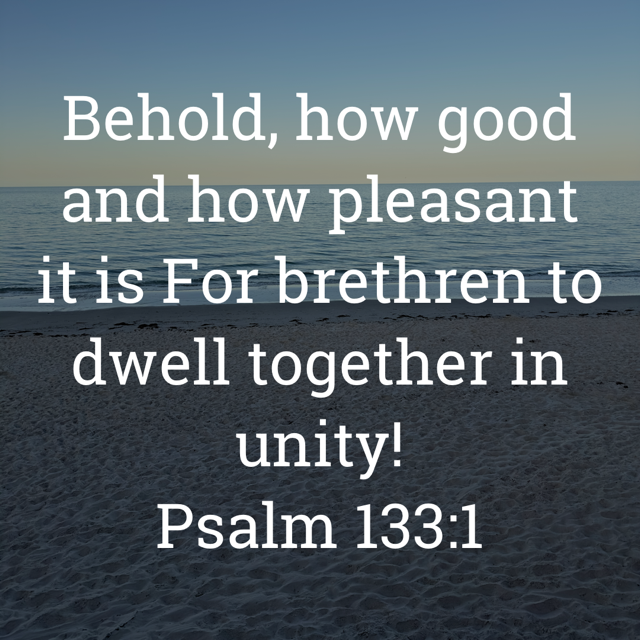
“Behold, how good and how pleasant it is for brethren to dwell together in unity!” King James Bible Online The King James Bible Bible.com
Psalm 133[i] is one of the Songs of Ascents, sung by pilgrims travelling up to Jerusalem for worship. It is attributed to David and reflects both poetic beauty and deep theological truth. Verse 1 sets the tone for the entire psalm, declaring the goodness and pleasantness of unity among God’s people.
1. Exegetical Commentary
1.1 “Behold” — A Call to Attention
The psalm begins with “Behold”, a word that invites the reader to stop, look, and consider. David is not making a casual observation; he is drawing attention to a spiritual reality that is easily overlooked. Unity is not accidental. It is a work of God and a gift to be treasured.
1.2 “How good and how pleasant” — Moral Goodness and Emotional Delight
David uses two adjectives:
- Good — morally right, aligned with God’s character and purposes.
- Pleasant — delightful, enjoyable, refreshing.
Some things are good but not pleasant (for example, discipline). Some things are pleasant but not good (for example, sinful indulgence). Unity among believers is both.
This dual emphasis reflects the Christian understanding that God’s commands are not only righteous but also for our joy.
1.3 “Brethren” — The Covenant Community
The term “brethren” refers to the people of God. Under the old covenant, this meant Israel. Under the new covenant, it refers to all who are united to Christ by faith.
The unity described is not generic human harmony, but specifically spiritual unity grounded in God’s covenant grace.
1.4 “To dwell together” — Shared Life, Not Mere Proximity
Unity is not simply being in the same room or belonging to the same organisation. It is a shared life shaped by love, forgiveness, humility, and mutual service.
The New Testament echoes this vision:
- “Endeavouring to keep the unity of the Spirit in the bond of peace.” (Ephesians 4:3, KJV)
1.5 “In unity” — A Gift and a Calling
Unity is both:
- A gift — created by God through Christ’s reconciling work.
- A calling — something believers must actively maintain.
Psalm 133 goes on to describe unity with two images:
1.5.1 The Anointing Oil (Psalm 133:2)
“It is like the precious ointment upon the head, that ran down upon the beard, even Aaron’s beard: that went down to the skirts of his garments.” King James Bible Online The King James Bible Bible.com
This image points to:
- Consecration — unity marks God’s people as holy.
- Abundance — the oil flows generously.
- Fragrance — unity is spiritually attractive.
1.5.2 The Dew of Hermon (Psalm 133:3)
“As the dew of Hermon, and as the dew that descended upon the mountains of Zion: for there the Lord commanded the blessing, even life for evermore.” King James Bible Online The King James Bible Bible.com
This image highlights:
- Refreshment — unity revives weary souls.
- Fruitfulness — dew brings life to dry places.
- Blessing — God commands life where unity dwells.
2. Theological Teaching
2.1 Unity Is Rooted in God’s Character
God is one. The unity of believers reflects the unity of the Triune God. Christian theology emphasises that the church is one because God has made it one in Christ.
2.2 Unity Flows from the Gospel
Unity is not achieved by human effort alone. It is grounded in Christ’s reconciling work:
- He reconciles us to God.
- He reconciles us to one another.
- He forms one new humanity (Ephesians 2:14–16[ii]).
14 For he is our peace, who hath made both one, and hath broken down the middle wall of partition between us;
15 Having abolished in his flesh the enmity, even the law of commandments contained in ordinances; for to make in himself of twain one new man, so making peace;
16 And that he might reconcile both unto God in one body by the cross, having slain the enmity thereby:
2.3 Unity Is a Mark of True Discipleship
Jesus said:
- “By this shall all men know that ye are my disciples, if ye have love one to another.” (John 13:35, KJV)
Unity is not optional. It is a witness to the world.
2.4 Unity Is Eschatological
Psalm 133 ends with “life for evermore”. Unity anticipates the eternal fellowship of the redeemed in the new creation.
3. Application to Modern Christian Living
3.1 Pursue Unity Actively
Unity does not happen by accident. It requires:
- Patience
- Humility
- Forgiveness
- Willingness to listen
- Commitment to truth
3.2 Resist the Spirit of Division
Modern culture often rewards outrage, tribalism, and suspicion. Christians must resist these impulses.
3.3 Practise Unity in the Local Church
Unity is lived out in:
- Shared worship
- Mutual encouragement
- Bearing one another’s burdens
- Serving together
- Reconciling quickly when conflict arises
3.4 Celebrate Diversity within Unity
Unity is not uniformity. The church is enriched by different gifts, backgrounds, and personalities.
3.5 Pray for Unity
Unity is ultimately a work of the Spirit. Pray for your church, your leaders, and your relationships.
4. Meditation Guide
Reflect
Read Psalm 133 slowly. Consider where God is calling you to pursue unity.
133 Behold, how good and how pleasant it is for brethren to dwell together in unity!
2 It is like the precious ointment upon the head, that ran down upon the beard, even Aaron’s beard: that went down to the skirts of his garments;
3 As the dew of Hermon, and as the dew that descended upon the mountains of Zion: for there the Lord commanded the blessing, even life for evermore.
Confess
Acknowledge any attitudes or actions that have contributed to division.
Give Thanks
Thank God for the unity you have experienced in Christian community.
Act
Identify one practical step you can take this week to strengthen unity.
Pray
Ask God to make your church a place where unity is both good and pleasant.
[i] Psalm 133
King James Version
133 Behold, how good and how pleasant it is for brethren to dwell together in unity!
2 It is like the precious ointment upon the head, that ran down upon the beard, even Aaron’s beard: that went down to the skirts of his garments;
3 As the dew of Hermon, and as the dew that descended upon the mountains of Zion: for there the Lord commanded the blessing, even life for evermore.
[ii] Ephesians 2:14-16
King James Version
14 For he is our peace, who hath made both one, and hath broken down the middle wall of partition between us;
15 Having abolished in his flesh the enmity, even the law of commandments contained in ordinances; for to make in himself of twain one new man, so making peace;
16 And that he might reconcile both unto God in one body by the cross, having slain the enmity thereby:
Discover more from Daily bible verses
Subscribe to get the latest posts sent to your email.


You must be logged in to post a comment.