
Commentary on 1 Timothy 4:8
1. The Text
1 Timothy 4:8 (King James Version):
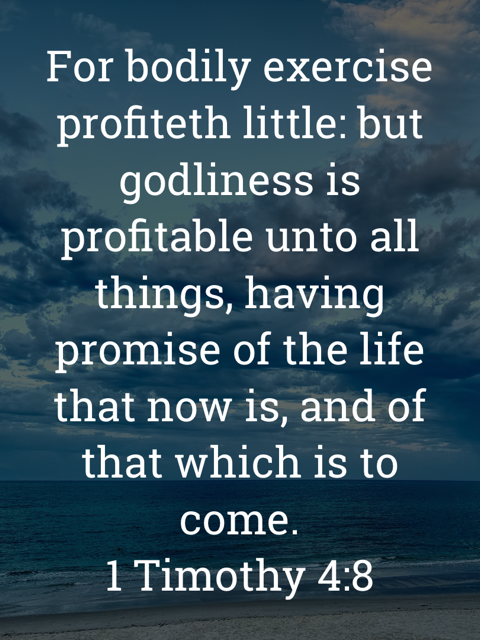
“For bodily exercise profiteth little: but godliness is profitable unto all things, having promise of the life that now is, and of that which is to come.”
2. Context in 1 Timothy 4[i]
Paul writes to Timothy, a young pastor in Ephesus, urging him to stand firm against false teaching and to train himself in true godliness. The chapter contrasts empty, ascetic[ii] religion with genuine, Christ‑centred devotion.
Key surrounding verses:
1 Timothy 4:7 (KJV):
“But refuse profane and old wives’ fables, and exercise thyself rather unto godliness.”
1 Timothy 4:9–10 (KJV):
“This is a faithful saying and worthy of all acceptation. For therefore we both labour and suffer reproach, because we trust in the living God, who is the Saviour of all men, specially of those that believe.”
Paul’s argument is clear: reject superstition and spiritual shortcuts; pursue disciplined godliness grounded in the gospel.
3. Exegetical Commentary on 1 Timothy 4:8
“For bodily exercise profiteth little”
Paul is not dismissing physical health. The phrase means that physical training has limited value. It is good, but it cannot reach into eternity. It cannot reconcile a person to God, nor can it produce spiritual fruit.
In the first century, physical training was admired in Greek culture. Paul acknowledges its worth but relativises it. In Christian theology, this fits the doctrine of common grace: physical health, discipline, and self‑control are good gifts, but they are not ultimate.
“But godliness is profitable unto all things”
“Godliness” (Greek: eusebeia) means reverent devotion to God expressed in a life shaped by the gospel. It is not mere outward religion but a heart transformed by grace.
Godliness is “profitable unto all things” because:
- It shapes character
- It orders priorities
- It strengthens endurance
- It blesses relationships
- It equips believers for suffering
- It aligns life with God’s will
- It bears fruit that lasts into eternity
This is consistent with the Christian emphasis on sanctification as the Spirit’s work in the believer, flowing from union with Christ.
“Having promise of the life that now is”
Godliness brings real benefits in the present life. These include:
- Peace of conscience
- Wisdom for daily decisions
- Freedom from enslaving sins
- A life marked by love, joy, and self‑control
- The comfort of God’s presence
- The stability of hope
These are not guarantees of ease, but they are genuine blessings.
“And of that which is to come”
Here Paul lifts Timothy’s eyes to eternity. Godliness has eternal promise because it is rooted in Christ, who secures everlasting life.
This reflects the Christian doctrine of perseverance: those who are truly in Christ will continue in godliness, and their hope is anchored in the unchanging promises of God.
4. Theological Insights from 1 Timothy 4
A. Godliness requires training (verse 7)
Paul uses athletic imagery. Just as athletes train with discipline, Christians must cultivate habits of grace: Scripture, prayer, fellowship, obedience, and repentance.
B. Godliness is grounded in the gospel (verse 10)
We labour because we trust in the living God. Christian effort is always rooted in divine grace, never human merit.
C. Godliness is lived out publicly (verses 12–16)
Timothy is to be an example in speech, conduct, love, faith, and purity. Godliness is not private mysticism; it is embodied holiness.
D. Godliness is sustained by Scripture (verse 13)
Paul urges Timothy to give attention to reading, exhortation, and doctrine. The Word shapes godliness.
5. Application to Modern Christian Living
1. Value physical health, but do not idolise it
In a culture obsessed with fitness, appearance, and longevity, Paul’s words are a needed correction. Exercise is good, but it cannot save, satisfy, or sanctify.
2. Prioritise spiritual disciplines
Training in godliness requires intentionality. This includes:
- Daily Scripture reading
- Prayer
- Worship with God’s people
- Repentance
- Service
- Guarding the heart
These are not burdens but means of grace.
3. Live with eternity in view
Modern life encourages short‑term thinking. Paul calls believers to live for what lasts. Godliness is an investment with eternal return.
4. Resist false teaching and empty spirituality
Just as Timothy faced myths and distortions, so do we. Godliness is grounded in truth, not trends.
5. Encourage younger believers
Paul’s pastoral tone toward Timothy reminds us to nurture and support those growing in faith.
6. Meditation Guide
Use these steps for personal reflection or group devotion.
A. Read the verse slowly
“For bodily exercise profiteth little: but godliness is profitable unto all things, having promise of the life that now is, and of that which is to come.”
B. Reflect on two questions
- What am I training myself for?
- Do my habits reflect a desire for godliness?
C. Pray
- Thank God for the gift of physical health.
- Ask Him to deepen your desire for godliness.
- Commit your daily routines to Him.
- Pray for endurance to pursue holiness.
D. Act
Choose one spiritual discipline to strengthen this week.
Choose one worldly distraction to set aside.
[i] 1 Timothy 4
King James Version
4 Now the Spirit speaketh expressly, that in the latter times some shall depart from the faith, giving heed to seducing spirits, and doctrines of devils;
2 Speaking lies in hypocrisy; having their conscience seared with a hot iron;
3 Forbidding to marry, and commanding to abstain from meats, which God hath created to be received with thanksgiving of them which believe and know the truth.
4 For every creature of God is good, and nothing to be refused, if it be received with thanksgiving:
5 For it is sanctified by the word of God and prayer.
6 If thou put the brethren in remembrance of these things, thou shalt be a good minister of Jesus Christ, nourished up in the words of faith and of good doctrine, whereunto thou hast attained.
7 But refuse profane and old wives’ fables, and exercise thyself rather unto godliness.
8 For bodily exercise profiteth little: but godliness is profitable unto all things, having promise of the life that now is, and of that which is to come.
9 This is a faithful saying and worthy of all acceptation.
10 For therefore we both labour and suffer reproach, because we trust in the living God, who is the Saviour of all men, specially of those that believe.
11 These things command and teach.
12 Let no man despise thy youth; but be thou an example of the believers, in word, in conversation, in charity, in spirit, in faith, in purity.
13 Till I come, give attendance to reading, to exhortation, to doctrine.
14 Neglect not the gift that is in thee, which was given thee by prophecy, with the laying on of the hands of the presbytery.
15 Meditate upon these things; give thyself wholly to them; that thy profiting may appear to all.
16 Take heed unto thyself, and unto the doctrine; continue in them: for in doing this thou shalt both save thyself, and them that hear thee.
[ii] An ascetic is someone who deliberately denies themselves physical comforts or pleasures in order to pursue some kind of spiritual, moral, or philosophical goal.
Discover more from Daily bible verses
Subscribe to get the latest posts sent to your email.


You must be logged in to post a comment.