
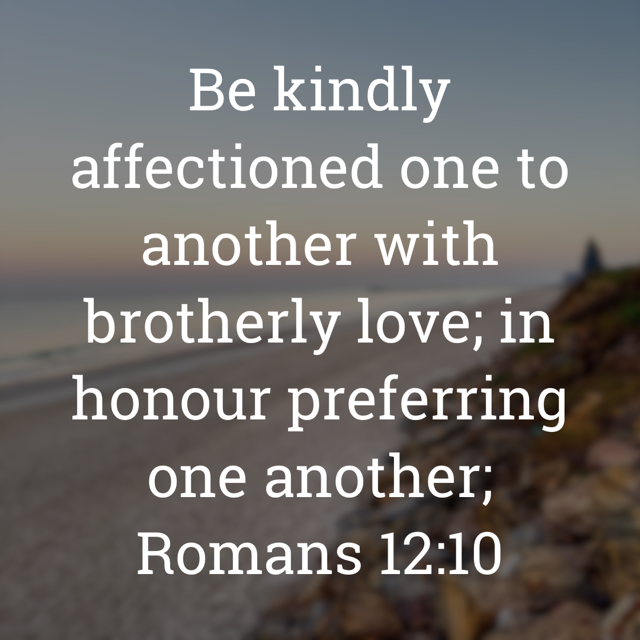
Commentary on Romans 12:10
1. The Text
Romans 12:10 (KJV):
“Be kindly affectioned one to another with brotherly love; in honour preferring one another.”
This short verse sits within a larger section where the Apostle Paul describes the shape of a life transformed by the mercies of God. Romans chapter 12 moves from doctrine to discipleship, from the gospel explained to the gospel embodied.
2. Immediate Context: Romans 12
Romans chapter 12[i] begins with Paul’s famous appeal:
Romans 12:1 (KJV):
“I beseech you therefore, brethren, by the mercies of God, that ye present your bodies a living sacrifice, holy, acceptable unto God, which is your reasonable service.”
Everything that follows in the chapter flows from this call to live a life shaped by the gospel. Verses 3 to 8 describe the diversity of gifts within the body of Christ. Verses 9 to 21 describe the character of Christian love.
Romans 12:10 sits at the heart of this ethical section. It is a practical expression of the “love without dissimulation[ii]” that Paul commands in verse 9.
Romans 12:9 (KJV):
“Let love be without dissimulation. Abhor that which is evil; cleave to that which is good.”
3. Exegetical Commentary on Romans 12:10
“Be kindly affectioned one to another with brotherly love”
The phrase “kindly affectioned” translates a Greek word that combines philos (love) and storgē (family affection). Paul is calling Christians to treat one another not merely with polite friendliness but with genuine familial warmth.
This is not optional sentimentality. It is a command grounded in the new identity believers share in Christ. The church is not a club or a loose association of individuals; it is a family created by the Spirit.
Paul reinforces this with the phrase “with brotherly love,” translating philadelphia. This is the love that siblings ideally show one another, i.e., loyal, committed, patient, and enduring.
This is the opposite of coldness, suspicion, competition, or indifference. It is a call to cultivate affection, not simply to tolerate one another.
“In honour preferring one another”
This phrase carries the sense of “outdoing one another in showing honour.” It is a deliberate, active posture of humility.
To “prefer” another in honour means:
- to take the initiative in showing respect
- to delight in the strengths and successes of others
- to resist the instinct to seek recognition for oneself
- to treat others as weighty, valuable, and worthy of dignity
This is deeply countercultural. In a world that prizes self-promotion, Paul calls Christians to a different way: a community where honour is not grasped but given.
This echoes the example of Christ:
Philippians 2:3–4 (KJV):
“Let nothing be done through strife or vainglory; but in lowliness of mind let each esteem other better than themselves.
Look not every man on his own things, but every man also on the things of others.”
4. Theological Insights
A. Love is the fruit of the gospel
Romans 12 assumes the gospel of Romans chapters 1 to 11. Christian love is not self-generated. It flows from God’s mercy.
We love because we have been loved.
B. The church is a family
Paul’s use of familial language is deliberate. In Christ, believers are adopted into God’s household. This shapes how we relate to one another.
C. Honour is a Christian virtue
Honour is not flattery. It is the recognition of God’s grace in another person. It is a refusal to treat people as disposable or insignificant.
D. Humility is central to Christian community
Romans 12:10 is a practical expression of the humility Paul commands earlier:
Romans 12:3 (KJV):
“For I say… to every man that is among you, not to think of himself more highly than he ought to think.”
5. Practical Application for Modern Christian Living
A. Cultivate genuine affection
- Pray for a heart that truly loves your brothers and sisters in Christ.
- Take time to know people beyond surface-level interactions.
- Show warmth in your tone, posture, and presence.
B. Practise honour in everyday life
- Speak well of others, especially when they are not present.
- Celebrate the gifts and achievements of others without envy.
- Give credit freely and gladly.
- Resist the urge to compare or compete.
C. Serve without seeking recognition
- Do unseen acts of kindness.
- Volunteer for tasks that bring no praise.
- Let others go first, speak first, or be recognised first.
D. Build a culture of encouragement
- Write notes of appreciation.
- Thank people for their service.
- Affirm the work of God you see in others.
E. Address conflict with grace
Affection and honour do not eliminate conflict, but they shape how we handle it. Approach disagreements with humility, patience, and a desire for reconciliation.
6. Meditation Guide
Use the following steps for personal reflection or group devotion.
Step 1: Read the verse slowly
“Be kindly affectioned one to another with brotherly love; in honour preferring one another.”
Let each phrase rest in your mind.
Step 2: Reflect on God’s love for you
How has God shown you kindness, affection, and honour in Christ?
Step 3: Examine your heart
- Do you genuinely love your church family?
- Are there people you avoid, resent, or compete with?
- Do you seek honour or give it?
Step 4: Pray for transformation
Ask the Spirit to soften your heart, deepen your affection, and grow humility.
Step 5: Choose one concrete action
Examples:
- Encourage someone today.
- Honour someone publicly.
- Reconcile with someone you have avoided.
- Serve someone without being noticed.
[i] Romans 12
King James Version
12 I beseech you therefore, brethren, by the mercies of God, that ye present your bodies a living sacrifice, holy, acceptable unto God, which is your reasonable service.
2 And be not conformed to this world: but be ye transformed by the renewing of your mind, that ye may prove what is that good, and acceptable, and perfect, will of God.
3 For I say, through the grace given unto me, to every man that is among you, not to think of himself more highly than he ought to think; but to think soberly, according as God hath dealt to every man the measure of faith.
4 For as we have many members in one body, and all members have not the same office:
5 So we, being many, are one body in Christ, and every one members one of another.
6 Having then gifts differing according to the grace that is given to us, whether prophecy, let us prophesy according to the proportion of faith;
7 Or ministry, let us wait on our ministering: or he that teacheth, on teaching;
8 Or he that exhorteth, on exhortation: he that giveth, let him do it with simplicity; he that ruleth, with diligence; he that sheweth mercy, with cheerfulness.
9 Let love be without dissimulation. Abhor that which is evil; cleave to that which is good.
10 Be kindly affectioned one to another with brotherly love; in honour preferring one another;
11 Not slothful in business; fervent in spirit; serving the Lord;
12 Rejoicing in hope; patient in tribulation; continuing instant in prayer;
13 Distributing to the necessity of saints; given to hospitality.
14 Bless them which persecute you: bless, and curse not.
15 Rejoice with them that do rejoice, and weep with them that weep.
16 Be of the same mind one toward another. Mind not high things, but condescend to men of low estate. Be not wise in your own conceits.
17 Recompense to no man evil for evil. Provide things honest in the sight of all men.
18 If it be possible, as much as lieth in you, live peaceably with all men.
19 Dearly beloved, avenge not yourselves, but rather give place unto wrath: for it is written, Vengeance is mine; I will repay, saith the Lord.
20 Therefore if thine enemy hunger, feed him; if he thirst, give him drink: for in so doing thou shalt heap coals of fire on his head.
21 Be not overcome of evil, but overcome evil with good.
[ii] The word “dissimulation” in the King James Version means pretence, hypocrisy, or acting a part. It comes from a Greek word that literally means “without a mask.”
So when Paul says, “Let love be without dissimulation,” he is commanding Christians to love one another genuinely, sincerely, and without hidden motives.
Discover more from Daily bible verses
Subscribe to get the latest posts sent to your email.


You must be logged in to post a comment.