
Commentary on 2 John 1:6
The Text (King James Version)
2 John 1:6
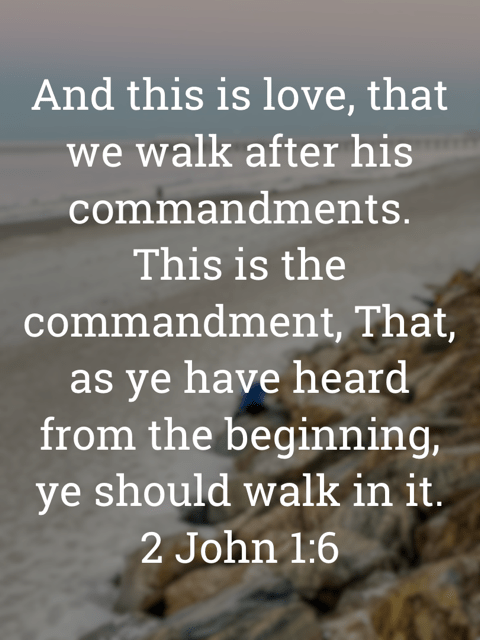
“And this is love, that we walk after his commandments. This is the commandment, That, as ye have heard from the beginning, ye should walk in it.”
1. Setting the Scene: The Message of 2 John
The Second Epistle of John[i] is a short but potent pastoral letter. John writes to “the elect lady and her children” (2 John 1:1), which may refer either to a specific Christian woman and her household or, more likely, to a local congregation and its members. The letter is concerned with two major themes:
- Truth: the apostolic teaching about Jesus Christ
- Love: the lived expression of that truth in Christian community
John’s pastoral burden is that believers remain steadfast in the truth and resist false teachers who deny the incarnation of Jesus Christ (2 John 1:7: “For many deceivers are entered into the world, who confess not that Jesus Christ is come in the flesh.”).
Against this backdrop, verse 6 defines what genuine Christian love looks like.
2. Exegetical Commentary on 2 John 1:6
“And this is love, that we walk after his commandments.”
John gives a definition of love that is strikingly different from modern sentimentality. Love is not primarily emotion, affection, or personal preference. Love is obedience.
To “walk” in biblical language means to conduct one’s life in a particular direction or pattern. It is a habitual, ongoing lifestyle. John is echoing Jesus’ own teaching:
- “If ye love me, keep my commandments.” (John 14:15)
Thus, Christian love is not self-defined. It is shaped by God’s revealed will. In Christian theology, this aligns with the conviction that God’s law is an expression of His character and therefore the proper guide for Christian living.
“This is the commandment, That, as ye have heard from the beginning, ye should walk in it.”
John emphasises continuity. The commandment is not new, innovative, or culturally adapted. It is the same message they heard “from the beginning”:
- “A new commandment I give unto you, That ye love one another.” (John 13:34)
- “Brethren, I write no new commandment unto you, but an old commandment which ye had from the beginning.” (1 John 2:7)
The “beginning” refers to the original apostolic proclamation of the gospel. John is urging the church to remain anchored in the foundational truths of Christ and to resist the temptation to redefine love according to the spirit of the age.
The commandment is singular because love summarises all of God’s moral law. As the Apostle Paul writes:
- “Love worketh no ill to his neighbour: therefore love is the fulfilling of the law.” (Romans 13:10)
Thus, John’s point is clear:
True Christian love is expressed through faithful obedience to God’s revealed truth.
3. Theological Insights
A. Love and Truth Are Inseparable
John refuses to separate love from truth. In 2 John 1:1–2 he writes:
“…whom I love in the truth; and not I only, but also all they that have known the truth; For the truth’s sake…”
In Christian theology, this unity is essential. Love without truth becomes sentimentality. Truth without love becomes harshness. Christian obedience flows from both.
B. Love Is Rooted in God’s Commandments
Love is not defined by cultural norms, personal feelings, or subjective impressions. It is defined by God’s commandments. This protects the church from drifting into moral relativism.
C. Love Is Active, Not Passive
“Walking” implies movement, intention, and perseverance. Love is not merely felt; it is lived.
D. Love Is Learned from the Beginning
Christian ethics are not invented anew in each generation. They are received. The church is a steward of apostolic truth, not its editor.
4. Application to Modern Christian Living
A. Love Requires Obedience
In a culture that often equates love with affirmation or emotional warmth, John’s definition is countercultural. To love God is to obey Him. To love others is to treat them according to God’s revealed will.
This means:
- Loving our neighbour includes speaking truth, even when it is uncomfortable.
- Loving God includes obeying His commands even when they conflict with cultural expectations.
- Loving the church includes guarding it from false teaching.
B. Love Requires Discernment
John warns of deceivers (2 John 1:7). Love does not mean naivety. Christians must be discerning about teaching, doctrine, and influences.
C. Love Requires Perseverance
Walking “from the beginning” means holding fast to the gospel we first received. The Christian life is not about novelty but faithfulness.
D. Love Requires Community
John writes to a community, not an isolated individual. Obedience and love are lived out in the fellowship of believers.
5. Meditation Guide
Use the following steps for personal or group reflection.
Step 1: Read the Verse Slowly
Read 2 John 1:6 aloud several times. Notice the connection between love and obedience.
“And this is love, that we walk after his commandments. This is the commandment, That, as ye have heard from the beginning, ye should walk in it.”
Step 2: Reflect on God’s Commandments
Ask:
- Which of God’s commandments am I tempted to ignore or soften?
- Where is God calling me to walk more faithfully?
Step 3: Examine Your Definition of Love
Consider:
- Do I define love according to Scripture or according to cultural expectations?
- How does obedience shape my love for God and others?
Step 4: Pray for a Heart of Obedience
Pray that the Holy Spirit would align your desires with God’s will.
Step 5: Commit to Walking in the Truth
Identify one concrete step of obedience you can take this week.
[i] 2 John
King James Version
1 The elder unto the elect lady and her children, whom I love in the truth; and not I only, but also all they that have known the truth;
2 For the truth’s sake, which dwelleth in us, and shall be with us for ever.
3 Grace be with you, mercy, and peace, from God the Father, and from the Lord Jesus Christ, the Son of the Father, in truth and love.
4 I rejoiced greatly that I found of thy children walking in truth, as we have received a commandment from the Father.
5 And now I beseech thee, lady, not as though I wrote a new commandment unto thee, but that which we had from the beginning, that we love one another.
6 And this is love, that we walk after his commandments. This is the commandment, That, as ye have heard from the beginning, ye should walk in it.
7 For many deceivers are entered into the world, who confess not that Jesus Christ is come in the flesh. This is a deceiver and an antichrist.
8 Look to yourselves, that we lose not those things which we have wrought, but that we receive a full reward.
9 Whosoever transgresseth, and abideth not in the doctrine of Christ, hath not God. He that abideth in the doctrine of Christ, he hath both the Father and the Son.
10 If there come any unto you, and bring not this doctrine, receive him not into your house, neither bid him God speed:
11 For he that biddeth him God speed is partaker of his evil deeds.
12 Having many things to write unto you, I would not write with paper and ink: but I trust to come unto you, and speak face to face, that our joy may be full.
13 The children of thy elect sister greet thee. Amen.
Discover more from Daily bible verses
Subscribe to get the latest posts sent to your email.


You must be logged in to post a comment.