
Commentary on Psalm 105:1
1. The Text (King James Version)
Psalm 105:1
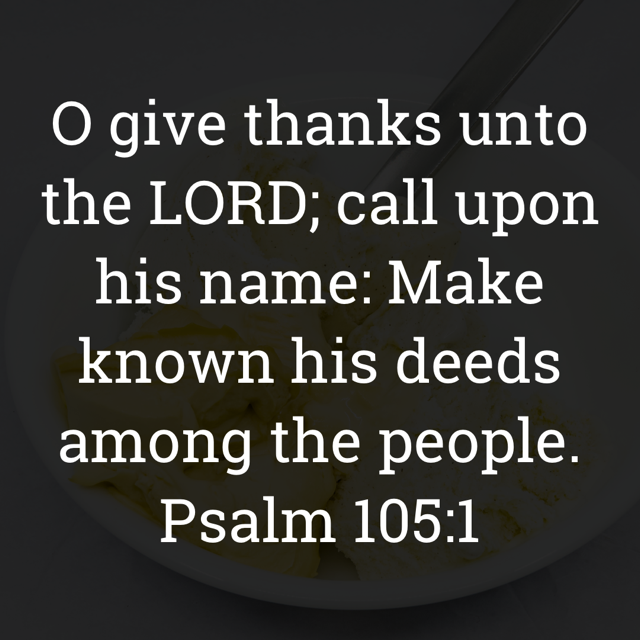
“O give thanks unto the LORD; call upon his name: make known his deeds among the people.”
2. Exegetical Commentary
A. Setting and Purpose of Psalm 105
Psalm 105[i] is a historical psalm that rehearses God’s mighty acts from the covenant with Abraham through the Exodus and into the promised land. It is a psalm of remembrance, worship, and covenant identity. The psalmist calls God’s people to praise by remembering God’s works and proclaiming them.
Psalm 105:1 is the doorway into the whole psalm. It contains three imperatives that shape the life of God’s people:
- Give thanks.
- Call upon God.
- Make His deeds known.
These commands are not burdens but invitations to live in the joy of God’s covenant faithfulness.
B. Phrase-by-Phrase Exegesis
1. “O give thanks unto the LORD”
The verb “give thanks” (yadah) means more than polite gratitude. It means to acknowledge God openly, confess His goodness, and praise Him for His saving acts.
Psalm 105 grounds this thanksgiving in God’s historical faithfulness:
- Psalm 105:8 — “He hath remembered his covenant for ever, the word which he commanded to a thousand generations.”
- Psalm 105:42 — “For he remembered his holy promise, and Abraham his servant.”
Thanksgiving is not based on mood but on God’s unchanging character and His mighty works.
2. “call upon his name”
To call upon God’s name is to pray, worship, and depend on Him. God’s “name” represents His revealed character and His covenant presence.
This echoes a long biblical pattern:
- Genesis 4:26 — “then began men to call upon the name of the LORD.”
- Psalm 116:4 — “Then called I upon the name of the LORD; O LORD, I beseech thee, deliver my soul.”
Calling upon God is an act of trust. It acknowledges that God alone saves, sustains, and guides His people.
3. “make known his deeds among the people”
The psalmist commands God’s people to speak publicly of His works. This is not private spirituality but outward proclamation.
Psalm 105 itself models this by recounting:
- God’s covenant with Abraham (verses 8–11)
- His protection of the patriarchs (verses 12–15)
- Joseph’s rise in Egypt (verses 16–22)
- The Exodus (verses 23–38)
- The wilderness journey (verses 39–41)
- The gift of the land (verses 42–45)
The psalmist is saying:
“Do not keep God’s works to yourself. Tell the world.”
This anticipates the mission of God’s people in every age.
3. Theological Themes
A. God’s Covenant Faithfulness
Psalm 105 is anchored in God’s covenant commitment. God remembers His promises, acts in history, and preserves His people. This is the foundation of Christian assurance.
B. Worship and Witness Belong Together
Psalm 105:1 links thanksgiving, prayer, and proclamation. Christian theology emphasises that God’s people exist both to glorify God and to declare His glory among the nations.
C. Salvation History Shapes Identity
The psalm teaches that God’s people understand themselves by remembering God’s works. Christians today remember God’s ultimate saving act in Jesus Christ.
D. The Mission of God’s People
“Make known his deeds among the people” anticipates the Great Commission. God’s people are always a proclaiming people.
4. Application to Modern Christian Living
A. Practising Thankfulness
Gratitude is a spiritual discipline. In a culture marked by anxiety and entitlement, Christians stand out by giving thanks.
Practical step:
Write down three specific things each day for which you can thank God.
B. Living in Dependence on God
Calling upon God’s name means refusing self-reliance. It means praying first, not last.
Practical step:
Begin each morning with a simple prayer acknowledging your need for God’s wisdom and strength.
C. Speaking of God’s Faithfulness
Christians are not silent recipients of grace. We are witnesses.
Practical step:
Share with one person this week a specific way God has been faithful to you.
D. Remembering God’s Story to Strengthen Your Own
Psalm 105 shows that remembering God’s works fuels obedience and hope.
Practical step:
Read Psalm 105 slowly. Note each act of God. Reflect on how God has acted similarly in your life.
5. Meditation Guide
A. Prepare Your Heart
Sit quietly. Ask the Holy Spirit to help you see God’s goodness.
B. Read Psalm 105:1 aloud
“O give thanks unto the LORD; call upon his name: make known his deeds among the people.”
C. Reflective Questions
1. “O give thanks unto the LORD”
- What has God done for me recently?
- Where have I forgotten to give thanks?
2. “call upon his name”
- What areas of my life am I trying to manage without prayer?
- How can I cultivate a deeper habit of calling on God?
3. “make known his deeds among the people”
- Who in my life needs to hear about God’s faithfulness?
- How can I speak naturally and humbly about God’s work?
D. Prayer
“Lord, thank you for your steadfast love and your mighty works. Teach me to call upon your name with trust and joy. Give me courage to make known your deeds among the people. Help me remember your faithfulness and live in the light of your salvation. Amen.”
E. Closing Thought
Psalm 105 begins with gratitude, dependence, and proclamation. A life shaped by these three practices honours God and blesses others.
[i] Psalm 105
King James Version
105 O give thanks unto the LORD; call upon his name: make known his deeds among the people.
2 Sing unto him, sing psalms unto him: talk ye of all his wondrous works.
3 Glory ye in his holy name: let the heart of them rejoice that seek the LORD.
4 Seek the LORD, and his strength: seek his face evermore.
5 Remember his marvellous works that he hath done; his wonders, and the judgments of his mouth;
6 O ye seed of Abraham his servant, ye children of Jacob his chosen.
7 He is the LORD our God: his judgments are in all the earth.
8 He hath remembered his covenant for ever, the word which he commanded to a thousand generations.
9 Which covenant he made with Abraham, and his oath unto Isaac;
10 And confirmed the same unto Jacob for a law, and to Israel for an everlasting covenant:
11 Saying, Unto thee will I give the land of Canaan, the lot of your inheritance:
12 When they were but a few men in number; yea, very few, and strangers in it.
13 When they went from one nation to another, from one kingdom to another people;
14 He suffered no man to do them wrong: yea, he reproved kings for their sakes;
15 Saying, Touch not mine anointed, and do my prophets no harm.
16 Moreover he called for a famine upon the land: he brake the whole staff of bread.
17 He sent a man before them, even Joseph, who was sold for a servant:
18 Whose feet they hurt with fetters: he was laid in iron:
19 Until the time that his word came: the word of the LORD tried him.
20 The king sent and loosed him; even the ruler of the people, and let him go free.
21 He made him lord of his house, and ruler of all his substance:
22 To bind his princes at his pleasure; and teach his senators wisdom.
23 Israel also came into Egypt; and Jacob sojourned in the land of Ham.
24 And he increased his people greatly; and made them stronger than their enemies.
25 He turned their heart to hate his people, to deal subtilly with his servants.
26 He sent Moses his servant; and Aaron whom he had chosen.
27 They shewed his signs among them, and wonders in the land of Ham.
28 He sent darkness, and made it dark; and they rebelled not against his word.
29 He turned their waters into blood, and slew their fish.
30 Their land brought forth frogs in abundance, in the chambers of their kings.
31 He spake, and there came divers sorts of flies, and lice in all their coasts.
32 He gave them hail for rain, and flaming fire in their land.
33 He smote their vines also and their fig trees; and brake the trees of their coasts.
34 He spake, and the locusts came, and caterpillers, and that without number,
35 And did eat up all the herbs in their land, and devoured the fruit of their ground.
36 He smote also all the firstborn in their land, the chief of all their strength.
37 He brought them forth also with silver and gold: and there was not one feeble person among their tribes.
38 Egypt was glad when they departed: for the fear of them fell upon them.
39 He spread a cloud for a covering; and fire to give light in the night.
40 The people asked, and he brought quails, and satisfied them with the bread of heaven.
41 He opened the rock, and the waters gushed out; they ran in the dry places like a river.
42 For he remembered his holy promise, and Abraham his servant.
43 And he brought forth his people with joy, and his chosen with gladness:
44 And gave them the lands of the heathen: and they inherited the labour of the people;
45 That they might observe his statutes, and keep his laws. Praise ye the LORD.
Discover more from Daily bible verses
Subscribe to get the latest posts sent to your email.


You must be logged in to post a comment.