
Commentary on 2 Corinthians 7:10
1. The Text
2 Corinthians 7:10 (King James Version):
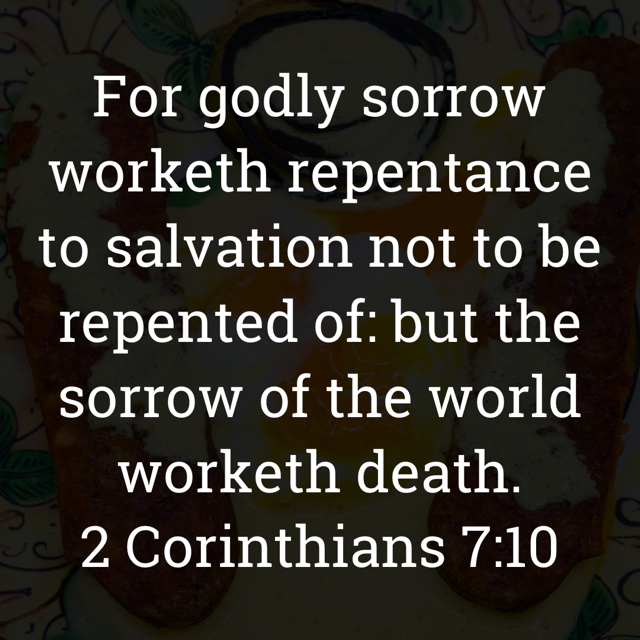
“For godly sorrow worketh repentance to salvation not to be repented of: but the sorrow of the world worketh death.”
This single verse sits at the heart of the Apostle Paul’s reflection on the Corinthians’ response to his earlier rebuke. It is a profound statement about the nature of true repentance, the work of the Holy Spirit, and the difference between life-giving conviction and destructive despair.
2. Literary and Pastoral Context: 2 Corinthians 7
Paul writes this chapter[i] with deep pastoral affection. He recalls the distress caused by his earlier letter, which confronted the Corinthians about sin in the church. Yet he rejoices that their grief led to genuine repentance.
Key verses that shape the context include:
2 Corinthians 7:8–9 (KJV):
“For though I made you sorry with a letter, I do not repent, though I did repent: for I perceive that the same epistle hath made you sorry, though it were but for a season.
Now I rejoice, not that ye were made sorry, but that ye sorrowed to repentance: for ye were made sorry after a godly manner…”
Paul is not pleased that they felt pain. He is pleased that their pain was godly—that is, it was the Spirit’s instrument to bring them back to Christ.
3. Exegetical Analysis of 2 Corinthians 7:10
A. “For godly sorrow worketh repentance to salvation not to be repented of”
“Godly sorrow”
The phrase literally means “sorrow according to God.”
It is sorrow shaped by God’s character, God’s holiness, and God’s purposes.
It is not self-pity.
It is not fear of consequences.
It is not embarrassment at being caught.
It is grief that recognises sin as an offence against God.
This echoes the experience of David:
Psalm 51:4 (KJV):
“Against thee, thee only, have I sinned, and done this evil in thy sight…”
“Worketh repentance”
Godly sorrow produces repentance.
Repentance is not merely emotion; it is a Spirit-enabled turning of the whole person—mind, heart, and will—away from sin and toward God.
Repentance is not the cause of salvation but the necessary fruit of God’s saving work.
“To salvation not to be repented of”
This means repentance leads to a salvation that will never be regretted.
No one will ever stand before Christ and wish they had clung to their sin instead.
Repentance is a gift, not a burden.
B. “But the sorrow of the world worketh death”
“The sorrow of the world”
This is sorrow centred on self rather than God.
It may include:
- shame at being exposed
- fear of consequences
- grief over damaged reputation
- frustration at losing control
- despair without hope
This is Judas-like sorrow, not Peter-like sorrow.
“Worketh death”
Worldly sorrow leads to spiritual ruin because it does not turn to God.
It spirals inward, feeding guilt, shame, and hopelessness.
It is the sorrow that says:
- “I have failed too badly.”
- “There is no way back.”
- “I must fix myself.”
It is sorrow without grace.
4. Theological Themes
A. The Work of the Holy Spirit
Godly sorrow is the Spirit’s convicting work (John 16:8).
8 And when he is come, he will reprove the world of sin, and of righteousness, and of judgment:
It is not self-generated.
It is a sign of God’s love, not His rejection.
B. The Nature of Repentance
Repentance is:
- more than emotion
- more than behaviour modification
- a Spirit-enabled turning to Christ
It is ongoing in the Christian life, not a one-off event.
C. Salvation as God’s Gift
Repentance leads to salvation because it is the fruit of God’s saving grace.
It is not a human achievement but a response to divine mercy.
D. The Danger of Worldly Sorrow
Worldly sorrow is spiritually deadly because it keeps the sinner at the centre.
It refuses grace.
It clings to self-justification or self-condemnation.
5. Practical Application for Modern Christian Living
A. Learning to Discern Our Sorrow
Christians often feel sorrow for sin, but not all sorrow is godly.
Ask:
- Does this sorrow lead me to Christ or away from Him?
- Does it produce humility or self-condemnation?
- Does it stir repentance or paralysis?
Godly sorrow leads to life.
Worldly sorrow leads to despair.
B. Welcoming the Spirit’s Conviction
Conviction is not condemnation.
Romans 8:1 (KJV):
“There is therefore now no condemnation to them which are in Christ Jesus…”
Conviction is God’s kindness drawing us back to Himself.
C. Repentance as a Daily Rhythm
Repentance is not a moment of crisis but a lifestyle of returning to Christ.
It involves:
- honesty about sin
- confidence in Christ’s mercy
- renewed obedience
D. Pastoral Sensitivity in Correction
Paul models how to correct others:
- with tears
- with clarity
- with hope
- with the aim of restoration
In a culture that avoids confrontation, Paul shows that loving correction can lead to life.
E. Hope for the Broken
No matter how deep the sin, godly sorrow opens the door to restoration.
Worldly sorrow says, “I am ruined.”
Godly sorrow says, “Christ can restore me.”
6. Meditation Guide
A. Reflective Reading
Read 2 Corinthians 7 slowly.
“For godly sorrow worketh repentance to salvation not to be repented of: but the sorrow of the world worketh death.”
Notice Paul’s affection, honesty, and joy.
B. Questions for the Heart
- What kind of sorrow do I usually feel when I sin?
- Do I run to Christ or hide from Him?
- Where is the Spirit inviting me to repent today?
C. Prayer of Repentance
“Father, give me godly sorrow that leads to life.
Turn my heart from sin and draw me to Christ.
Let Your Spirit produce true repentance in me,
and restore the joy of Your salvation.”
D. A Practice for the Week
Each evening, ask:
- Where did I resist God today?
- Where did I sense His grace?
- What do I need to confess and turn from?
End each day with the assurance of Christ’s forgiveness.
[i] 2 Corinthians 7
King James Version
7 Having therefore these promises, dearly beloved, let us cleanse ourselves from all filthiness of the flesh and spirit, perfecting holiness in the fear of God.
2 Receive us; we have wronged no man, we have corrupted no man, we have defrauded no man.
3 I speak not this to condemn you: for I have said before, that ye are in our hearts to die and live with you.
4 Great is my boldness of speech toward you, great is my glorying of you: I am filled with comfort, I am exceeding joyful in all our tribulation.
5 For, when we were come into Macedonia, our flesh had no rest, but we were troubled on every side; without were fightings, within were fears.
6 Nevertheless God, that comforteth those that are cast down, comforted us by the coming of Titus;
7 And not by his coming only, but by the consolation wherewith he was comforted in you, when he told us your earnest desire, your mourning, your fervent mind toward me; so that I rejoiced the more.
8 For though I made you sorry with a letter, I do not repent, though I did repent: for I perceive that the same epistle hath made you sorry, though it were but for a season.
9 Now I rejoice, not that ye were made sorry, but that ye sorrowed to repentance: for ye were made sorry after a godly manner, that ye might receive damage by us in nothing.
10 For godly sorrow worketh repentance to salvation not to be repented of: but the sorrow of the world worketh death.
11 For behold this selfsame thing, that ye sorrowed after a godly sort, what carefulness it wrought in you, yea, what clearing of yourselves, yea, what indignation, yea, what fear, yea, what vehement desire, yea, what zeal, yea, what revenge! In all things ye have approved yourselves to be clear in this matter.
12 Wherefore, though I wrote unto you, I did it not for his cause that had done the wrong, nor for his cause that suffered wrong, but that our care for you in the sight of God might appear unto you.
13 Therefore we were comforted in your comfort: yea, and exceedingly the more joyed we for the joy of Titus, because his spirit was refreshed by you all.
14 For if I have boasted any thing to him of you, I am not ashamed; but as we spake all things to you in truth, even so our boasting, which I made before Titus, is found a truth.
15 And his inward affection is more abundant toward you, whilst he remembereth the obedience of you all, how with fear and trembling ye received him.
16 I rejoice therefore that I have confidence in you in all things.
Discover more from Daily bible verses
Subscribe to get the latest posts sent to your email.


You must be logged in to post a comment.