
Commentary on Micah 6:8
1. The Text
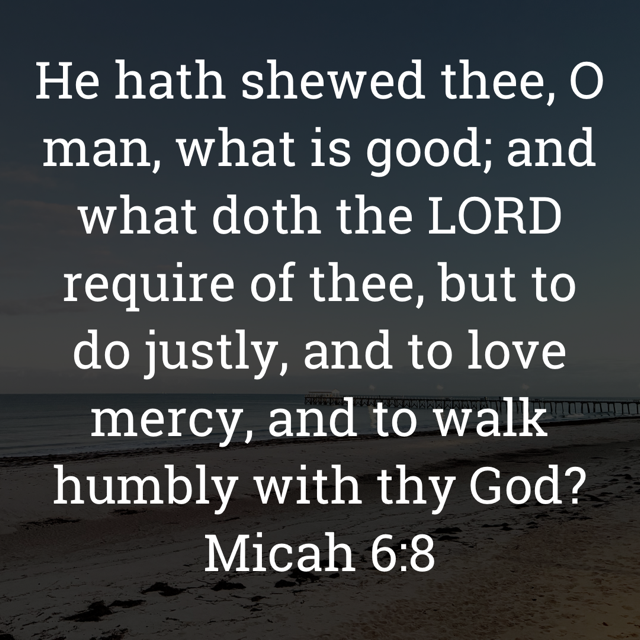
Micah 6:8 (King James Version): “He hath shewed thee, O man, what is good; and what doth the LORD require of thee, but to do justly, and to love mercy, and to walk humbly with thy God?”
2. Immediate Context: Micah 6
Micah 6[i] opens with a courtroom scene. The Lord summons Israel to hear His case against them. The mountains and hills serve as witnesses. God reminds His people of His saving acts:
- His deliverance from Egypt
- His protection from Balak and Balaam
- His faithful leading from Shittim to Gilgal
Israel responds with anxious questions about how to please God: Micah 6:6–7 (KJV): “Wherewith shall I come before the LORD, and bow myself before the high God? shall I come before him with burnt offerings, with calves of a year old? Will the LORD be pleased with thousands of rams, or with ten thousands of rivers of oil? shall I give my firstborn for my transgression, the fruit of my body for the sin of my soul?”
The people assume that God wants extravagant religious performance. Micah 6:8 corrects this misunderstanding by returning to the heart of covenant faithfulness.
3. Exegetical Commentary on Micah 6:8
3.1 “He hath shewed thee, O man, what is good”
God has already revealed His will. Israel does not need to guess. The Lord has spoken through the Law, the prophets, and His saving acts. This echoes: Deuteronomy 10:12–13 (KJV): “And now, Israel, what doth the LORD thy God require of thee, but to fear the LORD thy God, to walk in all his ways, and to love him, and to serve the LORD thy God with all thy heart and with all thy soul, To keep the commandments of the LORD, and his statutes, which I command thee this day for thy good?”
The “good” is not subjective. It is what God has declared to be good.
3.2 “What doth the LORD require of thee”
This is covenant language. God is not negotiating; He is reminding His people of the obligations that flow from His grace. Christian theology emphasises that divine requirements never precede grace. God redeemed Israel before He gave them the Law. Likewise, Christians obey because they have been redeemed in Christ.
3.3 “To do justly”
Justice in Scripture is relational, moral, and covenantal. It includes:
- fairness in dealings
- protection of the vulnerable
- honesty in speech and action
- refusal to exploit others
This reflects God’s own character: Psalm 89:14 (KJV): “Justice and judgment are the habitation of thy throne: mercy and truth shall go before thy face.”
Justice is not merely a social ideal; it is obedience to God.
3.4 “To love mercy”
The word translated “mercy” is chesed — covenant loyalty, steadfast love, kindness. God does not call His people merely to perform mercy but to love it. This means:
- delighting in forgiveness
- seeking reconciliation
- showing compassion
- extending patience
It reflects God’s own heart: Exodus 34:6 (KJV): “The LORD, The LORD God, merciful and gracious, longsuffering, and abundant in goodness and truth.”
3.5 “To walk humbly with thy God”
This is the climax. Walking humbly means:
- living in continual dependence on God
- rejecting pride and self-reliance
- submitting to God’s Word
- acknowledging God’s authority in every part of life
Humility is not self-hatred; it is right-sized self-understanding before a holy God.
This anticipates the New Testament call: James 4:6 (KJV): “God resisteth the proud, but giveth grace unto the humble.”
4. Theological Themes
4.1 Grace precedes obedience
Micah 6:8 is not a works-based path to salvation. God reminds Israel of His saving acts before He states His requirements. Christian theology insists that obedience flows from grace, not the other way around.
4.2 True religion is ethical, relational, and spiritual
Micah contrasts empty ritual with genuine covenant faithfulness. God is not impressed by religious performance without transformed hearts.
4.3 God’s character shapes the believer’s character
Justice, mercy, and humility are not arbitrary virtues. They reflect who God is. To walk with God is to become like Him.
4.4 The unity of faith and life
Micah 6:8 refuses to separate worship from ethics. The Christian life is whole-of-life discipleship.
5. Application to Modern Christian Living
5.1 Doing justice today
Christians are called to:
- act with integrity in workplaces
- refuse corruption or dishonesty
- advocate for the vulnerable
- treat all people with dignity
- resist prejudice and partiality
Justice begins with personal righteousness and extends to social responsibility.
5.2 Loving mercy in a harsh world
Modern culture often rewards outrage, retaliation, and self-protection. The gospel calls Christians to:
- forgive quickly
- show compassion to the struggling
- give generously
- assume the best of others
- seek reconciliation rather than victory
Mercy is countercultural and deeply Christlike.
5.3 Walking humbly with God in an age of self-promotion
Humility means:
- daily repentance
- prayerful dependence
- submitting to Scripture
- acknowledging limitations
- refusing to boast in achievements
Humility is not weakness; it is strength under God’s rule.
5.4 Worship that matches life
Micah warns against religious activity without obedience. Christians must ensure that:
- Sunday worship aligns with weekday behaviour
- public faith matches private character
- devotion is not a substitute for discipleship
God desires whole-hearted obedience, not performance.
6. Meditation Guide
6.1 Reflect
Read Micah 6:8 slowly.
8 He hath shewed thee, O man, what is good; and what doth the LORD require of thee, but to do justly, and to love mercy, and to walk humbly with thy God?
Ask:
- Where am I resisting justice?
- Do I love mercy, or merely tolerate it?
- Am I walking humbly, or relying on myself?
6.2 Pray
- Confess areas where your life does not reflect God’s character.
- Ask the Holy Spirit to shape justice, mercy, and humility in you.
- Thank God for His grace that precedes and empowers obedience.
6.3 Act
Choose one concrete action this week:
- Make restitution where you have wronged someone.
- Extend mercy to someone who has hurt you.
- Practise humility by seeking counsel or admitting fault.
6.4 Rest
Remember that Micah 6:8 is not a burden but an invitation to walk with God.
[i] Micah 6
King James Version
6 Hear ye now what the LORD saith; Arise, contend thou before the mountains, and let the hills hear thy voice.
2 Hear ye, O mountains, the LORD’s controversy, and ye strong foundations of the earth: for the LORD hath a controversy with his people, and he will plead with Israel.
3 O my people, what have I done unto thee? and wherein have I wearied thee? testify against me.
4 For I brought thee up out of the land of Egypt, and redeemed thee out of the house of servants; and I sent before thee Moses, Aaron, and Miriam.
5 O my people, remember now what Balak king of Moab consulted, and what Balaam the son of Beor answered him from Shittim unto Gilgal; that ye may know the righteousness of the LORD.
6 Wherewith shall I come before the LORD, and bow myself before the high God? shall I come before him with burnt offerings, with calves of a year old?
7 Will the LORD be pleased with thousands of rams, or with ten thousands of rivers of oil? shall I give my firstborn for my transgression, the fruit of my body for the sin of my soul?
8 He hath shewed thee, O man, what is good; and what doth the LORD require of thee, but to do justly, and to love mercy, and to walk humbly with thy God?
9 The LORD’s voice crieth unto the city, and the man of wisdom shall see thy name: hear ye the rod, and who hath appointed it.
10 Are there yet the treasures of wickedness in the house of the wicked, and the scant measure that is abominable?
11 Shall I count them pure with the wicked balances, and with the bag of deceitful weights?
12 For the rich men thereof are full of violence, and the inhabitants thereof have spoken lies, and their tongue is deceitful in their mouth.
13 Therefore also will I make thee sick in smiting thee, in making thee desolate because of thy sins.
14 Thou shalt eat, but not be satisfied; and thy casting down shall be in the midst of thee; and thou shalt take hold, but shalt not deliver; and that which thou deliverest will I give up to the sword.
15 Thou shalt sow, but thou shalt not reap; thou shalt tread the olives, but thou shalt not anoint thee with oil; and sweet wine, but shalt not drink wine.
16 For the statutes of Omri are kept, and all the works of the house of Ahab, and ye walk in their counsels; that I should make thee a desolation, and the inhabitants thereof an hissing: therefore ye shall bear the reproach of my people.
Discover more from Daily bible verses
Subscribe to get the latest posts sent to your email.


You must be logged in to post a comment.