
Commentary on 2 Corinthians 12:10 (King James Version)
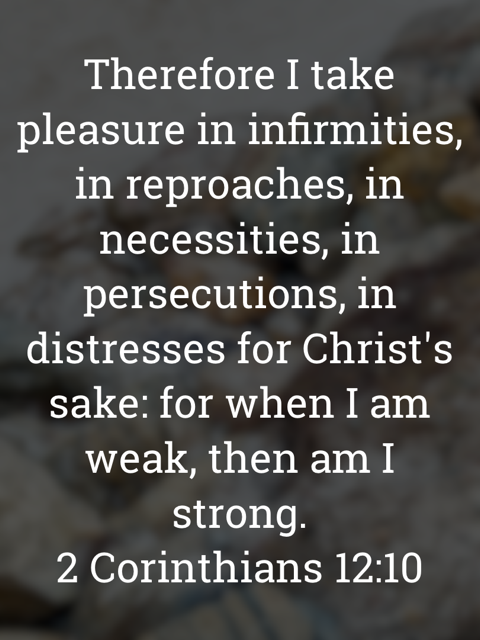
“Therefore I take pleasure in infirmities, in reproaches, in necessities, in persecutions, in distresses for Christ’s sake: for when I am weak, then am I strong.”
1. Setting the Scene: The Flow of 2 Corinthians Chapter 12
Paul’s words in 2 Corinthians chapter 12[i] come at the climax of a long defence of his apostleship. The Corinthian church had been swayed by so-called “super apostles” who boasted in their spiritual experiences, rhetorical skill, and outward strength. Paul responds not by matching their boasting but by turning the whole idea of boasting upside down.
Earlier in the chapter, Paul recounts an extraordinary spiritual experience:
2 Corinthians 12:2 (KJV):
“I knew a man in Christ above fourteen years ago, (whether in the body, I cannot tell; or whether out of the body, I cannot tell: God knoweth;) such an one caught up to the third heaven.”
He speaks of visions and revelations, but he does so reluctantly. His real point is not the glory of the experience but the humility that followed. God gave him a “thorn in the flesh” to keep him from pride.
2 Corinthians 12:7 (KJV):
“And lest I should be exalted above measure through the abundance of the revelations, there was given to me a thorn in the flesh, the messenger of Satan to buffet me, lest I should be exalted above measure.”
Paul pleaded for its removal, but the Lord answered:
2 Corinthians 12:9 (KJV):
“And he said unto me, My grace is sufficient for thee: for my strength is made perfect in weakness.”
This leads directly to verse 10, where Paul embraces weakness as the very place where Christ’s power is displayed.
2. Exegetical Commentary on 2 Corinthians 12:10
“Therefore I take pleasure…”
Paul is not saying he enjoys suffering for its own sake. The Greek idea behind “take pleasure” carries the sense of choosing, accepting, or delighting in something because of its purpose or outcome. Paul sees suffering through the lens of Christ’s grace.
“…in infirmities, in reproaches, in necessities, in persecutions, in distresses…”
Paul lists five categories of hardship:
- Infirmities – physical weakness, illness, frailty.
- Reproaches – insults, slander, public shaming.
- Necessities – hardships, pressures, unmet needs.
- Persecutions – hostility for the sake of Christ.
- Distresses – tight places, situations that feel like there is no escape.
These are not hypothetical. They describe Paul’s lived experience as an apostle.
“…for Christ’s sake…”
This phrase is crucial. Paul is not glorifying suffering in general. He is speaking of suffering that comes because he belongs to Christ and serves Christ. This aligns with Jesus’ own teaching:
Matthew 5:11 (KJV):
“Blessed are ye, when men shall revile you, and persecute you, and shall say all manner of evil against you falsely, for my sake.”
“…for when I am weak, then am I strong.”
This is the heart of the verse. Paul is not strong in himself. His weakness becomes the stage on which Christ’s power is displayed. This is not stoicism. It is not self-help. It is not positive thinking. It is the gospel lived out.
Paul’s theology of weakness reflects the pattern of Christ himself:
Philippians 2:7–8 (KJV):
“But made himself of no reputation, and took upon him the form of a servant… he humbled himself, and became obedient unto death, even the death of the cross.”
Christ’s apparent weakness on the cross was the moment of God’s greatest power.
3. Theological Insights
1. God’s grace is sufficient, not supplementary.
God does not top up our strength. He replaces it with his own. Paul’s weakness is not a barrier to ministry; it is the very means by which God works.
2. Christian maturity involves embracing dependence.
In Christian theology, human inability is not a flaw but a truth that drives us to Christ. Paul’s words echo the doctrine of total dependence on God’s grace.
3. Suffering for Christ is purposeful.
Paul does not romanticise suffering, but he recognises that God uses it to shape us, humble us, and display his power.
4. True spiritual authority is marked by humility.
Paul’s apostleship is authenticated not by triumphalism but by weakness, endurance, and reliance on Christ.
4. Application to Modern Christian Living
1. Weakness is not failure.
Many Christians feel inadequate—emotionally, physically, spiritually. Paul reminds us that weakness is not a disqualification from serving God. It is the very place where God delights to work.
2. We can face hardship with confidence in Christ.
Paul’s list of hardships mirrors the pressures of modern life: illness, financial strain, relational conflict, workplace hostility, and emotional distress. These are not signs of God’s absence but opportunities to experience his sustaining grace.
3. We must resist the temptation to boast in ourselves.
In a culture obsessed with achievement, image, and self-promotion, Paul calls us to a countercultural humility. Our boast is Christ alone.
4. Ministry is shaped by dependence, not performance.
Whether serving in church, caring for family, or witnessing to neighbours, our strength comes from Christ, not from our own capacity.
5. Christ’s power is most visible in our limitations.
When we cannot fix a situation, when we feel overwhelmed, when we have no answers—these are the moments when Christ’s grace shines most brightly.
5. Meditation Guide
Reflect
Read 2 Corinthians 12:9–10 slowly.
“Therefore I take pleasure in infirmities, in reproaches, in necessities, in persecutions, in distresses for Christ’s sake: for when I am weak, then am I strong.”
Ask: Where do I feel weak right now? Where do I feel pressured, distressed, or inadequate?
Pray
“Lord Jesus, teach me to rest in your grace. Help me to see my weakness not as a burden but as a place where your power can be made perfect.”
Confess
Acknowledge the ways you have relied on your own strength.
Confess the pride that resists dependence on God.
Receive
Hear Christ’s words:
2 Corinthians 12:9 (KJV):
“My grace is sufficient for thee: for my strength is made perfect in weakness.”
Let this truth settle into your heart.
Act
Choose one area of weakness and consciously entrust it to Christ today.
Tell a trusted Christian friend about it and ask them to pray with you.
[i] 2 Corinthians 12
King James Version
12 It is not expedient for me doubtless to glory. I will come to visions and revelations of the Lord.
2 I knew a man in Christ above fourteen years ago, (whether in the body, I cannot tell; or whether out of the body, I cannot tell: God knoweth;) such an one caught up to the third heaven.
3 And I knew such a man, (whether in the body, or out of the body, I cannot tell: God knoweth;)
4 How that he was caught up into paradise, and heard unspeakable words, which it is not lawful for a man to utter.
5 Of such an one will I glory: yet of myself I will not glory, but in mine infirmities.
6 For though I would desire to glory, I shall not be a fool; for I will say the truth: but now I forbear, lest any man should think of me above that which he seeth me to be, or that he heareth of me.
7 And lest I should be exalted above measure through the abundance of the revelations, there was given to me a thorn in the flesh, the messenger of Satan to buffet me, lest I should be exalted above measure.
8 For this thing I besought the Lord thrice, that it might depart from me.
9 And he said unto me, My grace is sufficient for thee: for my strength is made perfect in weakness. Most gladly therefore will I rather glory in my infirmities, that the power of Christ may rest upon me.
10 Therefore I take pleasure in infirmities, in reproaches, in necessities, in persecutions, in distresses for Christ’s sake: for when I am weak, then am I strong.
11 I am become a fool in glorying; ye have compelled me: for I ought to have been commended of you: for in nothing am I behind the very chiefest apostles, though I be nothing.
12 Truly the signs of an apostle were wrought among you in all patience, in signs, and wonders, and mighty deeds.
13 For what is it wherein ye were inferior to other churches, except it be that I myself was not burdensome to you? forgive me this wrong.
14 Behold, the third time I am ready to come to you; and I will not be burdensome to you: for I seek not yours but you: for the children ought not to lay up for the parents, but the parents for the children.
15 And I will very gladly spend and be spent for you; though the more abundantly I love you, the less I be loved.
16 But be it so, I did not burden you: nevertheless, being crafty, I caught you with guile.
17 Did I make a gain of you by any of them whom I sent unto you?
18 I desired Titus, and with him I sent a brother. Did Titus make a gain of you? walked we not in the same spirit? walked we not in the same steps?
19 Again, think ye that we excuse ourselves unto you? we speak before God in Christ: but we do all things, dearly beloved, for your edifying.
20 For I fear, lest, when I come, I shall not find you such as I would, and that I shall be found unto you such as ye would not: lest there be debates, envyings, wraths, strifes, backbitings, whisperings, swellings, tumults:
21 And lest, when I come again, my God will humble me among you, and that I shall bewail many which have sinned already, and have not repented of the uncleanness and fornication and lasciviousness which they have committed.
Discover more from Daily bible verses
Subscribe to get the latest posts sent to your email.


You must be logged in to post a comment.