
Commentary on Psalm 23:3
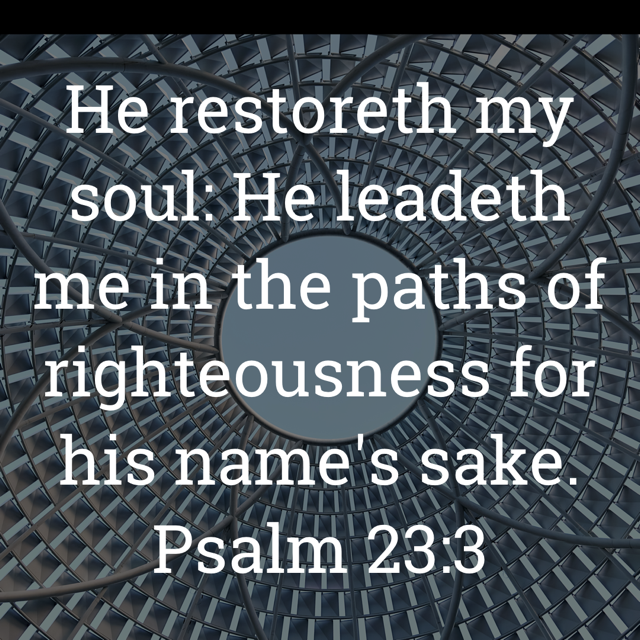
Psalm 23:3 “He restoreth my soul: he leadeth me in the paths of righteousness for his name’s sake.” (King James Version)
Psalm 23[i] as a whole is a confession of trust in the Lord as Shepherd. David speaks as one who knows the character of God personally and experientially. Verse 3 sits at the centre of the psalm and expresses both the Shepherd’s healing work and his guiding work. It is a verse rich in pastoral comfort, theological depth, and practical direction for Christian living.
1. Exegetical Commentary
A. “He restoreth my soul”
The verb “restoreth” carries the sense of returning, refreshing, or bringing back to life. In the Old Testament, the Hebrew term shuv often refers to turning back from wandering, recovering strength, or being brought back into right relationship with God.
David is not speaking merely of emotional uplift. He is speaking of the Shepherd’s active work in reviving the whole person. In Scripture, “soul” (nephesh) refers to the whole living being, not just inner feelings. The Shepherd restores the weary, the straying, the spiritually faint, and the morally compromised.
This restoration is not self-generated. It is the Shepherd’s initiative. The Christian life is sustained not by human resolve but by divine grace. This aligns with the broader testimony of Scripture:
Psalm 19:7 “The law of the LORD is perfect, converting the soul: the testimony of the LORD is sure, making wise the simple.”
Psalm 42:11 “Why art thou cast down, O my soul? and why art thou disquieted within me? hope thou in God: for I shall yet praise him, who is the health of my countenance, and my God.”
Restoration is both forgiveness and renewal. It is the Shepherd bringing the believer back to spiritual vitality.
B. “He leadeth me in the paths of righteousness”
The Shepherd not only restores but also leads. Restoration is not an end in itself; it is followed by guidance. The “paths of righteousness” are right paths, morally straight paths, paths that align with the character and commands of God.
This is not merely ethical instruction. It is covenantal guidance. The Shepherd leads his people in ways that reflect his holiness and goodness.
This echoes other passages:
Psalm 25:4–5 “Shew me thy ways, O LORD; teach me thy paths. Lead me in thy truth, and teach me: for thou art the God of my salvation; on thee do I wait all the day.”
Proverbs 3:5–6 “Trust in the LORD with all thine heart; and lean not unto thine own understanding. In all thy ways acknowledge him, and he shall direct thy paths.”
The Shepherd’s leading is personal, continuous, and purposeful.
C. “For his name’s sake”
This phrase grounds the entire verse in the character of God. The Shepherd restores and leads not because the sheep are worthy, but because his own name—his reputation, his covenant faithfulness, his revealed character—is at stake.
This is a profoundly Christian truth: God acts for the glory of his own name. His saving and sanctifying work is rooted in his eternal purpose.
Ezekiel 36:22 “Thus saith the LORD God; I do not this for your sakes, O house of Israel, but for mine holy name’s sake.”
1 Samuel 12:22 “For the LORD will not forsake his people for his great name’s sake.”
The believer’s confidence rests not in personal performance but in the unchanging character of God.
2. Theological Teaching
A. God’s grace restores the believer
Psalm 23:3 teaches that spiritual restoration is God’s work. This aligns with the doctrines of grace: regeneration, sanctification, and perseverance are all grounded in God’s initiative.
B. God’s guidance is moral and covenantal
The Shepherd leads his people in righteousness. Christian obedience is not a human attempt to earn favour but a Spirit-enabled walk in the ways of God.
C. God’s glory is the ultimate purpose
The believer’s life is shaped by the truth that God acts “for his name’s sake.” This guards against pride, despair, and self-reliance. It anchors the Christian life in God’s unchanging faithfulness.
3. Meditation Guide for Modern Christian Living
A. Reflect on your need for restoration
“He restoreth my soul: he leadeth me in the paths of righteousness for his name’s sake.”
Where are you weary, discouraged, or spiritually faint? Where have you wandered from the Shepherd’s ways?
Meditate on the Shepherd’s gentle work of restoring your soul. Restoration is not earned; it is received.
B. Consider the paths you are walking
Are your current choices, habits, and relationships aligned with the “paths of righteousness”? Are there areas where you are resisting the Shepherd’s leading?
Pray for a teachable heart and a willingness to follow.
C. Rest in the truth that God acts for his name’s sake
Your assurance does not rest on your strength but on God’s character. Your sanctification is grounded in his faithfulness. Your hope is anchored in his unchanging name.
Let this truth quiet your fears and strengthen your obedience.
D. Practise daily dependence
Psalm 23 is not a psalm of self-sufficiency. It is a psalm of trust. Begin each day with the prayer: “Lead me, Shepherd of my soul, in your paths today.”
[i] Psalm 23
King James Version
23 The LORD is my shepherd; I shall not want.
2 He maketh me to lie down in green pastures: he leadeth me beside the still waters.
3 He restoreth my soul: he leadeth me in the paths of righteousness for his name’s sake.
4 Yea, though I walk through the valley of the shadow of death, I will fear no evil: for thou art with me; thy rod and thy staff they comfort me.
5 Thou preparest a table before me in the presence of mine enemies: thou anointest my head with oil; my cup runneth over.
6 Surely goodness and mercy shall follow me all the days of my life: and I will dwell in the house of the LORD for ever.
Discover more from Daily bible verses
Subscribe to get the latest posts sent to your email.


You must be logged in to post a comment.