
Commentary on Psalm 143:8
1. The Text (King James Version)
Psalm 143:8
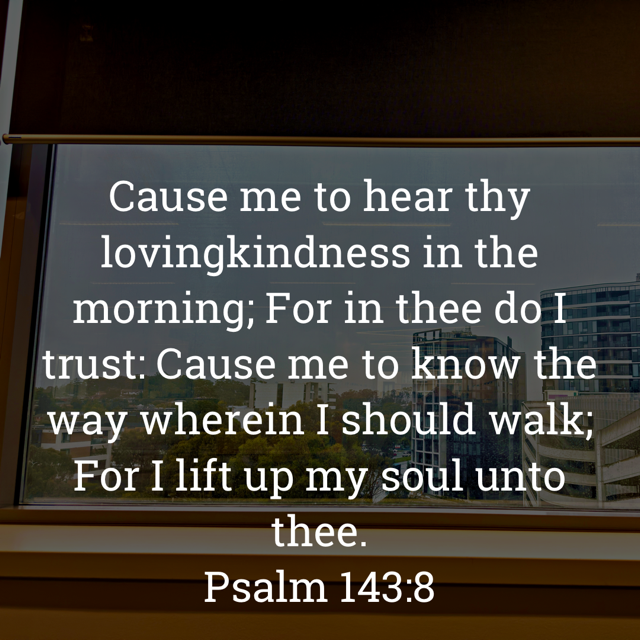
“Cause me to hear thy lovingkindness in the morning; for in thee do I trust: cause me to know the way wherein I should walk; for I lift up my soul unto thee.”
2. Context: Psalm 143 as a Whole
Psalm 143[i] is one of the seven traditional penitential psalms[ii]. It is attributed to David and reflects a moment of deep distress, spiritual weariness, and urgent dependence on God. The psalm moves through three major movements:
- A cry for mercy
“Hear my prayer, O LORD, give ear to my supplications: in thy faithfulness answer me, and in thy righteousness.” (Psalm 143:1) - A confession of human frailty and sin
“Enter not into judgment with thy servant: for in thy sight shall no man living be justified.” (Psalm 143:2) - A plea for guidance, deliverance, and renewed life
“Teach me to do thy will; for thou art my God: thy spirit is good; lead me into the land of uprightness.” (Psalm 143:10)
Psalm 143:8 sits at the heart of this final movement. It is a morning prayer, a request for God’s covenant love to be freshly heard and God’s guidance to be clearly known.
3. Exegetical Commentary on Psalm 143:8
“Cause me to hear thy lovingkindness in the morning”
The word lovingkindness translates the Hebrew ḥesed—God’s steadfast, covenantal, loyal love. David is not asking for new love from God but to hear afresh what is already true.
The phrase in the morning carries both literal and symbolic meaning:
- Literal: the start of the day, when David seeks God before anything else.
- Symbolic: the hope of a new beginning after a night of distress.
David is asking God to speak His love into the first moments of consciousness, shaping the whole day.
“For in thee do I trust”
This is not a bargaining chip but a declaration of faith. David’s trust is not in circumstances, strategies, or his own strength. It is in God’s character.
Trust is the foundation for hearing God’s lovingkindness. Without trust, God’s love sounds distant. With trust, it becomes the anchor of the soul.
“Cause me to know the way wherein I should walk”
David is not simply asking for information. He is asking for formation.
- He wants God to make the path clear.
- He wants God to make him able to walk it.
- He wants God to shape his desires so that he actually wants to walk it.
This echoes Psalm 143:10:
“Teach me to do thy will; for thou art my God: thy spirit is good; lead me into the land of uprightness.”
Guidance in Scripture is always relational. God does not hand David a map; He offers Himself as the guide.
“For I lift up my soul unto thee”
This is the posture of surrender, dependence, and worship.
To “lift up” one’s soul is to:
- offer one’s whole self to God
- acknowledge one’s inability
- seek God as the only source of life and direction
It is the opposite of self-reliance.
4. Theological Insights
A. God’s Lovingkindness Is the Christian’s Daily Anchor
The Christian tradition emphasises that God’s covenant love is the ground of our assurance. David appeals not to his own worthiness but to God’s steadfast character.
This aligns with the broader biblical witness:
- “It is of the LORD’s mercies that we are not consumed… they are new every morning.” (Lamentations 3:22–23)
B. Human Frailty Drives Us to Divine Guidance
Psalm 143:2 reminds us that no one can stand before God on the basis of personal righteousness. This humility shapes the request in verse 8. We seek guidance not because we are wise but because we are dependent.
C. Guidance Is Personal, Not Merely Practical
David does not ask for a list of steps. He asks for God Himself.
This reflects the Christian emphasis on God’s sovereignty and the believer’s union with Christ. Guidance flows from relationship, not technique.
D. Prayer Is the Means by Which God Shapes the Heart
David’s prayer is not merely expressive; it is transformative. God uses prayer to align our desires with His will.
5. Practical Application for Modern Christian Living
A. Begin the Day with God’s Voice, Not Your Own
David seeks God’s lovingkindness in the morning. In a world of notifications, news, and noise, Christians need to hear God’s covenant love before anything else.
A simple practice:
- Before checking your phone, pray Psalm 143:8.
- Let God’s love set the tone for the day.
B. Trust Is a Daily Decision
Trust is not a feeling; it is a posture. David says, “for in thee do I trust.”
Each morning, Christians can consciously place their trust in God’s character, not in their own capacity.
C. Seek God’s Guidance with an Open Heart
David does not tell God what path he wants. He asks God to reveal the path.
This challenges our tendency to ask God to bless our plans rather than submit to His.
D. Lift Up Your Soul—Do Not Carry It Alone
Modern life encourages self-sufficiency. Psalm 143:8 calls us to lift our souls to God instead of carrying burdens privately.
A practical step:
- At the start of the day, name the things weighing on you and consciously hand them to God.
E. Guidance Comes Through Scripture, Prayer, and Community
God’s guidance is not mystical guesswork. It is grounded in:
- the Word of God
- the Spirit’s work in prayer
- the wisdom of godly believers
6. Meditation Guide
A. Prepare Your Heart
Sit quietly. Breathe slowly. Ask God to speak His lovingkindness into your morning.
B. Read Psalm 143:8 Slowly
“Cause me to hear thy lovingkindness in the morning; for in thee do I trust: cause me to know the way wherein I should walk; for I lift up my soul unto thee.”
C. Reflect
- Where do I need to hear God’s lovingkindness today?
- What am I trusting in besides God?
- Where do I need guidance?
- What burdens do I need to lift up to Him?
D. Pray
Use David’s words as your own. Ask God to make His love clear and His path known.
E. Act
Choose one concrete step today that reflects trust in God’s lovingkindness.
[i] Psalm 143
King James Version
143 Hear my prayer, O LORD, give ear to my supplications: in thy faithfulness answer me, and in thy righteousness.
2 And enter not into judgment with thy servant: for in thy sight shall no man living be justified.
3 For the enemy hath persecuted my soul; he hath smitten my life down to the ground; he hath made me to dwell in darkness, as those that have been long dead.
4 Therefore is my spirit overwhelmed within me; my heart within me is desolate.
5 I remember the days of old; I meditate on all thy works; I muse on the work of thy hands.
6 I stretch forth my hands unto thee: my soul thirsteth after thee, as a thirsty land. Selah.
7 Hear me speedily, O LORD: my spirit faileth: hide not thy face from me, lest I be like unto them that go down into the pit.
8 Cause me to hear thy lovingkindness in the morning; for in thee do I trust: cause me to know the way wherein I should walk; for I lift up my soul unto thee.
9 Deliver me, O LORD, from mine enemies: I flee unto thee to hide me.
10 Teach me to do thy will; for thou art my God: thy spirit is good; lead me into the land of uprightness.
11 Quicken me, O LORD, for thy name’s sake: for thy righteousness’ sake bring my soul out of trouble.
12 And of thy mercy cut off mine enemies, and destroy all them that afflict my soul: for I am thy servant.
[ii] A penitential psalm is a psalm in which the psalmist honestly confesses sin, seeks God’s mercy, and expresses repentance and renewed trust in God.
Discover more from Daily bible verses
Subscribe to get the latest posts sent to your email.


You must be logged in to post a comment.