
Commentary on 2 Corinthians 4:18
1. The Text
2 Corinthians 4:18 (King James Version):
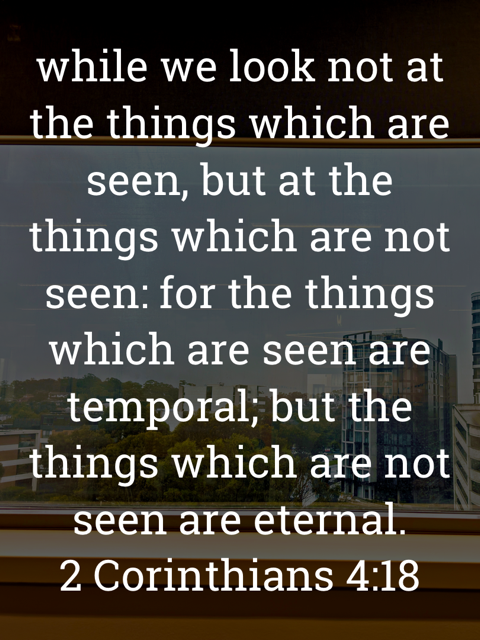
“While we look not at the things which are seen, but at the things which are not seen: for the things which are seen are temporal; but the things which are not seen are eternal.”
This single verse is the climax of Paul’s argument in 2 Corinthians 4[i]. It is a window into the Christian life: a life shaped not by what the eyes can see, but by what God has promised.
2. The Flow of Paul’s Argument in 2 Corinthians 4
Paul writes to a church that is discouraged, confused, and tempted to judge ministry by outward appearances. He reminds them that Christian ministry—and Christian life—takes place in weakness, but is sustained by God’s power.
Key verses frame the chapter:
2 Corinthians 4:7 (KJV):
“But we have this treasure in earthen vessels, that the excellency of the power may be of God, and not of us.”
2 Corinthians 4:16 (KJV):
“For which cause we faint not; but though our outward man perish, yet the inward man is renewed day by day.”
Paul’s logic is simple but profound:
- We suffer.
- We are weak.
- We decay.
- But God is at work.
- And glory is coming.
Verse 18 explains how Christians endure: by fixing their gaze on eternal realities.
3. Exegetical Commentary on 2 Corinthians 4:18
A. “While we look not at the things which are seen”
The word “look” refers not to a passing glance but to a deliberate focus. Paul is talking about the orientation of the heart.
The “things which are seen” include:
- Suffering
- Hardship
- Human weakness
- Earthly success or failure
- The visible decay of the body
- The pressures of daily life
Paul is not calling Christians to denial. Earlier he says:
2 Corinthians 4:8–9 (KJV):
“We are troubled on every side, yet not distressed; we are perplexed, but not in despair; persecuted, but not forsaken; cast down, but not destroyed.”
Paul sees reality clearly. But he refuses to let visible circumstances define ultimate truth.
B. “But at the things which are not seen”
The unseen things are the realities of God’s kingdom:
- The presence of Christ
- The renewing work of the Holy Spirit
- The promise of resurrection
- The coming glory of God
- The eternal inheritance of believers
These are unseen not because they are vague or imaginary, but because they belong to the eternal realm.
Paul has already pointed to this hope:
2 Corinthians 4:14 (KJV):
“Knowing that he which raised up the Lord Jesus shall raise up us also by Jesus, and shall present us with you.”
C. “For the things which are seen are temporal”
Everything visible is temporary. This includes both suffering and success.
- Pain is temporary.
- Pressure is temporary.
- Illness is temporary.
- Earthly achievements are temporary.
- Even the body itself is temporary.
Paul is not dismissing these things. He is placing them in their proper category: temporary, passing, fragile.
This echoes Jesus’ teaching:
Matthew 6:19–20 (KJV):
“Lay not up for yourselves treasures upon earth… But lay up for yourselves treasures in heaven…”
D. “But the things which are not seen are eternal”
This is the heart of the verse. The unseen realities of God’s kingdom are:
- Permanent
- Unshakeable
- Glorious
- Certain
Paul is not calling Christians to escapism. He is calling them to perspective. The eternal is more real and more solid than anything we can see.
This is why he can say:
2 Corinthians 4:17 (KJV):
“For our light affliction, which is but for a moment, worketh for us a far more exceeding and eternal weight of glory.”
Paul is not trivialising suffering. He is magnifying glory.
4. Theological Themes
A. The Christian Life Is Lived by Faith, Not Sight
This anticipates Paul’s later statement:
2 Corinthians 5:7 (KJV):
“For we walk by faith, not by sight.”
Faith is trust in the unseen God who has revealed himself in Jesus Christ.
B. The Temporary Nature of Suffering
Suffering is real, but it is not ultimate. It is temporary and purposeful.
C. The Renewal of the Inner Person
The Holy Spirit renews believers inwardly even as the body ages and weakens.
D. The Resurrection Hope
The unseen eternal things include the resurrection of the body and the restoration of all things.
E. The Glory of God as the Ultimate Reality
The Christian life is oriented toward the eternal glory of God revealed in Jesus Christ.
5. Practical Application for Modern Christian Living
A. Reframing Suffering
Christians today face:
- Chronic illness
- Anxiety
- Workplace stress
- Family conflict
- Loneliness
- Grief
Paul does not tell us to pretend these do not hurt. He tells us to interpret them through the lens of eternity.
Application:
When suffering feels overwhelming, remind yourself: This is temporary. God’s glory is eternal.
B. Cultivating Eternal Perspective
Modern life is full of distractions:
- Social media
- Career pressures
- Financial concerns
- The pursuit of comfort
Paul calls us to lift our eyes.
Application:
Build habits that direct your gaze toward eternal things:
- Daily Scripture reading
- Prayer
- Worship
- Christian fellowship
- Serving others
C. Valuing the Unseen Work of God
Much of God’s work in us is invisible:
- Growth in patience
- Quiet repentance
- Deepening love
- Renewed hope
Application:
Do not measure your spiritual life by outward success. Measure it by the unseen fruit of the Spirit.
D. Living with Hope in a Decaying World
Bodies age. Circumstances shift. The world is unstable.
Application:
Anchor your hope not in circumstances but in Christ’s eternal kingdom.
E. Encouraging Others with Eternal Perspective
Paul writes pastorally. We can do the same.
Application:
When comforting others, gently remind them of God’s eternal promises without minimising their pain.
6. Meditation Guide
Use these steps for personal devotion or group reflection.
Step 1: Read the Verse Slowly
Read 2 Corinthians 4:18 aloud several times.
“While we look not at the things which are seen, but at the things which are not seen: for the things which are seen are temporal; but the things which are not seen are eternal.”
Step 2: Reflect on What You Are Currently “Looking At”
Ask yourself:
- What dominates my attention?
- What worries or pressures feel overwhelming?
- What am I tempted to treat as ultimate?
Step 3: Consider the Eternal Realities
Reflect on:
- The presence of Christ
- The promise of resurrection
- The glory to come
- The Spirit’s work in you
Step 4: Pray for Renewed Vision
Ask God to help you see:
- The temporary as temporary
- The eternal as eternal
Step 5: Commit to One Practical Change
Examples:
- Memorise 2 Corinthians 4:18
- Begin or end each day with Scripture
- Encourage someone who is suffering
- Reduce a distraction that pulls your gaze away from Christ
[i] 2 Corinthians 4
King James Version
4 Therefore seeing we have this ministry, as we have received mercy, we faint not;
2 But have renounced the hidden things of dishonesty, not walking in craftiness, nor handling the word of God deceitfully; but by manifestation of the truth commending ourselves to every man’s conscience in the sight of God.
3 But if our gospel be hid, it is hid to them that are lost:
4 In whom the god of this world hath blinded the minds of them which believe not, lest the light of the glorious gospel of Christ, who is the image of God, should shine unto them.
5 For we preach not ourselves, but Christ Jesus the Lord; and ourselves your servants for Jesus’ sake.
6 For God, who commanded the light to shine out of darkness, hath shined in our hearts, to give the light of the knowledge of the glory of God in the face of Jesus Christ.
7 But we have this treasure in earthen vessels, that the excellency of the power may be of God, and not of us.
8 We are troubled on every side, yet not distressed; we are perplexed, but not in despair;
9 Persecuted, but not forsaken; cast down, but not destroyed;
10 Always bearing about in the body the dying of the Lord Jesus, that the life also of Jesus might be made manifest in our body.
11 For we which live are always delivered unto death for Jesus’ sake, that the life also of Jesus might be made manifest in our mortal flesh.
12 So then death worketh in us, but life in you.
13 We having the same spirit of faith, according as it is written, I believed, and therefore have I spoken; we also believe, and therefore speak;
14 Knowing that he which raised up the Lord Jesus shall raise up us also by Jesus, and shall present us with you.
15 For all things are for your sakes, that the abundant grace might through the thanksgiving of many redound to the glory of God.
16 For which cause we faint not; but though our outward man perish, yet the inward man is renewed day by day.
17 For our light affliction, which is but for a moment, worketh for us a far more exceeding and eternal weight of glory;
18 While we look not at the things which are seen, but at the things which are not seen: for the things which are seen are temporal; but the things which are not seen are eternal.
Discover more from Daily bible verses
Subscribe to get the latest posts sent to your email.


You must be logged in to post a comment.