
Commentary on Matthew 28:6
1. The Text
Matthew 28:6 (King James Version):
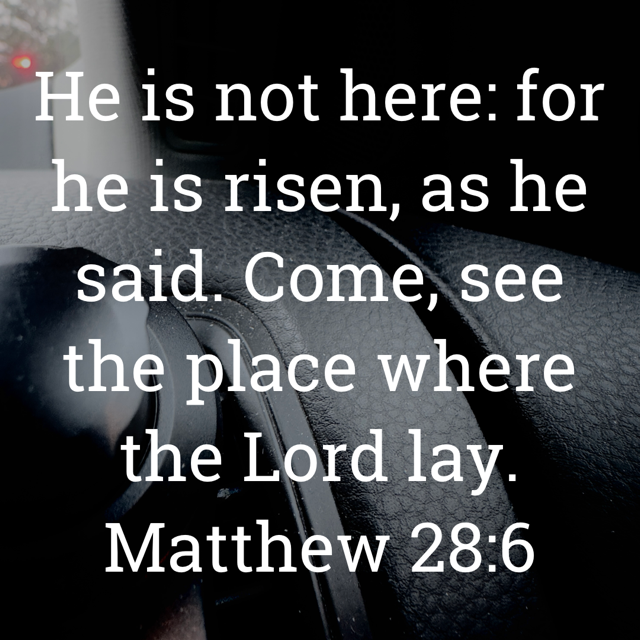
“He is not here: for he is risen, as he said. Come, see the place where the Lord lay.”
This short verse stands at the centre of the Christian faith. It is the angel’s declaration to the women at the tomb on the first day of the week. Everything in Matthew’s Gospel has been moving toward this moment. The crucified Christ is now the risen Christ. The tomb is empty, not because of theft or confusion, but because Jesus has conquered death.
2. Exegetical Commentary
2.1 Immediate Context: Matthew 28
Matthew 28[i] opens with the women going to the tomb:
Matthew 28:1 (KJV):
“In the end of the sabbath, as it began to dawn toward the first day of the week, came Mary Magdalene and the other Mary to see the sepulchre.”
Their intention is simple: to honour the crucified Jesus. Instead, they encounter an earthquake, an angel, and an empty tomb.
The angel’s message in verse 6 is structured in three movements:
- A declaration: “He is not here”
- A reason: “for he is risen, as he said”
- An invitation: “Come, see the place where the Lord lay”
Each movement carries theological weight.
2.2 “He is not here” — The Empty Tomb as Historical and Theological Fact
The angel does not offer speculation. He states a fact. The tomb is empty. Matthew has already anticipated alternative explanations, especially the rumour that the disciples stole the body (Matthew 28:11–15). The angel’s words cut through all such theories.
The empty tomb is not merely a symbol. It is a historical reality that grounds Christian hope. Without it, the Gospel collapses.
2.3 “For he is risen” — The Resurrection as God’s Vindication
The resurrection is not simply Jesus returning to life. It is God’s public vindication of His Son. Jesus had been mocked, beaten, crucified, and buried. The world judged Him a failure. God overturned that verdict.
This aligns with the broader New Testament witness:
Romans 1:4 (KJV):
“And declared to be the Son of God with power… by the resurrection from the dead.”
The resurrection is the Father’s “Yes” to the Son’s obedience and the guarantee that His atoning death was effective.
2.4 “As he said” — The Faithfulness of Christ’s Word
Jesus repeatedly predicted His death and resurrection:
Matthew 16:21 (KJV):
“From that time forth began Jesus to shew unto his disciples, how that he must… be killed, and be raised again the third day.”
Matthew 20:19 (KJV):
“…and the third day he shall rise again.”
The angel reminds the women—and us—that Jesus keeps His word. The resurrection is not a surprise twist. It is the fulfilment of divine promise.
This is deeply pastoral. The Christian life rests on the reliability of Christ’s promises.
2.5 “Come, see the place where the Lord lay” — Invitation to Faith Based on Evidence
Christian faith is not blind. The angel invites the women to inspect the evidence. The tomb is empty, the grave clothes undisturbed, and the stone rolled away.
Matthew emphasises that the resurrection is both supernatural and verifiable. The women see the empty tomb. They meet the risen Christ (Matthew 28:9). The disciples see Him in Galilee (Matthew 28:17).
Christian faith is grounded in historical truth.
3. Theological Themes
3.1 The Resurrection as the Foundation of Christian Hope
The resurrection is not an optional doctrine. It is the cornerstone of the Gospel. Without it, there is no forgiveness, no new life, and no future hope.
3.2 The Faithfulness of God
The phrase “as he said” highlights God’s unwavering commitment to His promises. The resurrection assures believers that every promise in Scripture will be fulfilled.
3.3 The Lordship of Christ
The angel refers to Jesus as “the Lord.” The resurrection confirms His divine authority, which culminates in the Great Commission:
Matthew 28:18 (KJV):
“All power is given unto me in heaven and in earth.”
4. Meditation Guide
Use the following movements for personal devotion, small groups, or teaching.
“He is not here: for he is risen, as he said. Come, see the place where the Lord lay.”
4.1 Reflect: “He is not here”
- Consider the emptiness of the tomb.
- What does it mean for your fears, your grief, your mortality?
- How does the empty tomb reshape your understanding of suffering?
4.2 Rejoice: “For he is risen”
- Sit with the reality that Jesus is alive.
- Let this truth speak into areas of despair or hopelessness.
- Praise God for His power to bring life out of death.
4.3 Remember: “As he said”
- Recall promises of Christ that you struggle to trust.
- Meditate on His perfect reliability.
- Ask the Spirit to strengthen your confidence in His word.
4.4 Respond: “Come, see”
- Examine the evidence of the resurrection in Scripture.
- Consider how the risen Christ has been at work in your life.
- Ask: How does the resurrection call me to obedience, courage, and mission?
5. Application to Modern Christian Living
5.1 Live with Resurrection Hope
Christians face real suffering, but not despair. The resurrection assures us that death does not have the final word.
5.2 Trust the Promises of Christ
In a world of broken promises, Christ’s faithfulness stands firm. His resurrection proves that His word is trustworthy.
5.3 Embrace the Mission of the Risen Lord
The resurrection leads directly to mission:
Matthew 28:19–20 (KJV):
“Go ye therefore, and teach all nations… teaching them to observe all things whatsoever I have commanded you.”
The risen Christ sends His people into the world with confidence and purpose.
5.4 Worship the Risen Lord
The women “held him by the feet, and worshipped him” (Matthew 28:9).
Resurrection faith leads to reverent, joyful worship.
[i] Matthew 28
King James Version
28 In the end of the sabbath, as it began to dawn toward the first day of the week, came Mary Magdalene and the other Mary to see the sepulchre.
2 And, behold, there was a great earthquake: for the angel of the Lord descended from heaven, and came and rolled back the stone from the door, and sat upon it.
3 His countenance was like lightning, and his raiment white as snow:
4 And for fear of him the keepers did shake, and became as dead men.
5 And the angel answered and said unto the women, Fear not ye: for I know that ye seek Jesus, which was crucified.
6 He is not here: for he is risen, as he said. Come, see the place where the Lord lay.
7 And go quickly, and tell his disciples that he is risen from the dead; and, behold, he goeth before you into Galilee; there shall ye see him: lo, I have told you.
8 And they departed quickly from the sepulchre with fear and great joy; and did run to bring his disciples word.
9 And as they went to tell his disciples, behold, Jesus met them, saying, All hail. And they came and held him by the feet, and worshipped him.
10 Then said Jesus unto them, Be not afraid: go tell my brethren that they go into Galilee, and there shall they see me.
11 Now when they were going, behold, some of the watch came into the city, and shewed unto the chief priests all the things that were done.
12 And when they were assembled with the elders, and had taken counsel, they gave large money unto the soldiers,
13 Saying, Say ye, His disciples came by night, and stole him away while we slept.
14 And if this come to the governor’s ears, we will persuade him, and secure you.
15 So they took the money, and did as they were taught: and this saying is commonly reported among the Jews until this day.
16 Then the eleven disciples went away into Galilee, into a mountain where Jesus had appointed them.
17 And when they saw him, they worshipped him: but some doubted.
18 And Jesus came and spake unto them, saying, All power is given unto me in heaven and in earth.
19 Go ye therefore, and teach all nations, baptising them in the name of the Father, and of the Son, and of the Holy Ghost:
20 Teaching them to observe all things whatsoever I have commanded you: and, lo, I am with you always, even unto the end of the world. Amen.
Discover more from Daily bible verses
Subscribe to get the latest posts sent to your email.


You must be logged in to post a comment.