
Commentary on Matthew 28:19
1. The Text
Matthew 28:19 (King James Version)
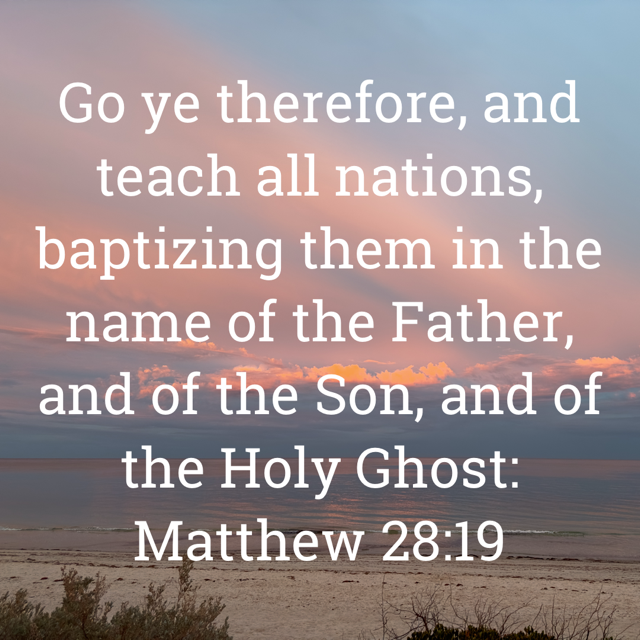
“Go ye therefore, and teach all nations, baptising them in the name of the Father, and of the Son, and of the Holy Ghost.”
This verse sits within the closing section of Matthew’s Gospel, often called The Great Commission. It is the risen Lord Jesus Christ’s authoritative charge to His disciples, grounded in His universal authority and directed toward the mission of the church until His return.
2. Literary and Biblical Context
Matthew 28:16–20 (KJV)
“Then the eleven disciples went away into Galilee, into a mountain where Jesus had appointed them.
And when they saw him, they worshipped him: but some doubted.
And Jesus came and spake unto them, saying, All power is given unto me in heaven and in earth.
Go ye therefore, and teach all nations, baptising them in the name of the Father, and of the Son, and of the Holy Ghost:
Teaching them to observe all things whatsoever I have commanded you: and, lo, I am with you alway, even unto the end of the world. Amen.”
The command of verse 19 flows directly from verse 18, where Jesus declares His universal authority. The commission is not a suggestion but a royal command from the risen King.
3. Exegetical Commentary
3.1 “Go ye therefore”
The command “go” is grounded in the “therefore” of Christ’s authority. The church’s mission is not self‑generated; it is authorised and empowered by the risen Christ.
In the Greek, “go” carries a sense of ongoing movement: as you go, in your going. It is not limited to overseas mission but includes the everyday witness of believers in their ordinary lives.
3.2 “Teach all nations”
The KJV translates the verb mathēteusate as “teach,” but the more precise meaning is “make disciples.”
A disciple is not merely an informed person but a follower, learner, and obedient apprentice of Jesus Christ.
“All nations” reflects the fulfilment of God’s promise to Abraham that all families of the earth would be blessed through his seed (Genesis 12:3). The gospel is not tribal, cultural, or national. It is global, universal, and inclusive of every people group.
3.3 “Baptising them in the name of the Father, and of the Son, and of the Holy Ghost”
Baptism is the visible sign of entry into the covenant community of Christ. It is a public identification with the Triune God.
The singular “name” with three persons is a profound witness to the doctrine of the Trinity. The early church did not invent Trinitarian theology; it received it from the lips of Jesus Himself.
Baptism signifies:
- union with Christ in His death and resurrection (Romans 6:3–4)
“Know ye not, that so many of us as were baptised into Jesus Christ were baptised into his death?
Therefore we are buried with him by baptism into death: that like as Christ was raised up from the dead by the glory of the Father, even so we also should walk in newness of life.”
- cleansing from sin (Acts 22:16)
“Arise, and be baptised, and wash away thy sins, calling on the name of the Lord.”
- incorporation into the body of Christ (1 Corinthians 12:13)
“For by one Spirit are we all baptised into one body…”
3.4 The Trinitarian Shape of Christian Mission
The Father sends the Son.
The Son sends the Spirit.
The Spirit empowers the church.
Mission is participation in the life and work of the Triune God.
3.5 The Commission Continues in Verse 20
The command cannot be separated from verse 20:
“Teaching them to observe all things whatsoever I have commanded you.”
Discipleship is not merely conversion but lifelong obedience.
The church’s mission is not only to proclaim but to form Christlike people.
4. Theological Themes
4.1 The Authority of Christ
Mission flows from Christ’s kingship.
Christian theology rightly emphasises that evangelism is not human initiative but obedience to divine command.
4.2 The Trinity
This verse is one of the clearest Trinitarian statements in Scripture.
The unity of the “name” and the distinction of the three persons are foundational to orthodox Christian belief.
4.3 The Nature of Discipleship
Discipleship involves:
- hearing the gospel
- responding in faith
- being baptised
- learning Christ’s commands
- obeying them
- persevering to the end
This is a holistic, lifelong process.
4.4 The Global Scope of the Gospel
The gospel is for all nations.
This includes:
- ethnic groups
- cultural groups
- social classes
- people across all ages and backgrounds
The church must resist the temptation to narrow the gospel to people like ourselves.
5. Meditation Guide
5.1 Reflective Questions
“Go ye therefore, and teach all nations, baptising them in the name of the Father, and of the Son, and of the Holy Ghost.”
- Where in my daily life is Jesus calling me to “go” with gospel intentionality?
- Do I see myself as a disciple who is continually learning and obeying Jesus?
- How does the reality of the Trinity shape my understanding of God’s love and mission?
- Are there people or groups I subconsciously exclude from the gospel?
- How might I participate more fully in making disciples in my church community?
5.2 Prayer Suggestions
- Thank God for the authority and presence of Jesus.
- Ask the Holy Spirit to give courage and clarity in witness.
- Pray for opportunities to disciple others.
- Pray for the nations, especially those with little gospel access.
- Pray for your local church to be faithful to the Great Commission.
5.3 Practical Applications for Modern Christian Living
- Cultivate intentional relationships with non‑Christians.
- Support global mission through prayer, giving, and partnership.
- Engage in discipling relationships within your church.
- Reflect on your baptism and what it signifies.
- Live with confidence in Christ’s authority and presence.
Discover more from Daily bible verses
Subscribe to get the latest posts sent to your email.


You must be logged in to post a comment.