
Commentary on John 5:24
1. The Text
John 5:24 (King James Version):
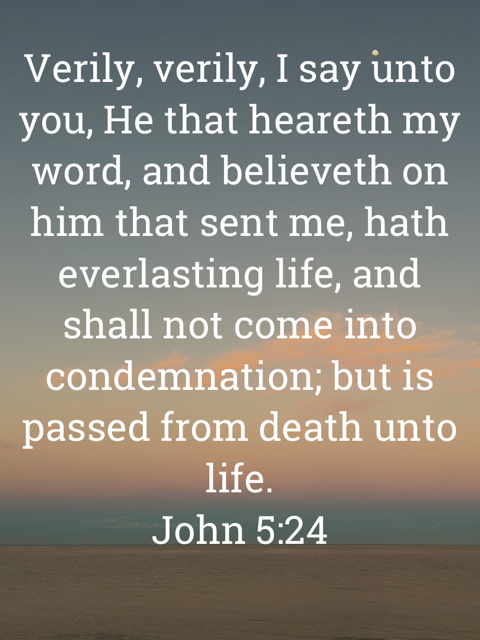
“Verily, verily, I say unto you, He that heareth my word, and believeth on him that sent me, hath everlasting life, and shall not come into condemnation; but is passed from death unto life.”
This single verse stands as one of the clearest and most comforting statements of the gospel in the entire New Testament. It is a declaration of Christ’s authority, the certainty of salvation, and the present reality of eternal life for all who believe.
2. Literary and Historical Context
John 5[i] records Jesus healing a man at the pool of Bethesda on the Sabbath. This miracle provokes controversy with the Jewish leaders, who accuse Jesus of breaking the Sabbath and blaspheming by calling God His Father.
Jesus responds by asserting His divine authority. The entire chapter is a sustained claim that the Son shares the prerogatives of the Father: giving life, executing judgement, and receiving honour.
Key surrounding verses include:
John 5:21 (KJV):
“For as the Father raiseth up the dead, and quickeneth them; even so the Son quickeneth whom he will.”
John 5:22 (KJV):
“For the Father judgeth no man, but hath committed all judgment unto the Son.”
John 5:26 (KJV):
“For as the Father hath life in himself; so hath he given to the Son to have life in himself.”
John 5:24 sits at the centre of this argument. Jesus is not merely a messenger; He is the life-giver and the judge. The salvation He offers is grounded in His divine authority.
3. Exegetical Analysis of John 5:24
3.1 “Verily, verily, I say unto you”
The double “verily” (literally “amen, amen”) is unique to the Gospel of John. It signals solemn truth and divine authority. Jesus is not offering speculation or possibility; He is declaring reality.
3.2 “He that heareth my word”
“Hearing” in Johannine theology is never passive. It means receiving, accepting, and responding to Christ’s teaching. It is akin to the Old Testament idea of “hearing” as obedience.
3.3 “And believeth on him that sent me”
To believe in the Father is to believe in the Son, and vice versa. Jesus is the Father’s authorised representative. Faith in Christ is faith in God.
This reflects the unity of the Father and the Son, a key theme in John’s Gospel.
3.4 “Hath everlasting life”
Note the present tense: hath. Eternal life is not merely a future hope; it is a present possession. In Johannine theology, eternal life is relational—knowing God through Christ.
3.5 “And shall not come into condemnation”
The believer is exempt from the final judgement of wrath. This echoes:
Romans 8:1 (KJV):
“There is therefore now no condemnation to them which are in Christ Jesus.”
The judgement has already been borne by Christ.
3.6 “But is passed from death unto life”
Again, note the present reality. The believer has already crossed over. This is regeneration—the new birth. It is the spiritual resurrection that anticipates the bodily resurrection to come.
This aligns with:
Ephesians 2:5 (KJV):
“Even when we were dead in sins, hath quickened us together with Christ.”
4. Theological Themes
4.1 The Authority of Christ
John 5 emphasises that Jesus has divine authority to give life and to judge. Salvation rests not on human effort but on the sovereign grace of the Son.
4.2 Justification by Faith
The believer “shall not come into condemnation.” This is the heart of justification: God declares the sinner righteous on the basis of Christ’s work.
4.3 The Already–Not Yet of Eternal Life
Eternal life begins now but is consummated in the resurrection. The believer lives in the overlap of the ages.
4.4 Union with Christ
To believe in Christ is to be united with Him in His life. The believer participates in His victory over death.
4.5 The Trinity in Salvation
The Father sends, the Son speaks and saves, and the Spirit (as seen later in John) gives life. Salvation is the work of the Triune God.
5. Practical Application for Modern Christian Living
5.1 Assurance of Salvation
Jesus promises that the believer has eternal life and will not face condemnation. This is not arrogance; it is trust in Christ’s word.
5.2 Hearing Christ’s Word Today
We hear Christ’s word through Scripture. To “hear” is to receive it with faith, humility, and obedience. Regular reading, meditation, and corporate worship are essential.
5.3 Living as People Who Have Passed from Death to Life
If we have already crossed from death to life, our lives should reflect resurrection reality:
- turning from sin
- pursuing holiness
- loving others sacrificially
- living with hope rather than fear
5.4 Confidence in Christ’s Authority
In a world of uncertainty, Christ’s authority gives stability. He is the judge of all and the giver of life. Christians can live with courage and integrity because their future is secure.
5.5 Evangelism
John 5:24 is a clear and simple gospel invitation. Christians can use it to explain salvation to others: hear Christ, believe in the Father who sent Him, receive eternal life.
6. Meditation Guide
6.1 Read the Verse Slowly
Read John 5:24 aloud several times. Emphasise different phrases each time.
“Verily, verily, I say unto you, He that heareth my word, and believeth on him that sent me, hath everlasting life, and shall not come into condemnation; but is passed from death unto life.”
6.2 Reflect on Three Questions
- What does it mean for me to “hear” Christ’s word today?
- Do I trust that I already have eternal life?
- How does knowing I will not face condemnation change the way I live?
6.3 Pray
- Thank God for sending His Son.
- Thank Jesus for giving life and bearing judgement.
- Ask the Spirit to deepen your faith and obedience.
6.4 Act
Choose one practical step that reflects your new life in Christ—perhaps forgiving someone, resisting a particular sin, or encouraging a fellow believer.
[i] John 5
King James Version
5 After this there was a feast of the Jews; and Jesus went up to Jerusalem.
2 Now there is at Jerusalem by the sheep market a pool, which is called in the Hebrew tongue Bethesda, having five porches.
3 In these lay a great multitude of impotent folk, of blind, halt, withered, waiting for the moving of the water.
4 For an angel went down at a certain season into the pool, and troubled the water: whosoever then first after the troubling of the water stepped in was made whole of whatsoever disease he had.
5 And a certain man was there, which had an infirmity thirty and eight years.
6 When Jesus saw him lie, and knew that he had been now a long time in that case, he saith unto him, Wilt thou be made whole?
7 The impotent man answered him, Sir, I have no man, when the water is troubled, to put me into the pool: but while I am coming, another steppeth down before me.
8 Jesus saith unto him, Rise, take up thy bed, and walk.
9 And immediately the man was made whole, and took up his bed, and walked: and on the same day was the sabbath.
10 The Jews therefore said unto him that was cured, It is the sabbath day: it is not lawful for thee to carry thy bed.
11 He answered them, He that made me whole, the same said unto me, Take up thy bed, and walk.
12 Then asked they him, What man is that which said unto thee, Take up thy bed, and walk?
13 And he that was healed wist not who it was: for Jesus had conveyed himself away, a multitude being in that place.
14 Afterward Jesus findeth him in the temple, and said unto him, Behold, thou art made whole: sin no more, lest a worse thing come unto thee.
15 The man departed, and told the Jews that it was Jesus, which had made him whole.
16 And therefore did the Jews persecute Jesus, and sought to slay him, because he had done these things on the sabbath day.
17 But Jesus answered them, My Father worketh hitherto, and I work.
18 Therefore the Jews sought the more to kill him, because he not only had broken the sabbath, but said also that God was his Father, making himself equal with God.
19 Then answered Jesus and said unto them, Verily, verily, I say unto you, The Son can do nothing of himself, but what he seeth the Father do: for what things soever he doeth, these also doeth the Son likewise.
20 For the Father loveth the Son, and sheweth him all things that himself doeth: and he will shew him greater works than these, that ye may marvel.
21 For as the Father raiseth up the dead, and quickeneth them; even so the Son quickeneth whom he will.
22 For the Father judgeth no man, but hath committed all judgment unto the Son:
23 That all men should honour the Son, even as they honour the Father. He that honoureth not the Son honoureth not the Father which hath sent him.
24 Verily, verily, I say unto you, He that heareth my word, and believeth on him that sent me, hath everlasting life, and shall not come into condemnation; but is passed from death unto life.
25 Verily, verily, I say unto you, The hour is coming, and now is, when the dead shall hear the voice of the Son of God: and they that hear shall live.
26 For as the Father hath life in himself; so hath he given to the Son to have life in himself;
27 And hath given him authority to execute judgment also, because he is the Son of man.
28 Marvel not at this: for the hour is coming, in the which all that are in the graves shall hear his voice,
29 And shall come forth; they that have done good, unto the resurrection of life; and they that have done evil, unto the resurrection of damnation.
30 I can of mine own self do nothing: as I hear, I judge: and my judgment is just; because I seek not mine own will, but the will of the Father which hath sent me.
31 If I bear witness of myself, my witness is not true.
32 There is another that beareth witness of me; and I know that the witness which he witnesseth of me is true.
33 Ye sent unto John, and he bare witness unto the truth.
34 But I receive not testimony from man: but these things I say, that ye might be saved.
35 He was a burning and a shining light: and ye were willing for a season to rejoice in his light.
36 But I have greater witness than that of John: for the works which the Father hath given me to finish, the same works that I do, bear witness of me, that the Father hath sent me.
37 And the Father himself, which hath sent me, hath borne witness of me. Ye have neither heard his voice at any time, nor seen his shape.
38 And ye have not his word abiding in you: for whom he hath sent, him ye believe not.
39 Search the scriptures; for in them ye think ye have eternal life: and they are they which testify of me.
40 And ye will not come to me, that ye might have life.
41 I receive not honour from men.
42 But I know you, that ye have not the love of God in you.
43 I am come in my Father’s name, and ye receive me not: if another shall come in his own name, him ye will receive.
44 How can ye believe, which receive honour one of another, and seek not the honour that cometh from God only?
45 Do not think that I will accuse you to the Father: there is one that accuseth you, even Moses, in whom ye trust.
46 For had ye believed Moses, ye would have believed me; for he wrote of me.
47 But if ye believe not his writings, how shall ye believe my words?
Discover more from Daily bible verses
Subscribe to get the latest posts sent to your email.


You must be logged in to post a comment.