
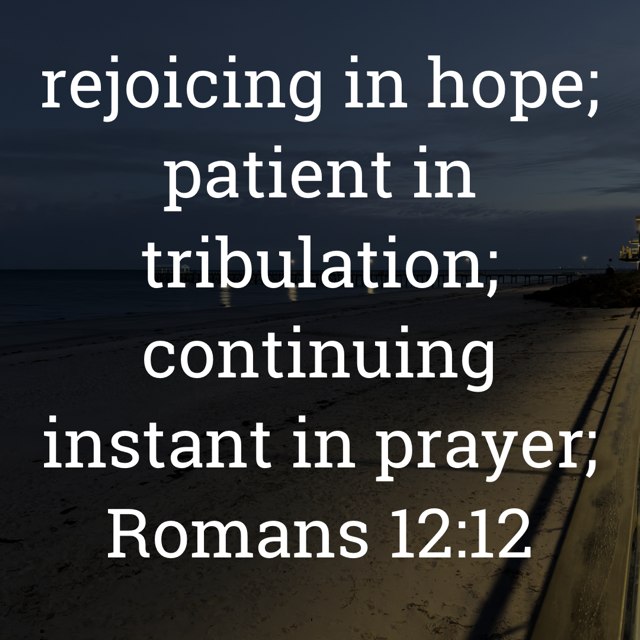
Commentary on Romans 12:12
Romans 12:12 (King James Version): “Rejoicing in hope; patient in tribulation; continuing instant in prayer.”
Romans 12[i] marks a major turning point in Paul’s letter. After eleven chapters of rich doctrinal exposition—human sin, divine mercy, justification by faith, union with Christ, the gift of the Spirit, and God’s sovereign purposes—Paul turns to the practical outworking of the gospel in everyday Christian living. Romans 12 is the lived shape of the gospel. It is theology made visible.
Romans 12:12 sits within a series of short, sharp exhortations that describe the character of a transformed life. These are not isolated moral commands; they are the fruit of the “renewing of your mind” (Romans 12:2, KJV: “And be not conformed to this world: but be ye transformed by the renewing of your mind, that ye may prove what is that good, and acceptable, and perfect, will of God.”). Verse 12 gives three marks of Spirit-shaped perseverance: hope, endurance, and prayer.
1. “Rejoicing in hope”
Exegesis
The verb “rejoicing” is present and active. It is not a passive feeling but a deliberate stance. The object of rejoicing is “hope”—not circumstances, achievements, or personal strength. In Romans, hope is always grounded in God’s promises secured through Christ.
Romans 5:2 (KJV): “By whom also we have access by faith into this grace wherein we stand, and rejoice in hope of the glory of God.”
Hope is future-oriented, but it is not uncertain. It is the confident expectation of God’s final salvation, the renewal of creation, and the full revelation of Christ’s glory. This hope is anchored in the resurrection (Romans 6:4) and sustained by the Spirit (Romans 8:24–25).
Romans 8:24–25 (KJV): “For we are saved by hope: but hope that is seen is not hope: for what a man seeth, why doth he yet hope for? But if we hope for that we see not, then do we with patience wait for it.”
Theological insight
Christian joy is not tied to present ease but to future certainty. It is eschatological joy—joy that looks forward. This joy is not escapist; it strengthens believers to live faithfully in the present.
Application
- Rejoicing in hope means cultivating habits that remind us of God’s promises: reading Scripture, singing truth, and speaking encouragement.
- It means resisting the modern temptation to locate joy in comfort, success, or self-fulfilment.
- It means choosing joy even when feelings lag, because joy is grounded in Christ’s finished work.
2. “Patient in tribulation”
Exegesis
The word “patient” carries the sense of steadfast endurance. “Tribulation” refers to pressure, distress, or affliction. Paul does not say “if tribulation comes” but assumes it as normal for Christian life.
Romans 5:3–4 (KJV): “And not only so, but we glory in tribulations also: knowing that tribulation worketh patience; And patience, experience; and experience, hope.”
Tribulation is not meaningless. God uses it to shape character, deepen faith, and strengthen hope. Romans 8 assures believers that suffering cannot separate them from the love of God in Christ Jesus.
Romans 8:35 (KJV): “Who shall separate us from the love of Christ? shall tribulation, or distress, or persecution, or famine, or nakedness, or peril, or sword?”
Theological insight
Endurance is not stoicism. It is trust. It is the settled conviction that God is sovereign, good, and present even when life is painful. Tribulation becomes a context for spiritual growth rather than spiritual defeat.
Application
- Being patient in tribulation means refusing to interpret hardship as abandonment.
- It means allowing suffering to drive us deeper into God’s character rather than into despair.
- It means supporting one another in hardship, because endurance is often communal.
3. “Continuing instant in prayer”
Exegesis
The phrase “continuing instant” means being devoted, persistent, or constant. Prayer is not an occasional activity but a continual posture. It is the lifeline of hope and endurance.
Romans 12:1–2 frames prayer as part of offering ourselves to God. Romans 8 shows that prayer is sustained by the Spirit, who “maketh intercession for us” (Romans 8:26, KJV: “Likewise the Spirit also helpeth our infirmities: for we know not what we should pray for as we ought: but the Spirit itself maketh intercession for us with groanings which cannot be uttered.”).
Theological insight
Prayer is the expression of dependence. It is the means by which believers draw strength from God, align their desires with his will, and persevere in faith. Persistent prayer is not about quantity but about constancy of heart.
Application
- Continuing instant in prayer means weaving prayer into the rhythms of daily life.
- It means praying when joyful, when suffering, and when uncertain.
- It means praying for others, not only for ourselves.
- It means trusting that God hears, even when answers seem delayed.
Meditation Guide
1. Reflect
Sit quietly and read Romans 12:12 aloud.
12 Rejoicing in hope; patient in tribulation; continuing instant in prayer;
Consider each phrase slowly. Ask:
- Where is my joy grounded?
- How do I respond to tribulation?
- What does my prayer life reveal about my dependence on God?
2. Pray
- Thank God for the hope secured in Christ.
- Ask for endurance in present trials.
- Commit yourself to persistent prayer, trusting the Spirit’s help.
3. Apply
Choose one practical action for today:
- Speak a word of hope to someone.
- Endure a difficulty with conscious trust in God.
- Set aside a specific time for prayer.
[i] Romans 12
King James Version
12 I beseech you therefore, brethren, by the mercies of God, that ye present your bodies a living sacrifice, holy, acceptable unto God, which is your reasonable service.
2 And be not conformed to this world: but be ye transformed by the renewing of your mind, that ye may prove what is that good, and acceptable, and perfect, will of God.
3 For I say, through the grace given unto me, to every man that is among you, not to think of himself more highly than he ought to think; but to think soberly, according as God hath dealt to every man the measure of faith.
4 For as we have many members in one body, and all members have not the same office:
5 So we, being many, are one body in Christ, and every one members one of another.
6 Having then gifts differing according to the grace that is given to us, whether prophecy, let us prophesy according to the proportion of faith;
7 Or ministry, let us wait on our ministering: or he that teacheth, on teaching;
8 Or he that exhorteth, on exhortation: he that giveth, let him do it with simplicity; he that ruleth, with diligence; he that sheweth mercy, with cheerfulness.
9 Let love be without dissimulation. Abhor that which is evil; cleave to that which is good.
10 Be kindly affectioned one to another with brotherly love; in honour preferring one another;
11 Not slothful in business; fervent in spirit; serving the Lord;
12 Rejoicing in hope; patient in tribulation; continuing instant in prayer;
13 Distributing to the necessity of saints; given to hospitality.
14 Bless them which persecute you: bless, and curse not.
15 Rejoice with them that do rejoice, and weep with them that weep.
16 Be of the same mind one toward another. Mind not high things, but condescend to men of low estate. Be not wise in your own conceits.
17 Recompense to no man evil for evil. Provide things honest in the sight of all men.
18 If it be possible, as much as lieth in you, live peaceably with all men.
19 Dearly beloved, avenge not yourselves, but rather give place unto wrath: for it is written, Vengeance is mine; I will repay, saith the Lord.
20 Therefore if thine enemy hunger, feed him; if he thirst, give him drink: for in so doing thou shalt heap coals of fire on his head.
21 Be not overcome of evil, but overcome evil with good.
Discover more from Daily bible verses
Subscribe to get the latest posts sent to your email.


You must be logged in to post a comment.