
Commentary on Genesis 2:3
King James Version (public domain)
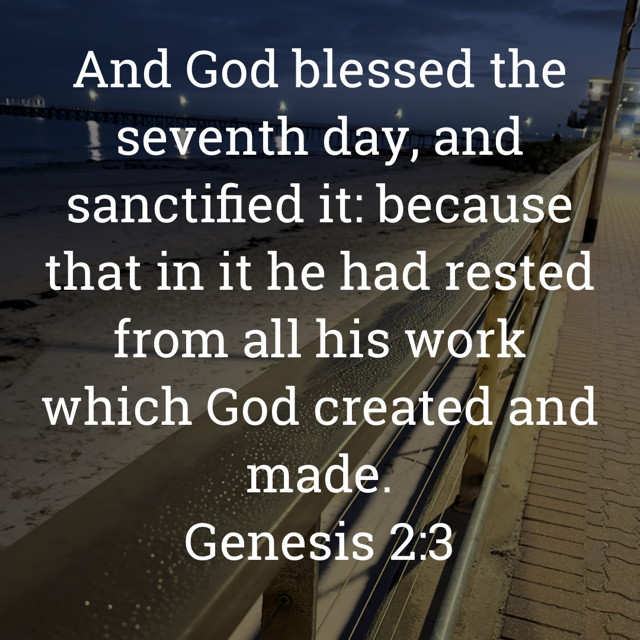
Genesis 2:3 — “And God blessed the seventh day, and sanctified it: because that in it he had rested from all his work which God created and made.”
✦ Concise Takeaway
Genesis 2:3 teaches that God’s blessing and sanctifying of the seventh day is a deliberate act of divine grace, establishing rest as a gift, a rhythm, and a sign pointing to God’s completed work. For modern Christians, this passage invites us to embrace rest as worship, trust, and identity in Christ.
✦ Exegetical Commentary
1. The Structure and Context of Genesis 2
Genesis 2[i] revisits the creation narrative with a more intimate, relational focus. Genesis 1 emphasises God’s cosmic sovereignty; Genesis 2 highlights God’s personal involvement with humanity. Genesis 2:1–3 forms the bridge between the two chapters, concluding the creation week and introducing the sanctity of rest.
Genesis 2:1 — “Thus the heavens and the earth were finished, and all the host of them.” Genesis 2:2 — “And on the seventh day God ended his work which he had made; and he rested on the seventh day from all his work which he had made.”
The repetition of “finished,” “ended,” and “rested” emphasises completeness. God’s rest is not due to fatigue but satisfaction in His perfect work.
2. “God blessed the seventh day”
Blessing in Genesis is always purposeful. When God blesses something, He imbues it with fruitfulness, goodness, and divine favour.
- God blesses creatures to multiply (Genesis 1:22).
- God blesses humanity to flourish (Genesis 1:28).
- Here, God blesses a day.
This is the first time in Scripture that God blesses time itself. The seventh day becomes a channel of divine goodness for humanity.
3. “And sanctified it”
To sanctify is to set apart for holy use. God declares the seventh day distinct from the other six.
This is significant:
- God sanctifies time before He sanctifies places (such as the tabernacle).
- God sanctifies rest before He sanctifies work.
The sanctification of the seventh day establishes a rhythm of life that reflects God’s own pattern.
4. “Because that in it he had rested”
God’s rest is not inactivity but cessation from creative work. It is the divine enjoyment of what He has made.
The Hebrew word shabath means “to cease.” God’s rest is purposeful, reflective, and celebratory.
5. “From all his work which God created and made”
The double expression “created and made” reinforces the completeness of God’s work. Nothing is lacking. Nothing needs revision. God’s rest is grounded in the perfection of His creation.
✦ Theological Teaching
1. Rest is rooted in God’s character
Rest is not a human invention. It is a divine act. God rests, blesses rest, and sanctifies rest. Therefore, rest is not optional for human flourishing.
2. The Sabbath principle is creational, not merely Mosaic
Genesis 2:3 predates the Law of Moses. The Sabbath command in Exodus 20:8–11 is grounded in creation.
Exodus 20:11 — “For in six days the LORD made heaven and earth… and rested the seventh day: wherefore the LORD blessed the sabbath day, and hallowed it.”
The Sabbath principle is woven into the fabric of creation itself.
3. Rest anticipates redemption
The New Testament reveals that Sabbath rest ultimately points to Christ.
Matthew 11:28 — “Come unto me, all ye that labour and are heavy laden, and I will give you rest.” Hebrews 4:9–10 — “There remaineth therefore a rest to the people of God. For he that is entered into his rest, he also hath ceased from his own works, as God did from his.”
Christ is the fulfilment of Sabbath rest. In Him, believers cease striving for righteousness and rest in His finished work.
4. Rest is an act of trust
To rest is to acknowledge that God sustains the world, not us. Rest is a confession of faith.
✦ Meditation Guide
1. Reflect on God’s completed work
Sit quietly and consider the perfection of God’s creation. Let the truth settle: God does not rush. God does not panic. God completes what He begins.
Meditation prompt: “Lord, help me trust that Your work is complete and Your rest is good.”
2. Examine your relationship with rest
Do you treat rest as weakness, indulgence, or inconvenience? Or as worship?
Ask yourself:
- Do I rest in God’s presence?
- Do I trust God enough to stop?
- Do I honour the rhythms God has built into creation?
3. Embrace Christ as your Sabbath
Rest is not merely a day; it is a person. Christ invites you to cease striving.
Meditation prompt: “Jesus, You are my rest. Help me cease from my works and trust in Yours.”
4. Practise Sabbath rhythms
Choose one practical action this week:
- Set aside time for worship and reflection.
- Turn off digital distractions for a period.
- Engage in restorative rest that honours God.
✦ Practical Application for Modern Christian Living
1. Rest as worship
Rest is not laziness. It is obedience. It is a declaration that God is God and we are not.
2. Rest as identity
In a culture driven by productivity, Christians bear witness to a different kingdom by embracing rest.
3. Rest as resistance
Rest resists the idols of busyness, achievement, and self-sufficiency.
4. Rest as community
Families, churches, and communities flourish when rest is honoured. Sabbath rhythms create space for relationships, reflection, and renewal.
5. Rest as hope
Every act of rest anticipates the eternal rest promised in Christ.
[i] Genesis 2
King James Version
2 Thus the heavens and the earth were finished, and all the host of them.
2 And on the seventh day God ended his work which he had made; and he rested on the seventh day from all his work which he had made.
3 And God blessed the seventh day, and sanctified it: because that in it he had rested from all his work which God created and made.
4 These are the generations of the heavens and of the earth when they were created, in the day that the LORD God made the earth and the heavens,
5 And every plant of the field before it was in the earth, and every herb of the field before it grew: for the LORD God had not caused it to rain upon the earth, and there was not a man to till the ground.
6 But there went up a mist from the earth, and watered the whole face of the ground.
7 And the LORD God formed man of the dust of the ground, and breathed into his nostrils the breath of life; and man became a living soul.
8 And the LORD God planted a garden eastward in Eden; and there he put the man whom he had formed.
9 And out of the ground made the LORD God to grow every tree that is pleasant to the sight, and good for food; the tree of life also in the midst of the garden, and the tree of knowledge of good and evil.
10 And a river went out of Eden to water the garden; and from thence it was parted, and became into four heads.
11 The name of the first is Pison: that is it which compasseth the whole land of Havilah, where there is gold;
12 And the gold of that land is good: there is bdellium and the onyx stone.
13 And the name of the second river is Gihon: the same is it that compasseth the whole land of Ethiopia.
14 And the name of the third river is Hiddekel: that is it which goeth toward the east of Assyria. And the fourth river is Euphrates.
15 And the LORD God took the man, and put him into the garden of Eden to dress it and to keep it.
16 And the LORD God commanded the man, saying, Of every tree of the garden thou mayest freely eat:
17 But of the tree of the knowledge of good and evil, thou shalt not eat of it: for in the day that thou eatest thereof thou shalt surely die.
18 And the LORD God said, It is not good that the man should be alone; I will make him an help meet for him.
19 And out of the ground the LORD God formed every beast of the field, and every fowl of the air; and brought them unto Adam to see what he would call them: and whatsoever Adam called every living creature, that was the name thereof.
20 And Adam gave names to all cattle, and to the fowl of the air, and to every beast of the field; but for Adam there was not found an help meet for him.
21 And the LORD God caused a deep sleep to fall upon Adam, and he slept: and he took one of his ribs, and closed up the flesh instead thereof;
22 And the rib, which the LORD God had taken from man, made he a woman, and brought her unto the man.
23 And Adam said, This is now bone of my bones, and flesh of my flesh: she shall be called Woman, because she was taken out of Man.
24 Therefore shall a man leave his father and his mother, and shall cleave unto his wife: and they shall be one flesh.
25 And they were both naked, the man and his wife, and were not ashamed.
Discover more from Daily bible verses
Subscribe to get the latest posts sent to your email.


You must be logged in to post a comment.