
Devotion on Matthew 7:24
Matthew 7
English Standard Version
Judging Others
7 “Judge not, that you be not judged. 2 For with the judgment you pronounce you will be judged, and with the measure you use it will be measured to you. 3 Why do you see the speck that is in your brother’s eye, but do not notice the log that is in your own eye? 4 Or how can you say to your brother, ‘Let me take the speck out of your eye,’ when there is the log in your own eye? 5 You hypocrite, first take the log out of your own eye, and then you will see clearly to take the speck out of your brother’s eye.
6 “Do not give dogs what is holy, and do not throw your pearls before pigs, lest they trample them underfoot and turn to attack you.
Ask, and It Will Be Given
7 “Ask, and it will be given to you; seek, and you will find; knock, and it will be opened to you. 8 For everyone who asks receives, and the one who seeks finds, and to the one who knocks it will be opened. 9 Or which one of you, if his son asks him for bread, will give him a stone? 10 Or if he asks for a fish, will give him a serpent? 11 If you then, who are evil, know how to give good gifts to your children, how much more will your Father who is in heaven give good things to those who ask him!
The Golden Rule
12 “So whatever you wish that others would do to you, do also to them, for this is the Law and the Prophets.
13 “Enter by the narrow gate. For the gate is wide and the way is easy[a] that leads to destruction, and those who enter by it are many. 14 For the gate is narrow and the way is hard that leads to life, and those who find it are few.
A Tree and Its Fruit
15 “Beware of false prophets, who come to you in sheep’s clothing but inwardly are ravenous wolves. 16 You will recognise them by their fruits. Are grapes gathered from thornbushes, or figs from thistles? 17 So, every healthy tree bears good fruit, but the diseased tree bears bad fruit. 18 A healthy tree cannot bear bad fruit, nor can a diseased tree bear good fruit. 19 Every tree that does not bear good fruit is cut down and thrown into the fire. 20 Thus you will recognise them by their fruits.
I Never Knew You
21 “Not everyone who says to me, ‘Lord, Lord,’ will enter the kingdom of heaven, but the one who does the will of my Father who is in heaven. 22 On that day many will say to me, ‘Lord, Lord, did we not prophesy in your name, and cast out demons in your name, and do many mighty works in your name?’ 23 And then will I declare to them, ‘I never knew you; depart from me, you workers of lawlessness.’
Build Your House on the Rock
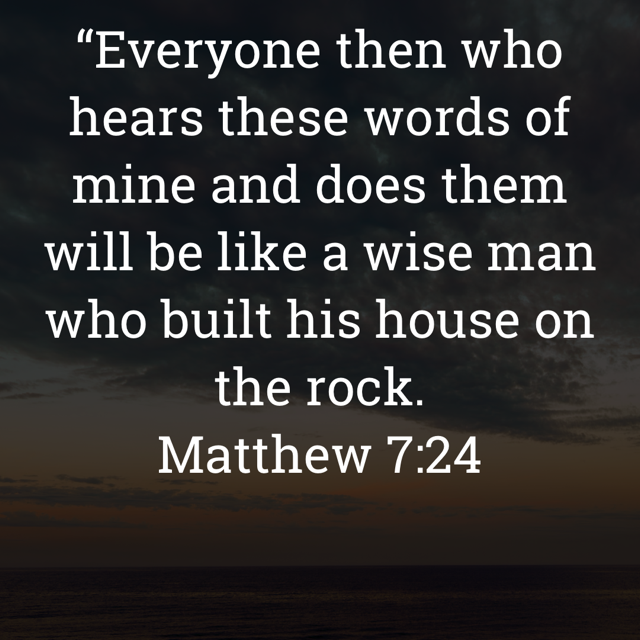
24 “Everyone then who hears these words of mine and does them will be like a wise man who built his house on the rock. 25 And the rain fell, and the floods came, and the winds blew and beat on that house, but it did not fall, because it had been founded on the rock. 26 And everyone who hears these words of mine and does not do them will be like a foolish man who built his house on the sand. 27 And the rain fell, and the floods came, and the winds blew and beat against that house, and it fell, and great was the fall of it.”
The Authority of Jesus
28 And when Jesus finished these sayings, the crowds were astonished at his teaching, 29 for he was teaching them as one who had authority, and not as their scribes.
- Matthew 7:13 Some manuscripts For the way is wide and easy
The ESV® Bible (The Holy Bible, English Standard Version®), © 2001 by Crossway, a publishing ministry of Good News Publishers. ESV Text Edition: 2025.
1. Exegesis
- A concluding call: The opening connective in the English Standard Version presents this verse as a conclusion to Jesus’ teaching. Matthew 7 moves from humble discernment and dependent prayer to the choice between two roads, the testing of fruit, the exposure of empty profession, and the contrast between two builders (Matthew 7:1–27).
- Hearing must become obedience: Both builders hear Jesus’ teaching; their difference is whether they practise it. The English Standard Version preserves the connection between hearing and doing, and the future comparison with a wise builder. Religious knowledge, admiration, and verbal profession cannot replace responsive discipleship (Matthew 7:21–27).
- The foundation: Jesus makes his own teaching decisive. In the immediate illustration, building on rock means hearing his words and obeying them, not merely possessing correct beliefs. Identifying Christ as the believer’s ultimate foundation is a sound wider biblical connection, but it must not erase this passage’s explicit demand for obedience (Matthew 7:24–29; 1 Corinthians 3:11).
- The coming test: Both houses encounter the storm. Present trials provide a legitimate application, but the warning about final judgement immediately before the parable gives its deepest context. Jesus does not promise freedom from suffering; he exposes the ruin of a life that hears without obeying (Matthew 7:21–27).
- The wider Gospel: Jesus’ authority at the sermon’s conclusion anticipates his risen authority and his command that disciples be taught to obey. The speaker is also the Saviour who gives his life for others and secures forgiveness (Matthew 7:28–29; 20:28; 26:28; 28:18–20). This reading follows the Gospel’s emphasis on authority and obedient discipleship.
2. Theological teaching
- Grace is the source, not the reward, of saving faith: God declares sinners righteous through faith alone because of Christ’s righteousness, not their obedience. Matthew’s account of Christ’s saving death supplies the Gospel context; Romans 3:21–28 and Ephesians 2:8–10 explain the distinction between salvation’s basis and its fruit.
- Living faith bears fruit: Obedience is a necessary fruit and evidence of genuine faith, never an additional payment for acceptance with God. Matthew 7:24 confronts the claim that someone can receive Jesus as Saviour while permanently rejecting his authority. The issue is a repentant direction of life, not sinless performance (Matthew 7:15–27; James 2:14–26).
- The Spirit enables active obedience: Sanctification is God’s continuing work of making believers holy. Christians depend on the Holy Spirit while deliberately practising what Christ commands. Dependence does not excuse inactivity, and responsibility does not imply self-sufficiency (Philippians 2:12–13).
- Christ preserves his people: The parable warns against false assurance, not that Christ’s saving work is unreliable. Believers rest in his keeping power and heed his warnings as part of persevering faith. Their security is in Christ, whose grace produces continued trust, repentance, and obedience (John 10:27–29; Matthew 7:24–27).
3. Practical application
- Turn learning into action: After reading Scripture or hearing a sermon, identify one command, one obstacle, and one faithful response. During the week, review what changed rather than merely how much information you gained (Matthew 7:24–27; James 1:22–25).
- Practise humble discernment: Examine your own conduct before correcting someone else. In online discussion, avoid hypocrisy, check claims carefully, and respond with the fairness you would want to receive (Matthew 7:1–6, 12).
- Connect prayer with conduct: Ask the Father for wisdom and help, then act honestly and generously in your work, household, and community. Prayerful dependence should express itself in concrete love for others (Matthew 7:7–12).
- Test your sources of assurance: Church attendance, theological vocabulary, and visible ministry are not substitutes for belonging to Christ. Consider whether his teaching is shaping your choices; bring failures to him in repentance rather than disguising them (Matthew 7:15–23).
- Prepare for difficulty without blaming sufferers: Establish habits of Scripture reading, prayer, worship, and fellowship before pressure intensifies. The storm reaches both houses, so suffering itself is not proof of disobedience, and comfortable circumstances are not proof of faithfulness (Matthew 7:24–27).
4. Meditation Guide
Set aside about ten minutes. Keep the focus on Christ and a concrete response, not on measuring your spiritual worth.
- Read: Slowly read Matthew 7:21–29.
21 “Not everyone who says to me, ‘Lord, Lord,’ will enter the kingdom of heaven, but the one who does the will of my Father who is in heaven. 22 On that day many will say to me, ‘Lord, Lord, did we not prophesy in your name, and cast out demons in your name, and do many mighty works in your name?’ 23 And then will I declare to them, ‘I never knew you; depart from me, you workers of lawlessness.’
24 “Everyone then who hears these words of mine and does them will be like a wise man who built his house on the rock. 25 And the rain fell, and the floods came, and the winds blew and beat on that house, but it did not fall, because it had been founded on the rock. 26 And everyone who hears these words of mine and does not do them will be like a foolish man who built his house on the sand. 27 And the rain fell, and the floods came, and the winds blew and beat against that house, and it fell, and great was the fall of it.”
28 And when Jesus finished these sayings, the crowds were astonished at his teaching, 29 for he was teaching them as one who had authority, and not as their scribes.
Notice what both builders share and what separates them. - Reflect: What does Jesus’ authority require of me? Where have I confused knowing his teaching with obeying it?
- Examine: Identify one area in which comfort, approval, or habit is overriding his instruction. Be specific without treating every weakness as evidence that you do not belong to him.
- Rest and repent: Recall Christ’s saving work and God’s gift of grace (Matthew 20:28; 26:28; Ephesians 2:8–10). Confess the failure, and ask the Holy Spirit to enable a faithful response.
- Respond: Choose one manageable action for today, such as correcting a misleading statement, listening before replying, or giving practical help. Review the outcome tomorrow, thanking God for progress and seeking help where you struggled.
Prayer: Heavenly Father, forgive me for hearing without obeying. Thank you for Jesus, whose saving work is my hope. By your Spirit, help me trust his words, practise them with humility, and remain faithful under pressure. Amen.
Unless otherwise indicated, all Scripture quotations are from the ESV® Bible (The Holy Bible, English Standard Version®), © 2001 by Crossway, a publishing ministry of Good News Publishers. ESV Text Edition: 2025. Used by permission. All rights reserved.
Discover more from Daily bible verses
Subscribe to get the latest posts sent to your email.


You must be logged in to post a comment.