
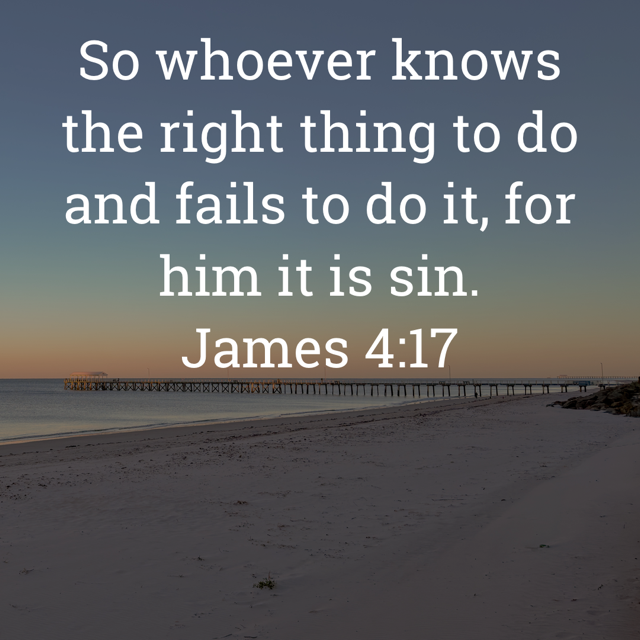
Devotion on James 4:17
James 4
English Standard Version
Warning Against Worldliness
4 What causes quarrels and what causes fights among you? Is it not this, that your passions[a] are at war within you?[b] 2 You desire and do not have, so you murder. You covet and cannot obtain, so you fight and quarrel. You do not have, because you do not ask. 3 You ask and do not receive, because you ask wrongly, to spend it on your passions. 4 You adulterous people![c] Do you not know that friendship with the world is enmity with God? Therefore whoever wishes to be a friend of the world makes himself an enemy of God. 5 Or do you suppose it is to no purpose that the Scripture says, “He yearns jealously over the spirit that he has made to dwell in us”? 6 But he gives more grace. Therefore it says, “God opposes the proud but gives grace to the humble.” 7 Submit yourselves therefore to God. Resist the devil, and he will flee from you. 8 Draw near to God, and he will draw near to you. Cleanse your hands, you sinners, and purify your hearts, you double-minded. 9 Be wretched and mourn and weep. Let your laughter be turned to mourning and your joy to gloom. 10 Humble yourselves before the Lord, and he will exalt you.
11 Do not speak evil against one another, brothers.[d] The one who speaks against a brother or judges his brother, speaks evil against the law and judges the law. But if you judge the law, you are not a doer of the law but a judge. 12 There is only one lawgiver and judge, he who is able to save and to destroy. But who are you to judge your neighbour?
Boasting About Tomorrow
13 Come now, you who say, “Today or tomorrow we will go into such and such a town and spend a year there and trade and make a profit”— 14 yet you do not know what tomorrow will bring. What is your life? For you are a mist that appears for a little time and then vanishes. 15 Instead you ought to say, “If the Lord wills, we will live and do this or that.” 16 As it is, you boast in your arrogance. All such boasting is evil. 17 So whoever knows the right thing to do and fails to do it, for him it is sin.
- James 4:1 Greek pleasures; also verse 3
- James 4:1 Greek in your members
- James 4:4 Or You adulteresses!
- James 4:11 Or brothers and sisters
The ESV® Bible (The Holy Bible, English Standard Version®), © 2001 by Crossway, a publishing ministry of Good News Publishers. ESV Text Edition: 2025.
James 4:17. “So whoever knows the right thing to do and fails to do it, for him it is sin.”
1. Exegesis
The immediate setting. James 4:13–17 challenges merchants who speak as though their future, lifespan, and profit are under their control. James does not condemn planning or business itself. He condemns arrogant independence from God. The right response is to recognise that both continued life and successful activity depend on the Lord’s will. Verse 17 therefore addresses a known duty: acknowledge God’s authority and live accordingly, rather than merely understand the correction.
The argument of the English Standard Version. “So” connects the verse to the preceding warning; it is not an isolated slogan about kindness. “Whoever knows” makes the principle applicable to anyone who recognises a duty. “The right thing to do” concerns morally good action, not simply personal preference. “Fails to do it” identifies omission: sin includes neglecting what God requires, not only committing what he forbids. “For him it is sin” stresses personal accountability; it does not make morality subjective or imply that ignorance makes every wrong action innocent. Connect the verse with submission to God’s will while recognising its wider application to known duties.
The chapter and book. James 4 exposes selfish desires, divided loyalty, pride, and slander, and calls for repentance and humble submission to God (James 4:1–12). Verse 17 brings that submission into action. Across the letter, receiving God’s word must lead to doing it, including practical care for vulnerable people (James 1:21–27; James 2:14–17). The verse’s wider principle grows from its immediate context: knowing God’s will without obeying it is not faithful dependence.
2. Theological Teaching
God’s sovereignty does not cancel responsibility. Our future belongs to God, but his revealed commands still require obedience. Trusting his providence means planning humbly and doing the good before us, not waiting passively for circumstances to change (James 4:13–17).
Grace is the foundation, not the reward, of obedience. James places God’s generosity and life-giving action before his call to faithful living (James 1:17–18; James 4:6–10). In Christian theology, justification is God’s declaration that a sinner is righteous because of Christ’s obedience and saving death, received through faith alone. Good works neither purchase forgiveness nor supplement Christ’s righteousness. They are the fruit and evidence of living faith (Ephesians 2:8–10; James 2:14–17).
Repentance leads to Spirit-dependent action. Recognising neglected duties should move us to humble confession, renewed trust in Christ, and changed conduct, not self-punishment. The Holy Spirit enables obedience, yet dependence on him is no excuse for negligence. Even sincere Christian works remain imperfect and are accepted through Christ, not because they earn God’s favour.
3. Practical Application
The following are illustrative applications, not additional commands detached from Scripture:
- Plans and work: Pray over career, financial, and family decisions. Make responsible plans, but remain willing to revise them rather than treating success as guaranteed (James 4:13–17).
- Relationships and speech: Where you know you have wronged someone, stop excusing the harm and take an appropriate step towards repair. Refuse to repeat slander in conversation or online (James 4:1–3, 11–12).
- Practical care: When a fellow Christian lacks essentials, consider what concrete help you can responsibly offer. Kind words should not replace available, appropriate assistance (James 1:27; James 2:15–17).
- Learning and obedience: After reading Scripture or hearing a sermon, identify one clear duty to practise. More information is not a substitute for a faithful response (James 1:22–25).
A pastoral safeguard: This verse is not a demand to meet every conceivable need or treat every anxious thought as a divine command. Test obligations by Scripture, and use wisdom about responsibilities, opportunities, and genuine limitations. Seek counsel when duties conflict. Do not confuse creaturely limits with wilful neglect, or use those limits to excuse a clearly recognised duty (James 1:5).
4. Meditation Guide
Use these steps slowly, alone or with another Christian. The purpose is attentive, prayerful obedience, not a technique for earning acceptance.
- Read: Read James 4,
4 What causes quarrels and what causes fights among you? Is it not this, that your passions are at war within you? 2 You desire and do not have, so you murder. You covet and cannot obtain, so you fight and quarrel. You do not have, because you do not ask. 3 You ask and do not receive, because you ask wrongly, to spend it on your passions. 4 You adulterous people! Do you not know that friendship with the world is enmity with God? Therefore whoever wishes to be a friend of the world makes himself an enemy of God. 5 Or do you suppose it is to no purpose that the Scripture says, “He yearns jealously over the spirit that he has made to dwell in us”? 6 But he gives more grace. Therefore it says, “God opposes the proud but gives grace to the humble.” 7 Submit yourselves therefore to God. Resist the devil, and he will flee from you. 8 Draw near to God, and he will draw near to you. Cleanse your hands, you sinners, and purify your hearts, you double-minded. 9 Be wretched and mourn and weep. Let your laughter be turned to mourning and your joy to gloom. 10 Humble yourselves before the Lord, and he will exalt you.
11 Do not speak evil against one another, brothers. The one who speaks against a brother or judges his brother, speaks evil against the law and judges the law. But if you judge the law, you are not a doer of the law but a judge. 12 There is only one lawgiver and judge, he who is able to save and to destroy. But who are you to judge your neighbour?
13 Come now, you who say, “Today or tomorrow we will go into such and such a town and spend a year there and trade and make a profit”— 14 yet you do not know what tomorrow will bring. What is your life? For you are a mist that appears for a little time and then vanishes. 15 Instead you ought to say, “If the Lord wills, we will live and do this or that.” 16 As it is, you boast in your arrogance. All such boasting is evil. 17 So whoever knows the right thing to do and fails to do it, for him it is sin.
then return to James 4:13–17.
13 Come now, you who say, “Today or tomorrow we will go into such and such a town and spend a year there and trade and make a profit”— 14 yet you do not know what tomorrow will bring. What is your life? For you are a mist that appears for a little time and then vanishes. 15 Instead you ought to say, “If the Lord wills, we will live and do this or that.” 16 As it is, you boast in your arrogance. All such boasting is evil. 17 So whoever knows the right thing to do and fails to do it, for him it is sin.
Notice how the final verse follows the warning against arrogant planning. - Reflect: Where am I treating tomorrow as mine to control? What clear duty have I recognised but postponed? Is pride, convenience, fear, or resentment behind my inaction?
- Confess and receive: Name a specific omission without excuses. Remember God’s grace to the humble, and rest in Christ rather than your record of achievement (James 4:6–10; Ephesians 2:8–10).
- Respond: Choose one appropriate act of obedience today. Write down what you will do and when. If the situation is uncertain, seek wise counsel rather than making a rash promise.
- Review: At day’s end, ask whether you acted and what you learnt. Give thanks for help received, confess remaining neglect, and continue in dependence on God.
Prayer: Father, forgive my proud plans and the good I have knowingly left undone. Thank you that my hope rests in Jesus Christ, not in my performance. By your Spirit, give me wisdom to recognise my responsibilities, humility to accept my limits, and courage to obey. Help me serve others today and entrust tomorrow to you. Amen.
Unless otherwise indicated, all Scripture quotations are from the ESV® Bible (The Holy Bible, English Standard Version®), © 2001 by Crossway, a publishing ministry of Good News Publishers. ESV Text Edition: 2025. Used by permission. All rights reserved.
Discover more from Daily bible verses
Subscribe to get the latest posts sent to your email.


You must be logged in to post a comment.