
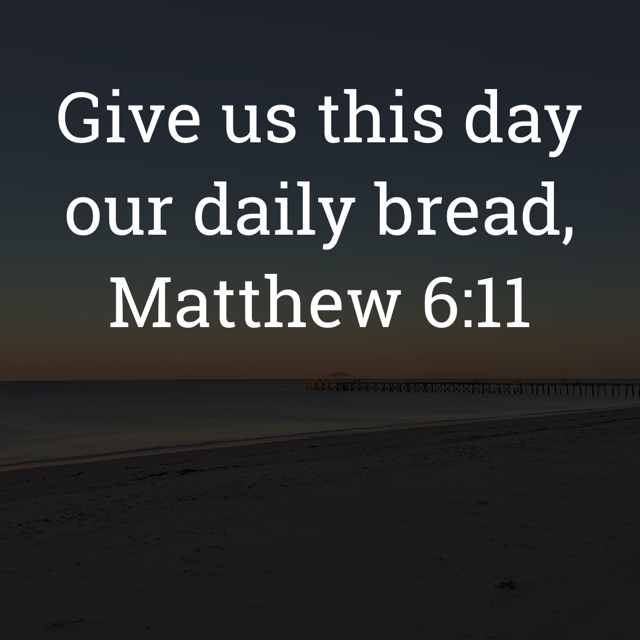
Devotion on Matthew 6:11
Matthew 6
English Standard Version
Giving to the Needy
6 “Beware of practising your righteousness before other people in order to be seen by them, for then you will have no reward from your Father who is in heaven.
2 “Thus, when you give to the needy, sound no trumpet before you, as the hypocrites do in the synagogues and in the streets, that they may be praised by others. Truly, I say to you, they have received their reward. 3 But when you give to the needy, do not let your left hand know what your right hand is doing, 4 so that your giving may be in secret. And your Father who sees in secret will reward you.
The Lord’s Prayer
5 “And when you pray, you must not be like the hypocrites. For they love to stand and pray in the synagogues and at the street corners, that they may be seen by others. Truly, I say to you, they have received their reward. 6 But when you pray, go into your room and shut the door and pray to your Father who is in secret. And your Father who sees in secret will reward you.
7 “And when you pray, do not heap up empty phrases as the Gentiles do, for they think that they will be heard for their many words. 8 Do not be like them, for your Father knows what you need before you ask him. 9 Pray then like this:
“Our Father in heaven,
hallowed be your name.[a]
10 Your kingdom come,
your will be done,[b]
on earth as it is in heaven.
11 Give us this day our daily bread,[c]
12 and forgive us our debts,
as we also have forgiven our debtors.
13 And lead us not into temptation,
but deliver us from evil.[d]
14 For if you forgive others their trespasses, your heavenly Father will also forgive you, 15 but if you do not forgive others their trespasses, neither will your Father forgive your trespasses.
Fasting
16 “And when you fast, do not look gloomy like the hypocrites, for they disfigure their faces that their fasting may be seen by others. Truly, I say to you, they have received their reward. 17 But when you fast, anoint your head and wash your face, 18 that your fasting may not be seen by others but by your Father who is in secret. And your Father who sees in secret will reward you.
Lay Up Treasures in Heaven
19 “Do not lay up for yourselves treasures on earth, where moth and rust[e] destroy and where thieves break in and steal, 20 but lay up for yourselves treasures in heaven, where neither moth nor rust destroys and where thieves do not break in and steal. 21 For where your treasure is, there your heart will be also.
22 “The eye is the lamp of the body. So, if your eye is healthy, your whole body will be full of light, 23 but if your eye is bad, your whole body will be full of darkness. If then the light in you is darkness, how great is the darkness!
24 “No one can serve two masters, for either he will hate the one and love the other, or he will be devoted to the one and despise the other. You cannot serve God and money.[f]
Do Not Be Anxious
25 “Therefore I tell you, do not be anxious about your life, what you will eat or what you will drink, nor about your body, what you will put on. Is not life more than food, and the body more than clothing? 26 Look at the birds of the air: they neither sow nor reap nor gather into barns, and yet your heavenly Father feeds them. Are you not of more value than they? 27 And which of you by being anxious can add a single hour to his span of life?[g] 28 And why are you anxious about clothing? Consider the lilies of the field, how they grow: they neither toil nor spin, 29 yet I tell you, even Solomon in all his glory was not arrayed like one of these. 30 But if God so clothes the grass of the field, which today is alive and tomorrow is thrown into the oven, will he not much more clothe you, O you of little faith? 31 Therefore do not be anxious, saying, ‘What shall we eat?’ or ‘What shall we drink?’ or ‘What shall we wear?’ 32 For the Gentiles seek after all these things, and your heavenly Father knows that you need them all. 33 But seek first the kingdom of God and his righteousness, and all these things will be added to you.
34 “Therefore do not be anxious about tomorrow, for tomorrow will be anxious for itself. Sufficient for the day is its own trouble.
- Matthew 6:9 Or Let your name be kept holy, or Let your name be treated with reverence
- Matthew 6:10 Or Let your kingdom come, let your will be done
- Matthew 6:11 Or our bread for tomorrow
- Matthew 6:13 Or the evil one; some manuscripts add For yours is the kingdom and the power and the glory, forever. Amen
- Matthew 6:19 Or worm; also verse 20
- Matthew 6:24 Greek mammon, a Semitic word for money or possessions
- Matthew 6:27 Or a single cubit to his stature; a cubit was about 18 inches or 45 centimetres
The ESV® Bible (The Holy Bible, English Standard Version®), © 2001 by Crossway, a publishing ministry of Good News Publishers. ESV Text Edition: 2025.
Matthew 6:11. “Give us this day our daily bread,”
1. Exegesis
The setting. Within the Sermon on the Mount, Jesus teaches prayer directed to the Father, not performed for an audience or strengthened by empty repetition (Matthew 6:5–8). The request for bread follows petitions for God’s name, kingdom, and will: bodily needs matter, but belong within a God-centred life (Matthew 6:9–13).
Give us. This is a direct request, not a demand based on personal merit. Daily provision is God’s gift, even when received through labour; the plural pronouns also direct our prayer beyond ourselves.
This day … daily bread. The English Standard Version retains the familiar rendering, while its footnote allows the alternative sense of bread for tomorrow. The Greek adjective epiousios has a disputed meaning, so the translation should not be treated as settling every lexical question. Nevertheless, the main wording and footnote both fit a request for needed provision in dependence on God, rather than guaranteed wealth; Matthew 6:25–34 reinforces this reading.
Bread and the wider biblical story. Bread primarily means food and, by extension, bodily necessities, rather than a hidden reference only to spiritual nourishment. The manna background illustrates renewed dependence (Exodus 16:4–5), while Jesus’ response to temptation shows that obtaining food must never displace obedience to God (Deuteronomy 8:3; Matthew 4:1–4). These connections enrich the petition without changing its primary material meaning.
2. Theological Teaching
God’s providence is personal. The Father knows his children’s needs before they ask; prayer expresses trust, rather than supplying information he lacks (Matthew 6:8, 25–32). Christian teaching recognises him as the source of all good, whose blessing makes both our labour and its fruit useful.
Grace, not entitlement. Daily provision is a free gift, received through lawful means and according to the Father’s wisdom, not earned through impressive prayers. In Matthew’s wider gospel, Jesus is the Saviour from sin, not merely a provider of improved circumstances (Matthew 1:21). Prayer for bread therefore belongs to discipleship under Christ, rather than a technique for securing prosperity.
Trust does not exclude hardship. Jesus joins the Father’s care with the priority of his kingdom, and acknowledges daily trouble (Matthew 6:33–34). Paul’s experience of both hunger and abundance confirms that Christian contentment is sustained by Christ, not by uninterrupted comfort (Philippians 4:11–13). Scarcity is not, by itself, evidence of deficient faith or divine rejection.
3. Practical Application to Modern Christian Living
- Ask specifically, and give thanks. Bring food, rent, essential bills, and employment needs to the Father. At meals, remember that provision is a gift, not simply the product of your effort.
- Plan responsibly without making money your master. Budget, work honestly where able, and seek appropriate assistance. These are applications of dependence through lawful means, not alternatives to it (Matthew 6:24).
- Let shared prayer become practical generosity. Include people facing food insecurity, unemployment, or illness in your prayers. Where possible, offer a meal, contribute to church relief, or help someone access support: prayer for others’ provision belongs alongside discreet giving (Matthew 6:1–4, 11).
- Practise contentment without dismissing distress. Resist comparison and unnecessary accumulation, but do not tell a hungry person merely to worry less. Offer concrete help, and encourage pastoral support; Christ’s strengthening meets believers in need as well as plenty (Philippians 4:11–13).
4. Meditation Guide
Use this short pattern in the morning, and return to it briefly in the evening.
- Read slowly. Read Matthew 6:9–13,
9 Pray then like this:
“Our Father in heaven,
hallowed be your name.
10 Your kingdom come,
your will be done,
on earth as it is in heaven.
11 Give us this day our daily bread,
12 and forgive us our debts,
as we also have forgiven our debtors.
13 And lead us not into temptation,
then Matthew 6:25–34.
25 “Therefore I tell you, do not be anxious about your life, what you will eat or what you will drink, nor about your body, what you will put on. Is not life more than food, and the body more than clothing? 26 Look at the birds of the air: they neither sow nor reap nor gather into barns, and yet your heavenly Father feeds them. Are you not of more value than they? 27 And which of you by being anxious can add a single hour to his span of life? 28 And why are you anxious about clothing? Consider the lilies of the field, how they grow: they neither toil nor spin, 29 yet I tell you, even Solomon in all his glory was not arrayed like one of these. 30 But if God so clothes the grass of the field, which today is alive and tomorrow is thrown into the oven, will he not much more clothe you, O you of little faith? 31 Therefore do not be anxious, saying, ‘What shall we eat?’ or ‘What shall we drink?’ or ‘What shall we wear?’ 32 For the Gentiles seek after all these things, and your heavenly Father knows that you need them all. 33 But seek first the kingdom of God and his righteousness, and all these things will be added to you.
34 “Therefore do not be anxious about tomorrow, for tomorrow will be anxious for itself. Sufficient for the day is its own trouble.
Notice how your needs sit within the Father’s kingdom purposes. - Recognise dependence. Ask: What do I need today? What have I begun treating as my ultimate security?
- Receive with gratitude. Name several ordinary gifts, including the people whose work makes your daily life possible.
- Remember others. Name someone whose basic needs are uncertain. Decide on one realistic act of help.
- Rest, and respond. Entrust tomorrow to the Father, then take today’s next faithful step. In the evening, review what you received, where you struggled, and whom you helped.
Unless otherwise indicated, all Scripture quotations are from the ESV® Bible (The Holy Bible, English Standard Version®), © 2001 by Crossway, a publishing ministry of Good News Publishers. ESV Text Edition: 2025. Used by permission. All rights reserved.
Discover more from Daily bible verses
Subscribe to get the latest posts sent to your email.


You must be logged in to post a comment.