
Devotion on John 14:27
John 14
English Standard Version
I Am the Way, and the Truth, and the Life
14 ”Let not your hearts be troubled. Believe in God;[a] believe also in me. 2 In my Father’s house are many rooms. If it were not so, would I have told you that I go to prepare a place for you?[b] 3 And if I go and prepare a place for you, I will come again and will take you to myself, that where I am you may be also. 4 And you know the way to where I am going.”[c] 5 Thomas said to him, “Lord, we do not know where you are going. How can we know the way?” 6 Jesus said to him, “I am the way, and the truth, and the life. No one comes to the Father except through me. 7 If you had known me, you would have known my Father also.[d] From now on you do know him and have seen him.”
8 Philip said to him, “Lord, show us the Father, and it is enough for us.” 9 Jesus said to him, “Have I been with you so long, and you still do not know me, Philip? Whoever has seen me has seen the Father. How can you say, ‘Show us the Father’? 10 Do you not believe that I am in the Father and the Father is in me? The words that I say to you I do not speak on my own authority, but the Father who dwells in me does his works. 11 Believe me that I am in the Father and the Father is in me, or else believe on account of the works themselves.
12 ”Truly, truly, I say to you, whoever believes in me will also do the works that I do; and greater works than these will he do, because I am going to the Father. 13 Whatever you ask in my name, this I will do, that the Father may be glorified in the Son. 14 If you ask me[e] anything in my name, I will do it.
Jesus Promises the Holy Spirit
15 ”If you love me, you will keep my commandments. 16 And I will ask the Father, and he will give you another Helper,[f] to be with you forever, 17 even the Spirit of truth, whom the world cannot receive, because it neither sees him nor knows him. You know him, for he dwells with you and will be[g] in you.
18 ”I will not leave you as orphans; I will come to you. 19 Yet a little while and the world will see me no more, but you will see me. Because I live, you also will live. 20 In that day you will know that I am in my Father, and you in me, and I in you. 21 Whoever has my commandments and keeps them, he it is who loves me. And he who loves me will be loved by my Father, and I will love him and manifest myself to him.” 22 Judas (not Iscariot) said to him, “Lord, how is it that you will manifest yourself to us, and not to the world?” 23 Jesus answered him, “If anyone loves me, he will keep my word, and my Father will love him, and we will come to him and make our home with him. 24 Whoever does not love me does not keep my words. And the word that you hear is not mine but the Father’s who sent me.
25 ”These things I have spoken to you while I am still with you. 26 But the Helper, the Holy Spirit, whom the Father will send in my name, he will teach you all things and bring to your remembrance all that I have said to you. 27 Peace I leave with you; my peace I give to you. Not as the world gives do I give to you. Let not your hearts be troubled, neither let them be afraid. 28 You heard me say to you, ‘I am going away, and I will come to you.’ If you loved me, you would have rejoiced, because I am going to the Father, for the Father is greater than I. 29 And now I have told you before it takes place, so that when it does take place you may believe. 30 I will no longer talk much with you, for the ruler of this world is coming. He has no claim on me, 31 but I do as the Father has commanded me, so that the world may know that I love the Father. Rise, let us go from here.
- John 14:1 Or You believe in God
- John 14:2 Or In my Father’s house are many rooms; if it were not so, I would have told you; for I go to prepare a place for you
- John 14:4 Some manuscripts Where I am going you know, and the way you know
- John 14:7 Or If you know me, you will know my Father also, or If you have known me, you will know my Father also
- John 14:14 Some manuscripts omit me
- John 14:16 Or Advocate, or Counsellor; also 14:26; 15:26; 16:7
- John 14:17 Some manuscripts and is
The ESV® Bible (The Holy Bible, English Standard Version®), © 2001 by Crossway, a publishing ministry of Good News Publishers. ESV Text Edition: 2025.
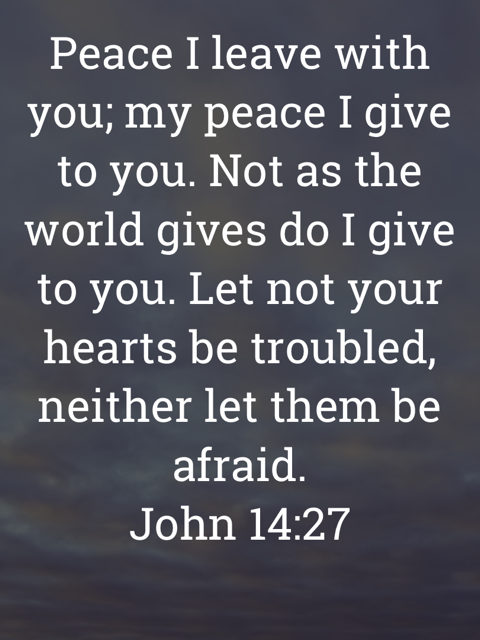
John 14:27. “Peace I leave with you; my peace I give to you. Not as the world gives do I give to you. Let not your hearts be troubled, neither let them be afraid.”
1. Exegesis
Context in John 14
Jesus speaks these words in the upper room, on the night before his crucifixion (John 13:1–17:26). He has just announced his departure and Peter’s denial (John 13:33–38). The disciples are afraid. Jesus opens chapter 14 with a command not to let their hearts be troubled (John 14:1), and he returns to that command in verse 27. The chapter therefore opens and closes with the same concern, and everything between is the basis for it: the Father’s house and the way to it (John 14:2–6), the Father revealed in the Son (John 14:7–11), the promise of answered prayer (John 14:12–14), and the gift of the Holy Spirit (John 14:15–26).
Phrase-by-phrase reading
“Peace I leave with you.” The Greek word for peace, eirene, carries the Hebrew sense of shalom: wholeness, well-being, and right relationship with God. “Leave” is the language of a bequest. Jesus is dying, and he leaves his people an inheritance, as in a will. This is a settled gift, not a passing wish (compare Numbers 6:24–26).
“My peace I give to you.” The shift from “leave” to “give” and the repeated “my” stress that this peace belongs to Christ. It is the peace he has with the Father and the calm he will show in the face of the cross (John 14:30–31; John 16:32–33). The verb “give” is in the present tense, which shows that Christ continues to impart it. The disciples do not produce peace; they receive it.
“Not as the world gives do I give to you.” In John’s Gospel, the world is humanity in rebellion against God (John 1:10; John 15:18–19). The world’s peace is conditional, fragile, and often only the absence of conflict. The world’s greetings and gifts cannot reach the conscience or the fear of death. Christ’s gift differs in source, in permanence, and in power.
“Let not your hearts be troubled, neither let them be afraid.” The commands are grounded in the gifts that precede them. Believers are not told to manufacture calm; they are told to stop yielding to fear because peace has already been given. The word for “afraid” suggests timidity or cowardice, and it appears only here in John’s Gospel.
Connection with the wider book
The peace of John 14:27 is bound to the Spirit, whom Jesus calls the Helper (John 14:16–17, 14:26). It is confirmed by the risen Christ, who greets his disciples with “Peace be with you” (John 20:19–21, 20:26). It is expected to coexist with tribulation (John 16:33). Elsewhere in Scripture, peace with God is the fruit of justification (Romans 5:1), and the peace of God guards the hearts of those who pray (Philippians 4:6–7).
2. Theological Teaching
Peace is the fruit of Christ’s saving work. Christian theology teaches that the root problem is enmity between sinners and a holy God. Christ’s atoning death removes that enmity (Isaiah 53:5; Ephesians 2:13–17; Colossians 1:19–22). Peace in John 14:27 is therefore first an objective reality, reconciliation with God, and only then a subjective experience of calm.
Peace is a gift of grace, not an achievement. The language of bequest and giving fits the Christian emphasis on salvation by grace alone, through faith alone, in Christ alone (Ephesians 2:8–9). The disciples contribute nothing; the Lord gives, and they receive.
Peace is applied by the Holy Spirit. The Father sends the Spirit in the name of the Son (John 14:26), and the Spirit’s fruit includes peace (Galatians 5:22–23). The Trinity is at work: the Father gives the Son, the Son gives his peace, and the Spirit applies it to the heart.
Peace is secure because God preserves his people. Christ’s promise cannot be undone by circumstances, because those the Father has given to the Son will not be lost (John 10:27–30; Romans 8:31–39).
Peace does not remove trouble. Christ promises peace in tribulation, not freedom from it (John 16:33). The Christian life holds both real sorrow and real peace.
3. Practical Application to Modern Christian Living
Anxiety and mental pressure. Many people live with work stress, financial strain, and constant news. Christ’s peace does not replace wise counsel, medical care, or rest, which are good gifts of God. It does give a foundation beneath them: you are known, forgiven, and held by God. Where anxiety is persistent, seek help from a doctor and a pastor without shame.
Fear of the future. Illness, ageing, and death raise deep fears. Because Christ has gone to prepare a place for his people (John 14:2–3), the believer can face loss with hope.
Conflict in the church and home. People who have received Christ’s peace are called to pursue peace with others (Romans 12:18; Matthew 5:9). Forgiveness and honest reconciliation reflect the gospel.
Distraction and false peace. The world offers comfort through entertainment, achievement, and consumption. These soothe for a moment but do not reconcile us to God. Learn to notice where you turn first when you feel unsettled.
Regular means of grace. Peace is nourished by Scripture, prayer, the Lord’s Supper, and fellowship with God’s people (Acts 2:42). Take your worries to God in prayer with thanksgiving (Philippians 4:6–7).
4. Meditation Guide
Preparation (two minutes). Choose a quiet place and put away your phone. Ask the Holy Spirit to open your heart to the Word (Psalm 119:18).
Read. Read John 14:1–31 slowly,
14 ”Let not your hearts be troubled. Believe in God; believe also in me. 2 In my Father’s house are many rooms. If it were not so, would I have told you that I go to prepare a place for you? 3 And if I go and prepare a place for you, I will come again and will take you to myself, that where I am you may be also. 4 And you know the way to where I am going.” 5 Thomas said to him, “Lord, we do not know where you are going. How can we know the way?” 6 Jesus said to him, “I am the way, and the truth, and the life. No one comes to the Father except through me. 7 If you had known me, you would have known my Father also. From now on you do know him and have seen him.”
8 Philip said to him, “Lord, show us the Father, and it is enough for us.” 9 Jesus said to him, “Have I been with you so long, and you still do not know me, Philip? Whoever has seen me has seen the Father. How can you say, ‘Show us the Father’? 10 Do you not believe that I am in the Father and the Father is in me? The words that I say to you I do not speak on my own authority, but the Father who dwells in me does his works. 11 Believe me that I am in the Father and the Father is in me, or else believe on account of the works themselves.
12 ”Truly, truly, I say to you, whoever believes in me will also do the works that I do; and greater works than these will he do, because I am going to the Father. 13 Whatever you ask in my name, this I will do, that the Father may be glorified in the Son. 14 If you ask me anything in my name, I will do it.
Jesus Promises the Holy Spirit
15 ”If you love me, you will keep my commandments. 16 And I will ask the Father, and he will give you another Helper, to be with you forever, 17 even the Spirit of truth, whom the world cannot receive, because it neither sees him nor knows him. You know him, for he dwells with you and will be in you.
18 ”I will not leave you as orphans; I will come to you. 19 Yet a little while and the world will see me no more, but you will see me. Because I live, you also will live. 20 In that day you will know that I am in my Father, and you in me, and I in you. 21 Whoever has my commandments and keeps them, he it is who loves me. And he who loves me will be loved by my Father, and I will love him and manifest myself to him.” 22 Judas (not Iscariot) said to him, “Lord, how is it that you will manifest yourself to us, and not to the world?” 23 Jesus answered him, “If anyone loves me, he will keep my word, and my Father will love him, and we will come to him and make our home with him. 24 Whoever does not love me does not keep my words. And the word that you hear is not mine but the Father’s who sent me.
25 ”These things I have spoken to you while I am still with you. 26 But the Helper, the Holy Spirit, whom the Father will send in my name, he will teach you all things and bring to your remembrance all that I have said to you. 27 Peace I leave with you; my peace I give to you. Not as the world gives do I give to you. Let not your hearts be troubled, neither let them be afraid. 28 You heard me say to you, ‘I am going away, and I will come to you.’ If you loved me, you would have rejoiced, because I am going to the Father, for the Father is greater than I. 29 And now I have told you before it takes place, so that when it does take place you may believe. 30 I will no longer talk much with you, for the ruler of this world is coming. He has no claim on me, 31 but I do as the Father has commanded me, so that the world may know that I love the Father. Rise, let us go from here.
then John 14:27 three times, pausing at each phrase.
27 Peace I leave with you; my peace I give to you. Not as the world gives do I give to you. Let not your hearts be troubled, neither let them be afraid.
27 Peace I leave with you; my peace I give to you. Not as the world gives do I give to you. Let not your hearts be troubled, neither let them be afraid.
27 Peace I leave with you; my peace I give to you. Not as the world gives do I give to you. Let not your hearts be troubled, neither let them be afraid.
Reflect. Consider these questions, one at a time:
- What is troubling my heart today, and have I named it honestly before God?
- What does it mean that Christ “leaves” and “gives” his peace, and that I have not earned it?
- Where have I looked to the world for peace instead of to Christ?
- How does Christ’s own calm before the cross (John 18:1–11) encourage me?
- How does the Spirit’s presence (John 14:16–17) change how I face fear?
Respond in prayer. Confess any unbelief and anxiety. Give thanks for peace with God through Christ (Romans 5:1). Ask for the Spirit’s help to trust, and name one person with whom you can seek peace.
Resolve. Choose one concrete step this week, such as setting aside ten minutes each morning to read John 14, memorising John 14:27, or contacting someone to reconcile.
Closing. Pray the words of Psalm 4:8 as you end, and carry the verse with you through the day.
Psalm 4:8
In peace I will both lie down and sleep;
for you alone, O LORD, make me dwell in safety.
Unless otherwise indicated, all Scripture quotations are from the ESV® Bible (The Holy Bible, English Standard Version®), © 2001 by Crossway, a publishing ministry of Good News Publishers. ESV Text Edition: 2025. Used by permission. All rights reserved.
Discover more from Daily bible verses
Subscribe to get the latest posts sent to your email.


You must be logged in to post a comment.