
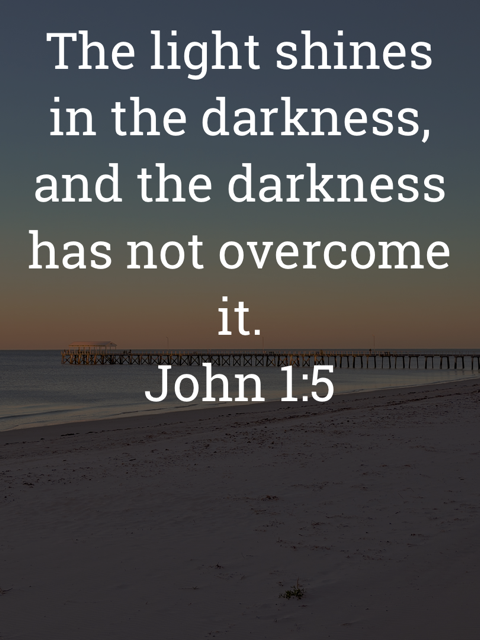
Devotion on John 1:5
John 1
English Standard Version
The Word Became Flesh
1 In the beginning was the Word, and the Word was with God, and the Word was God. 2 He was in the beginning with God. 3 All things were made through him, and without him was not any thing made that was made. 4 In him was life,[a] and the life was the light of men. 5 The light shines in the darkness, and the darkness has not overcome it.
6 There was a man sent from God, whose name was John. 7 He came as a witness, to bear witness about the light, that all might believe through him. 8 He was not the light, but came to bear witness about the light.
9 The true light, which gives light to everyone, was coming into the world. 10 He was in the world, and the world was made through him, yet the world did not know him. 11 He came to his own,[b] and his own people[c] did not receive him. 12 But to all who did receive him, who believed in his name, he gave the right to become children of God, 13 who were born, not of blood nor of the will of the flesh nor of the will of man, but of God.
14 And the Word became flesh and dwelt among us, and we have seen his glory, glory as of the only Son[d] from the Father, full of grace and truth. 15 (John bore witness about him, and cried out, “This was he of whom I said, ‘He who comes after me ranks before me, because he was before me.’”) 16 For from his fullness we have all received, grace upon grace.[e] 17 For the law was given through Moses; grace and truth came through Jesus Christ. 18 No one has ever seen God; God the only Son, who[f] is at the Father’s side,[g] he has made him known.
The Testimony of John the Baptist
19 And this is the testimony of John, when the Jews sent priests and Levites from Jerusalem to ask him, “Who are you?” 20 He confessed, and did not deny, but confessed, “I am not the Christ.” 21 And they asked him, “What then? Are you Elijah?” He said, “I am not.” “Are you the Prophet?” And he answered, “No.” 22 So they said to him, “Who are you? We need to give an answer to those who sent us. What do you say about yourself?” 23 He said, “I am the voice of one crying out in the wilderness, ‘Make straight[h] the way of the Lord,’ as the prophet Isaiah said.”
24 (Now they had been sent from the Pharisees.) 25 They asked him, “Then why are you baptising, if you are neither the Christ, nor Elijah, nor the Prophet?” 26 John answered them, “I baptise with water, but among you stands one you do not know, 27 even he who comes after me, the strap of whose sandal I am not worthy to untie.” 28 These things took place in Bethany across the Jordan, where John was baptising.
Behold, the Lamb of God
29 The next day he saw Jesus coming toward him, and said, “Behold, the Lamb of God, who takes away the sin of the world! 30 This is he of whom I said, ‘After me comes a man who ranks before me, because he was before me.’ 31 I myself did not know him, but for this purpose I came baptising with water, that he might be revealed to Israel.” 32 And John bore witness: “I saw the Spirit descend from heaven like a dove, and it remained on him. 33 I myself did not know him, but he who sent me to baptise with water said to me, ‘He on whom you see the Spirit descend and remain, this is he who baptises with the Holy Spirit.’ 34 And I have seen and have borne witness that this is the Son[i] of God.”
Jesus Calls the First Disciples
35 The next day again John was standing with two of his disciples, 36 and he looked at Jesus as he walked by and said, “Behold, the Lamb of God!” 37 The two disciples heard him say this, and they followed Jesus. 38 Jesus turned and saw them following and said to them, “What are you seeking?” And they said to him, “Rabbi” (which means Teacher), “where are you staying?” 39 He said to them, “Come and you will see.” So they came and saw where he was staying, and they stayed with him that day, for it was about the tenth hour.[j] 40 One of the two who heard John speak and followed Jesus[k] was Andrew, Simon Peter’s brother. 41 He first found his own brother Simon and said to him, “We have found the Messiah” (which means Christ). 42 He brought him to Jesus. Jesus looked at him and said, “You are Simon the son of John. You shall be called Cephas” (which means Peter[l]).
Jesus Calls Philip and Nathanael
43 The next day Jesus decided to go to Galilee. He found Philip and said to him, “Follow me.” 44 Now Philip was from Bethsaida, the city of Andrew and Peter. 45 Philip found Nathanael and said to him, “We have found him of whom Moses in the Law and also the prophets wrote, Jesus of Nazareth, the son of Joseph.” 46 Nathanael said to him, “Can anything good come out of Nazareth?” Philip said to him, “Come and see.” 47 Jesus saw Nathanael coming toward him and said of him, “Behold, an Israelite indeed, in whom there is no deceit!” 48 Nathanael said to him, “How do you know me?” Jesus answered him, “Before Philip called you, when you were under the fig tree, I saw you.” 49 Nathanael answered him, “Rabbi, you are the Son of God! You are the King of Israel!” 50 Jesus answered him, “Because I said to you, ‘I saw you under the fig tree,’ do you believe? You will see greater things than these.” 51 And he said to him, “Truly, truly, I say to you,[m] you will see heaven opened, and the angels of God ascending and descending on the Son of Man.”
- John 1:4 Or was not any thing made. That which has been made was life in him
- John 1:11 Greek to his own things; that is, to his own domain, or to his own people
- John 1:11 People is implied in Greek
- John 1:14 Or only One, or unique One
- John 1:16 Or grace in place of grace
- John 1:18 Or seen God; the only God who; some manuscripts seen God; the only Son, who (see verse 14)
- John 1:18 Greek in the bosom of the Father
- John 1:23 Or crying out, ‘In the wilderness make straight
- John 1:34 Some manuscripts the Chosen One
- John 1:39 That is, about 4 p.m.
- John 1:40 Greek him
- John 1:42 Cephas and Peter are from the word for rock in Aramaic and Greek, respectively
- John 1:51 The Greek for you is plural; twice in this verse
The ESV® Bible (The Holy Bible, English Standard Version®), © 2001 by Crossway, a publishing ministry of Good News Publishers. ESV Text Edition: 2025.
“The light shines in the darkness, and the darkness has not overcome it.” — John 1:5, English Standard Version.
1. Exegesis of the Verse
The light is personal. John 1:5 belongs to the opening account of the eternal Word, who is with God, is God, creates all things, and possesses life (John 1:1–4). The light is therefore not positive thinking or an independent spiritual force: it is the life and revelation given through Jesus Christ. The Word becomes flesh and makes the Father known (John 1:14–18).
The darkness is moral and spiritual. The world fails to recognise its Creator, and his own people reject him (John 1:9–11). John 3:19–21 explains that this resistance involves love of evil and avoidance of exposure, not merely lack of information. Darkness describes human alienation from God; it should not be equated with every experience of sadness or uncertainty.
The light continues to shine. The present-tense verb presents the shining as ongoing, rather than as a light that appeared and then disappeared. The wording directs attention to Christ’s enduring activity, although tense alone does not establish a complete doctrine of his victory.
The darkness has not overcome it. The English Standard Version foregrounds the failure of darkness to defeat the light. The underlying Greek verb can also refer to grasping or understanding. John 12:35 uses the same verb for darkness overtaking someone, supporting the conflict sense here; John 1:10–11 also supplies the theme of failed recognition. Both themes fit the Gospel, but this commentary follows the English Standard Version’s primary emphasis without claiming that a deliberate double meaning is certain.
Within John 1, the light’s arrival leads to witness, God-given new birth, and disciples following Jesus (John 1:6–8, 12–13, 35–49). Across the Gospel, his death judges the world’s ruler, and his resurrection confirms that rejection has not defeated him (John 12:31–33; John 20:24–31). John 1:5 anticipates this outcome; it does not narrate the cross and resurrection by itself.
2. Theological Teaching
Christ is God’s decisive revelation. The Son is fully divine and truly human, not a created rival to darkness. Because everything created owes its existence to him, evil is not an equal, eternal power alongside God (John 1:1–3, 14–18).
Salvation begins with God’s grace. John joins receiving Christ through faith with being born of God (John 1:12–13). Christian theology understands this new birth as God’s sovereign renewal, not the achievement of ancestry, determination, or moral improvement. Natural understanding cannot bring fallen people to saving knowledge of Christ without God’s renewing help. This supports dependence on grace.
Grace produces a changed life. Believers are accepted through faith in the Son, not through earning their way into the light; coming into the light also exposes and transforms their conduct (John 3:16–21). Christ’s victory grounds confidence amid trouble, not a promise of comfortable circumstances or the salvation of everyone irrespective of faith (John 16:33; John 3:18).
3. Practical Application to Modern Christian Living
Bring hidden conduct into the light. Examine dishonesty at work, resentment at home, and harmful online habits. Confess a specific sin, seek appropriate accountability, and take one concrete step of repentance. Exposure is not the enemy of grace; concealment resists the truth (John 3:19–21).
Practise hopeful endurance. When news, hostility, or personal loss feels overwhelming, return to Christ’s victory rather than measuring his faithfulness by your mood or circumstances (John 16:33). Pray honestly, remain connected to your church, and accept practical support. Do not interpret another person’s grief or mental distress as proof of spiritual darkness.
Witness without superiority. John the Baptist points away from himself towards Jesus, and the first disciples invite others to meet him (John 1:6–8, 35–46). Speak truthfully and gently, serve neighbours, and resist contempt in public debate. Remember that you also depend on God’s grace, rather than treating people outside the church as enemies to defeat.
4. Meditation Guide
Set aside a quiet moment with your Bible. Meditation means attentive reflection on God’s written Word, not emptying your mind or searching for a private revelation.
Read. Read John 1:1–18,
1 In the beginning was the Word, and the Word was with God, and the Word was God. 2 He was in the beginning with God. 3 All things were made through him, and without him was not any thing made that was made. 4 In him was life, and the life was the light of men. 5 The light shines in the darkness, and the darkness has not overcome it.
6 There was a man sent from God, whose name was John. 7 He came as a witness, to bear witness about the light, that all might believe through him. 8 He was not the light, but came to bear witness about the light.
9 The true light, which gives light to everyone, was coming into the world. 10 He was in the world, and the world was made through him, yet the world did not know him. 11 He came to his own, and his own people did not receive him. 12 But to all who did receive him, who believed in his name, he gave the right to become children of God, 13 who were born, not of blood nor of the will of the flesh nor of the will of man, but of God.
14 And the Word became flesh and dwelt among us, and we have seen his glory, glory as of the only Son from the Father, full of grace and truth. 15 (John bore witness about him, and cried out, “This was he of whom I said, ‘He who comes after me ranks before me, because he was before me.’”) 16 For from his fullness we have all received, grace upon grace. 17 For the law was given through Moses; grace and truth came through Jesus Christ. 18 No one has ever seen God; God the only Son, who is at the Father’s side, he has made him known.
then John 1:5 slowly.
5 The light shines in the darkness, and the darkness has not overcome it.
Notice who the light is, where it shines, and what darkness fails to do.
Reflect. What changes when I remember that the light is the eternal Son rather than my own strength? Where am I avoiding the exposure described in John 3:19–21?
Receive. Consider John 1:12–13 and John 16:33. Let God-given belonging and Christ’s victory, rather than your performance, shape your response.
Pray. Father, thank you for making yourself known through your Son. Expose what I hide, renew my trust, and help me follow Jesus in truth and love. Give me courage to endure hardship and humility to point others towards him. Amen.
Respond. Choose one action today: correct a dishonest statement, seek reconciliation, or contact someone who needs encouragement. Return to John 1:5 in the evening and reflect on how the passage guided your choices.
Unless otherwise indicated, all Scripture quotations are from the ESV® Bible (The Holy Bible, English Standard Version®), © 2001 by Crossway, a publishing ministry of Good News Publishers. ESV Text Edition: 2025. Used by permission. All rights reserved.
Discover more from Daily bible verses
Subscribe to get the latest posts sent to your email.


You must be logged in to post a comment.