
Commentary on Isaiah 12:2
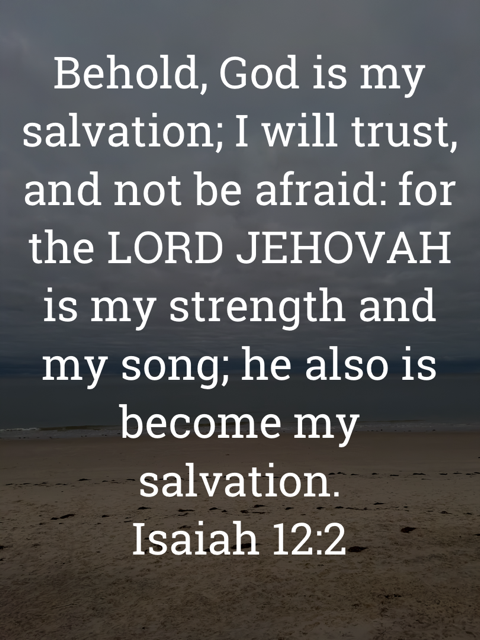
Isaiah 12:2 (King James Version): “Behold, God is my salvation; I will trust, and not be afraid: for the LORD JEHOVAH is my strength and my song; he also is become my salvation.”
1. Concise Takeaway
Isaiah 12:2 proclaims that the believer’s confidence, courage, joy, and strength rest entirely in the saving work and character of the Lord. It calls modern Christians to a life shaped by trust, gratitude, and fearless obedience grounded in God’s completed and ongoing salvation.
2. Literary and Biblical Context
Isaiah 12[i] is a short hymn of praise concluding the larger section of Isaiah 1–12, which alternates between judgement and hope. After warnings of divine discipline, Isaiah 11 promises a coming Davidic king, the Messiah, who will rule with righteousness and gather a redeemed people. Isaiah 12 responds to that promise with worship.
Isaiah 12:1 (KJV): “And in that day thou shalt say, O LORD, I will praise thee: though thou wast angry with me, thine anger is turned away, and thou comfortedst me.”
This sets the tone: God’s righteous anger has been replaced by comfort through his saving action. Verse 2 then expands this theme by grounding the believer’s confidence in God’s character and work.
3. Exegetical Analysis of Isaiah 12:2
3.1 “Behold, God is my salvation”
The verse begins with “Behold”—a call to attention. Isaiah wants the reader to stop and see something astonishing: salvation is not merely something God gives; God himself is the salvation of his people.
This echoes earlier declarations:
Exodus 15:2 (KJV): “The LORD is my strength and song, and he is become my salvation.”
Isaiah intentionally draws on the language of the Exodus, the foundational act of redemption in the Old Testament. As God saved Israel from Egypt, so he will save his people through the Messiah.
3.2 “I will trust, and not be afraid”
Trust is the appropriate response to God’s saving presence. Fear is displaced not by inner resolve but by confidence in God’s character.
This anticipates the New Testament’s teaching:
Romans 8:31 (KJV): “What shall we then say to these things? If God be for us, who can be against us?”
Fear is not denied; it is overcome by a greater reality: God is for his people.
3.3 “For the LORD JEHOVAH is my strength and my song”
The double divine name “LORD JEHOVAH” (literally “Yah Yahweh”) intensifies the emphasis on God’s covenant faithfulness. Isaiah is not speaking of a generic deity but of the God who binds himself to his people.
Strength and song belong together. God not only empowers his people; he gives them joy. Salvation produces doxology.
3.4 “He also is become my salvation”
The verse ends where it began: salvation is personal, relational, and centred on God himself. This is not merely deliverance from danger but reconciliation with God.
For Christians, this finds its fulfilment in Jesus Christ:
Matthew 1:21 (KJV): “And she shall bring forth a son, and thou shalt call his name JESUS: for he shall save his people from their sins.”
Jesus embodies the truth of Isaiah 12:2. In him, God becomes our salvation.
4. Theological Themes
4.1 Salvation is God-centred
Isaiah does not say, “God gives me salvation,” but “God is my salvation.” Christian theology rightly emphasises that salvation is entirely God’s work—planned by the Father, accomplished by the Son, applied by the Spirit.
4.2 Trust replaces fear
Fear is a universal human experience. Isaiah teaches that trust in God’s saving character displaces fear. This is not stoicism but faith.
4.3 Joy flows from salvation
God is not only strength but also song. Salvation produces worship, gratitude, and delight.
4.4 Salvation is both present and future
Isaiah speaks as though salvation is already accomplished, even though its fulfilment lies ahead. This anticipates the Christian experience of the “already and not yet.”
5. Application to Modern Christian Living
5.1 Live with confidence grounded in God’s character
Christians today face uncertainty, anxiety, and cultural pressures. Isaiah 12:2 calls believers to anchor their confidence not in circumstances but in the unchanging God who saves.
5.2 Replace fear with trust
Fear often arises from misplaced trust. Isaiah invites believers to rehearse God’s saving acts—especially the cross and resurrection—to cultivate courage.
5.3 Let salvation shape your worship
If God is your salvation, then worship becomes a natural response. Singing, praying, and gathering with God’s people are not duties but expressions of joy.
5.4 Remember that salvation is personal
Isaiah speaks in the first person: “my salvation… my strength… my song.” Faith is not merely doctrinal assent; it is personal trust in the living God.
5.5 Witness through confidence and joy
A fearful, joyless Christianity contradicts Isaiah 12. A confident, grateful believer bears witness to the God who saves.
6. Meditation Guide
6.1 Reflect
Read Isaiah 12 slowly.
12 And in that day thou shalt say, O LORD, I will praise thee: though thou wast angry with me, thine anger is turned away, and thou comfortedst me.
2 Behold, God is my salvation; I will trust, and not be afraid: for the LORD JEHOVAH is my strength and my song; he also is become my salvation.
3 Therefore with joy shall ye draw water out of the wells of salvation.
4 And in that day shall ye say, Praise the LORD, call upon his name, declare his doings among the people, make mention that his name is exalted.
5 Sing unto the LORD; for he hath done excellent things: this is known in all the earth.
6 Cry out and shout, thou inhabitant of Zion: for great is the Holy One of Israel in the midst of thee.
Consider how God has shown himself to be your salvation. Ask:
- Where am I tempted to trust in myself rather than God?
- What fears dominate my thinking?
- How has God been my strength and song in the past?
6.2 Pray
Use the words of Isaiah 12:2 as a prayer: “LORD, you are my salvation. Help me trust and not be afraid. Be my strength and my song.”
6.3 Sing
Choose a hymn or psalm that celebrates God’s salvation. Singing reinforces trust and joy.
6.4 Act
Identify one area of life where fear has been holding you back. Take one concrete step of obedience grounded in trust.
[i] Isaiah 12
King James Version
12 And in that day thou shalt say, O LORD, I will praise thee: though thou wast angry with me, thine anger is turned away, and thou comfortedst me.
2 Behold, God is my salvation; I will trust, and not be afraid: for the LORD JEHOVAH is my strength and my song; he also is become my salvation.
3 Therefore with joy shall ye draw water out of the wells of salvation.
4 And in that day shall ye say, Praise the LORD, call upon his name, declare his doings among the people, make mention that his name is exalted.
5 Sing unto the LORD; for he hath done excellent things: this is known in all the earth.
6 Cry out and shout, thou inhabitant of Zion: for great is the Holy One of Israel in the midst of thee.
Discover more from Daily bible verses
Subscribe to get the latest posts sent to your email.


You must be logged in to post a comment.