
Commentary on John 15:2
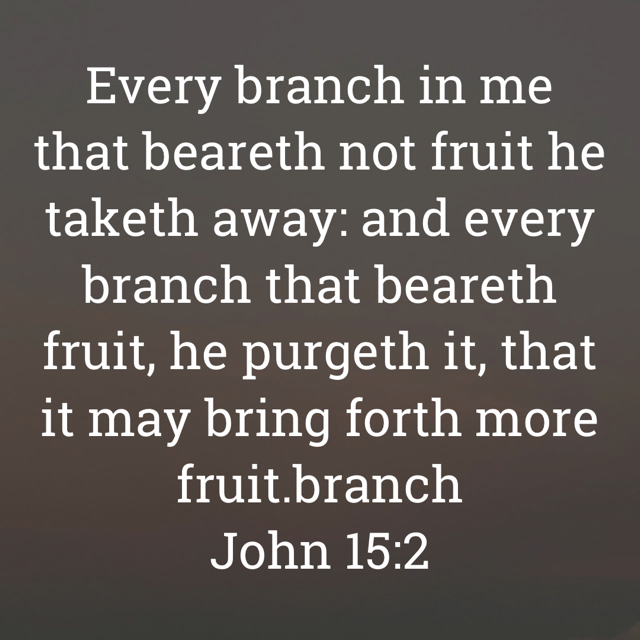
John 15:2 (King James Version): “Every branch in me that beareth not fruit he taketh away: and every branch that beareth fruit, he purgeth it, that it may bring forth more fruit.”
1. Immediate Context within John 15
John 15[i] sits within Jesus’ Farewell Discourse (John chapters 13 to 17), spoken on the night before his crucifixion. Jesus prepares his disciples for life without his physical presence. He gives them a vision of union with him, dependence upon him, and fruitfulness through him.
The chapter opens with the well‑known image of the vine and the branches:
John 15:1 (KJV): “I am the true vine, and my Father is the husbandman.”
Jesus identifies himself as the true vine, the source of life. The Father is the gardener who tends the vine. The disciples are the branches. Fruitfulness is the expected outcome of genuine union with Christ.
2. Exegetical Analysis of John 15:2
2.1 “Every branch in me that beareth not fruit he taketh away”
This phrase raises pastoral and theological questions. What does it mean for a branch to be “in” Christ yet bear no fruit? The language reflects covenantal belonging rather than guaranteed salvation. Judas is the clearest example in the immediate context: outwardly among the disciples, yet inwardly not united to Christ.
The Father “taketh away” such branches. The verb can mean “remove,” “lift up,” or “take away.” In this context, removal fits the flow of the passage, especially when compared with verse 6:
John 15:6 (KJV): “If a man abide not in me, he is cast forth as a branch, and is withered; and men gather them, and cast them into the fire, and they are burned.”
The image is sobering. Fruitlessness reveals a lack of true abiding. The Father’s action is decisive and just.
2.2 “And every branch that beareth fruit, he purgeth it”
The Father’s care extends not only to removing fruitless branches but also to pruning fruitful ones. “Purgeth” means “prunes,” “cleanses,” or “purifies.” The same root appears in verse 3:
John 15:3 (KJV): “Now ye are clean through the word which I have spoken unto you.”
Pruning is not punishment. It is purposeful, loving, and necessary. The Father removes what hinders growth, trims what is excessive, and cuts back what is diseased or misdirected.
2.3 “That it may bring forth more fruit”
The Father’s goal is increased fruitfulness. Fruit in John 15 includes obedience (John 15:10), love (John 15:12), joy (John 15:11), answered prayer (John 15:7), and witness to the world (John 15:27). Fruit is the outward evidence of inward union with Christ.
3. Theological Themes
3.1 Union with Christ
Fruitfulness flows from abiding in Christ. Union is the root; fruit is the result. This is a central Christian theme: salvation is not merely a legal declaration but a living union with the risen Christ.
3.2 The Father’s Sovereign Care
The Father is the gardener. He acts with wisdom, purpose, and love. His pruning is never random. His removal of fruitless branches is never unjust.
3.3 The Necessity of Fruit
Fruit does not save, but it demonstrates salvation. The Christian tradition affirms that justification is by faith alone, yet the faith that justifies is never alone. Fruit is the inevitable evidence of genuine faith.
3.4 The Pain and Purpose of Pruning
Pruning is often uncomfortable. The Father may remove comforts, expose sin, or redirect desires. Yet pruning is always for our good and his glory.
4. Practical Application for Modern Christian Living
4.1 Examine Your Fruit
Ask: What fruit is the Spirit producing in my life? Consider the fruit of the Spirit (Galatians 5:22 to 23). Fruitlessness is a warning sign. Fruitfulness is a sign of grace.
4.2 Embrace the Father’s Pruning
Pruning may come through hardship, correction, or conviction. Rather than resisting, receive it as the Father’s loving work.
Hebrews 12:11 (KJV): “Now no chastening for the present seemeth to be joyous, but grievous: nevertheless afterward it yieldeth the peaceable fruit of righteousness unto them which are exercised thereby.”
4.3 Abide in Christ Daily
Abiding is not passive. It involves:
- reading and meditating on Scripture
- prayer
- obedience
- fellowship with believers
- resisting sin
- resting in Christ’s finished work
4.4 Expect Growth, Not Perfection
Fruit grows gradually. The Father is patient. Christians should be patient with themselves and with others.
4.5 Witness to the World
Fruitfulness is missional. A fruitful life displays Christ to a watching world.
5. Meditation Guide
5.1 Reflect
Sit quietly and read John 15:1 to 11 slowly. Ask: Where do I see the Father pruning me? Where do I resist his work?
5.2 Pray
“Father, prune what hinders my growth. Make me more like Christ. Help me abide in him.”
5.3 Apply
Choose one area of life where you sense the Father’s pruning. Respond with obedience, trust, and gratitude.
5.4 Rest
Remember that pruning is a sign of the Father’s love, not his displeasure.
[i] John 15
King James Version
15 I am the true vine, and my Father is the husbandman.
2 Every branch in me that beareth not fruit he taketh away: and every branch that beareth fruit, he purgeth it, that it may bring forth more fruit.
3 Now ye are clean through the word which I have spoken unto you.
4 Abide in me, and I in you. As the branch cannot bear fruit of itself, except it abide in the vine; no more can ye, except ye abide in me.
5 I am the vine, ye are the branches: He that abideth in me, and I in him, the same bringeth forth much fruit: for without me ye can do nothing.
6 If a man abide not in me, he is cast forth as a branch, and is withered; and men gather them, and cast them into the fire, and they are burned.
7 If ye abide in me, and my words abide in you, ye shall ask what ye will, and it shall be done unto you.
8 Herein is my Father glorified, that ye bear much fruit; so shall ye be my disciples.
9 As the Father hath loved me, so have I loved you: continue ye in my love.
10 If ye keep my commandments, ye shall abide in my love; even as I have kept my Father’s commandments, and abide in his love.
11 These things have I spoken unto you, that my joy might remain in you, and that your joy might be full.
12 This is my commandment, That ye love one another, as I have loved you.
13 Greater love hath no man than this, that a man lay down his life for his friends.
14 Ye are my friends, if ye do whatsoever I command you.
15 Henceforth I call you not servants; for the servant knoweth not what his lord doeth: but I have called you friends; for all things that I have heard of my Father I have made known unto you.
16 Ye have not chosen me, but I have chosen you, and ordained you, that ye should go and bring forth fruit, and that your fruit should remain: that whatsoever ye shall ask of the Father in my name, he may give it you.
17 These things I command you, that ye love one another.
18 If the world hate you, ye know that it hated me before it hated you.
19 If ye were of the world, the world would love his own: but because ye are not of the world, but I have chosen you out of the world, therefore the world hateth you.
20 Remember the word that I said unto you, The servant is not greater than his lord. If they have persecuted me, they will also persecute you; if they have kept my saying, they will keep yours also.
21 But all these things will they do unto you for my name’s sake, because they know not him that sent me.
22 If I had not come and spoken unto them, they had not had sin: but now they have no cloak for their sin.
23 He that hateth me hateth my Father also.
24 If I had not done among them the works which none other man did, they had not had sin: but now have they both seen and hated both me and my Father.
25 But this cometh to pass, that the word might be fulfilled that is written in their law, They hated me without a cause.
26 But when the Comforter is come, whom I will send unto you from the Father, even the Spirit of truth, which proceedeth from the Father, he shall testify of me:
27 And ye also shall bear witness, because ye have been with me from the beginning.
Discover more from Daily bible verses
Subscribe to get the latest posts sent to your email.


You must be logged in to post a comment.