
Commentary on Psalm 42:11
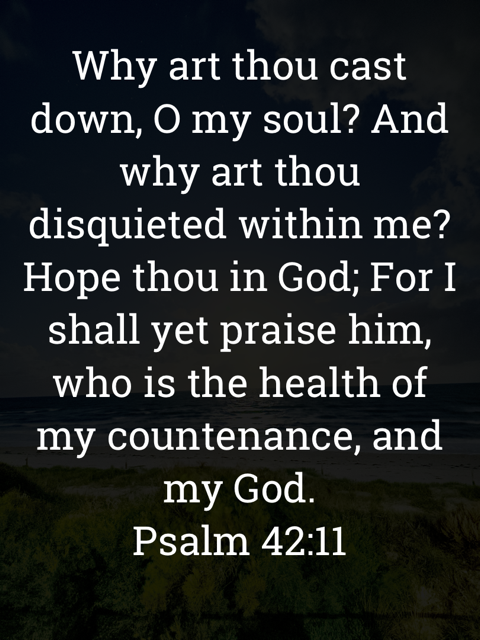
“Why art thou cast down, O my soul? and why art thou disquieted within me? hope thou in God: for I shall yet praise him, who is the health of my countenance, and my God.” (Psalm 42:11, King James Version)
1. Concise Takeaway
Psalm 42:11 teaches that the believer’s deepest hope is not found in changing circumstances but in the unchanging character of God himself, who restores, steadies, and sustains the soul. The psalmist models honest lament, disciplined self‑address, and determined trust.
2. Exegetical Commentary
The structure of Psalm 42
Psalm 42[i] forms the first half of a two‑part lament (Psalm 42–43). It is written by the sons of Korah, likely for corporate worship, yet it is deeply personal. The psalm alternates between lament and hope, with verse 11 repeating the refrain found in Psalm 42:5 and again in Psalm 43:5.
“Why art thou cast down, O my soul?”
The psalmist speaks to his own inner life. The phrase “cast down” conveys a picture of being bowed low, depressed, or weighed down. Earlier in the psalm he has described his tears as his food (Psalm 42:3: “My tears have been my meat day and night, while they continually say unto me, Where is thy God?”), and he remembers joyful worship now replaced by isolation (Psalm 42:4: “When I remember these things, I pour out my soul in me…”).
The psalmist does not deny his distress. He names it. This is biblical honesty.
“And why art thou disquieted within me?”
“Disquieted” suggests inner turmoil, agitation, or restlessness. The psalmist’s circumstances include distance from the temple (Psalm 42:6), taunts from enemies (Psalm 42:10), and a sense of divine absence (Psalm 42:9: “I will say unto God my rock, Why hast thou forgotten me?”). His inner world reflects these pressures.
Yet he interrogates his own despair. This is not self‑condemnation but spiritual self‑examination.
“Hope thou in God”
This is the turning point. The psalmist commands his soul to hope. Hope in Scripture is not wishful thinking but confident expectation grounded in God’s covenant faithfulness. The psalmist does not yet feel restored, but he chooses trust.
This is the heart of Christian spirituality: faith resting on God’s character, not on emotional stability.
“For I shall yet praise him”
The psalmist anticipates future worship. “Yet” is a word of defiant faith. Circumstances have not changed, but his posture has. He believes that God will act, and that praise will again rise from his lips.
“Who is the health of my countenance, and my God”
The phrase “health of my countenance” can also be translated “the salvation of my face.” God is the one who lifts the face that has fallen in sorrow. He restores joy, dignity, and confidence.
The psalm ends not with resolution but with relationship: “my God.” This is covenant language. The psalmist’s hope is grounded in belonging.
3. Theological Insights
1. Honest lament is part of faithful Christian living
The psalmist does not pretend. He brings his anguish before God. This aligns with the Christian understanding that the Christian life is lived coram Deo — before the face of God — with integrity.
2. Faith includes speaking truth to oneself
The psalmist preaches to his own soul. This is not self‑help; it is self‑shepherding. The believer must remind themselves of God’s promises when emotions cloud perception.
3. Hope is anchored in God’s character, not circumstances
The psalmist’s situation has not improved, yet he hopes. This reflects the doctrine of God’s immutability: God does not change, and therefore hope is secure.
4. God himself is the believer’s salvation
The psalmist does not merely seek deliverance; he seeks God. This anticipates the New Testament fulfilment in Jesus Christ, who is our salvation and our peace.
4. Meditation Guide for Modern Christian Living
A. Reflect
- Where do you feel “cast down” or “disquieted” today?
- What circumstances tempt you to believe that God is distant?
- What truths about God’s character do you need to speak to your soul?
B. Pray
Use the psalmist’s pattern:
- Name your sorrow honestly.
- Ask God to steady your heart.
- Declare your hope in him even before you feel it.
C. Apply
- Practise spiritual self‑talk grounded in Scripture.
When anxiety rises, speak God’s promises aloud. - Commit to future praise.
Even if you cannot praise with joy today, commit to praise tomorrow. - Seek God, not merely relief.
Let your prayer be not only “change my circumstances” but “be my God in the midst of them.”
D. Rest
Remember that God is “the health of your countenance.” He lifts your face. He restores your joy. He is your God.
[i] Psalm 42
King James Version
42 As the hart panteth after the water brooks, so panteth my soul after thee, O God.
2 My soul thirsteth for God, for the living God: when shall I come and appear before God?
3 My tears have been my meat day and night, while they continually say unto me, Where is thy God?
4 When I remember these things, I pour out my soul in me: for I had gone with the multitude, I went with them to the house of God, with the voice of joy and praise, with a multitude that kept holyday.
5 Why art thou cast down, O my soul? and why art thou disquieted in me? hope thou in God: for I shall yet praise him for the help of his countenance.
6 O my God, my soul is cast down within me: therefore will I remember thee from the land of Jordan, and of the Hermonites, from the hill Mizar.
7 Deep calleth unto deep at the noise of thy waterspouts: all thy waves and thy billows are gone over me.
8 Yet the Lord will command his lovingkindness in the day time, and in the night his song shall be with me, and my prayer unto the God of my life.
9 I will say unto God my rock, Why hast thou forgotten me? why go I mourning because of the oppression of the enemy?
10 As with a sword in my bones, mine enemies reproach me; while they say daily unto me, Where is thy God?
11 Why art thou cast down, O my soul? and why art thou disquieted within me? hope thou in God: for I shall yet praise him, who is the health of my countenance, and my God.
Discover more from Daily bible verses
Subscribe to get the latest posts sent to your email.


You must be logged in to post a comment.