
Commentary on Romans 12:1
King James Version (public domain)
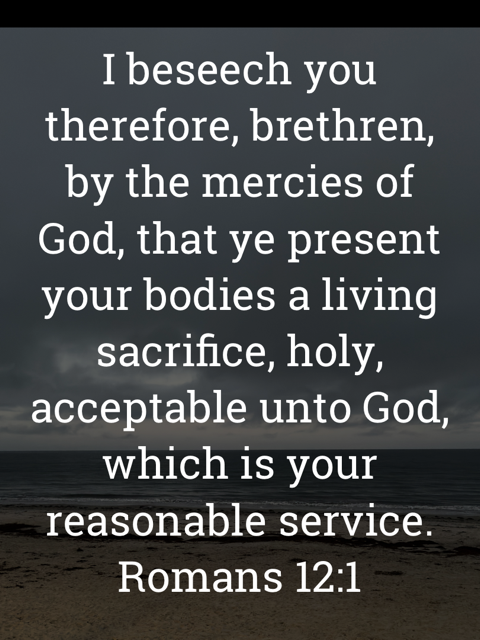
“I beseech you therefore, brethren, by the mercies of God, that ye present your bodies a living sacrifice, holy, acceptable unto God, which is your reasonable service.” (Romans 12:1)
1. Immediate Context within Romans
Romans 12[i] marks a decisive shift in Paul’s letter. After eleven chapters of dense doctrinal exposition—sin, justification, union with Christ, the work of the Spirit, election, and God’s covenant faithfulness—Paul turns to practical Christian living. The hinge is the word “therefore.” Everything that follows in Romans 12 flows from the gospel truths already established.
Romans 12 is a sustained call to transformed living: worship, humility, service, love, perseverance, peace, and goodness. Romans 12:1–2 form the foundation for the entire chapter. Verse 1 addresses the nature of Christian worship; verse 2 addresses the renewal of the mind. Together they describe the whole-of-life response to God’s saving mercy.
2. Exegetical Commentary on Romans 12:1
2.1 “I beseech you therefore, brethren”
Paul’s tone is pastoral, urgent, and affectionate. “I beseech you” is not a command barked from above but a heartfelt appeal. He addresses “brethren,” signalling shared identity in Christ and shared participation in the gospel.
2.2 “By the mercies of God”
This phrase is the theological engine of the verse. Paul grounds Christian obedience not in fear, guilt, or moralism, but in mercy. The plural “mercies” points to the manifold kindnesses of God described in Romans 1–11:
- justification by faith (Romans 5:1)
- peace with God (Romans 5:1)
- the gift of the Spirit (Romans 8:1–11)
- adoption (Romans 8:15–17)
- assurance (Romans 8:31–39)
- God’s sovereign grace (Romans 9–11)
Christian living begins with remembering what God has done.
2.3 “That ye present your bodies”
The verb “present” recalls sacrificial language from the Old Testament. In Romans 6:13 Paul uses the same word:
“Neither yield ye your members as instruments of unrighteousness unto sin: but yield yourselves unto God…” (Romans 6:13)
“Bodies” means the whole embodied life—actions, habits, speech, sexuality, work, relationships. Paul does not promote a disembodied spirituality. Worship is lived out in the physical world.
2.4 “A living sacrifice”
Old Testament sacrifices were killed. The Christian’s sacrifice is living. This is a daily, ongoing offering of oneself to God. It is continual devotion rather than a single ritual act.
2.5 “Holy, acceptable unto God”
Holiness is not optional. It is the fitting character of a life offered to God. “Acceptable” does not mean “good enough” but “pleasing,” echoing Old Testament sacrificial language where offerings were described as “a sweet savour.”
2.6 “Which is your reasonable service”
The word translated “reasonable” can also mean “spiritual” or “rational.” Paul is saying that whole-of-life worship is the only fitting response to God’s mercy. It is not irrational fanaticism; it is thoughtful, deliberate devotion. Worship is not confined to singing or Sunday gatherings. It is the entire life lived unto God.
3. Theological Themes
3.1 Worship as Whole-of-Life
Romans 12:1 teaches that worship is not primarily an event but a life. The Christian tradition rightly emphasises that all of life is lived coram Deo—before the face of God.
3.2 Grace as Motivation
Christian obedience flows from mercy, not merit. The gospel does not merely save; it reshapes the believer’s desires and direction.
3.3 Embodied Holiness
Christian spirituality is not escapist. It is lived in the body, in the ordinary rhythms of work, rest, relationships, and service.
3.4 Sacrificial Living
The believer’s life mirrors Christ’s own self-giving. We do not atone for sin; Christ alone does that. But we imitate his pattern of sacrificial love.
4. Meditation Guide
4.1 Remember the Mercies of God
Sit quietly and recall specific mercies God has shown you.
- Forgiveness
- Adoption
- The Spirit’s presence
- The hope of glory. Let gratitude rise. Let mercy soften your heart.
4.2 Offer Your Body
Consider your physical life.
- How you use your hands, eyes, mouth, time, energy Ask: “Lord, how can my body be used today in ways that honour you?”
4.3 Embrace Daily Sacrifice
Reflect on areas where self-interest dominates.
- Comfort
- Convenience
- Control Pray for grace to choose sacrificial love.
4.4 Pursue Holiness
Holiness is not dour or joyless. It is life aligned with God’s goodness. Ask: “Where is God calling me to grow in purity, integrity, or obedience?”
4.5 Understand Worship Properly
Worship is not limited to church services. Ask: “How can my work, study, parenting, friendships, and rest become acts of worship?”
5. Application to Modern Christian Living
5.1 In the Workplace
Present your body by working with integrity, diligence, and kindness. Resist gossip, dishonesty, and selfish ambition.
5.2 In Relationships
Sacrificial love means listening well, forgiving quickly, and serving generously. Holiness means purity in speech and conduct.
5.3 In Digital Life
Offer your eyes, attention, and time to God. Resist addictive patterns, unhelpful content, and online hostility.
5.4 In Physical Health
Caring for your body is part of presenting it to God. Steward your sleep, nutrition, exercise, and rest.
5.5 In Church Life
Serve with humility, recognising that your gifts are for the good of others (Romans 12:3–8).
“Having then gifts differing according to the grace that is given to us…” (Romans 12:6)
5.6 In Society
Live peaceably, honouring others, resisting evil, and overcoming evil with good (Romans 12:9–21).
“Be not overcome of evil, but overcome evil with good.” (Romans 12:21)
[i] Romans 12
King James Version
12 I beseech you therefore, brethren, by the mercies of God, that ye present your bodies a living sacrifice, holy, acceptable unto God, which is your reasonable service.
2 And be not conformed to this world: but be ye transformed by the renewing of your mind, that ye may prove what is that good, and acceptable, and perfect, will of God.
3 For I say, through the grace given unto me, to every man that is among you, not to think of himself more highly than he ought to think; but to think soberly, according as God hath dealt to every man the measure of faith.
4 For as we have many members in one body, and all members have not the same office:
5 So we, being many, are one body in Christ, and every one members one of another.
6 Having then gifts differing according to the grace that is given to us, whether prophecy, let us prophesy according to the proportion of faith;
7 Or ministry, let us wait on our ministering: or he that teacheth, on teaching;
8 Or he that exhorteth, on exhortation: he that giveth, let him do it with simplicity; he that ruleth, with diligence; he that sheweth mercy, with cheerfulness.
9 Let love be without dissimulation. Abhor that which is evil; cleave to that which is good.
10 Be kindly affectioned one to another with brotherly love; in honour preferring one another;
11 Not slothful in business; fervent in spirit; serving the Lord;
12 Rejoicing in hope; patient in tribulation; continuing instant in prayer;
13 Distributing to the necessity of saints; given to hospitality.
14 Bless them which persecute you: bless, and curse not.
15 Rejoice with them that do rejoice, and weep with them that weep.
16 Be of the same mind one toward another. Mind not high things, but condescend to men of low estate. Be not wise in your own conceits.
17 Recompense to no man evil for evil. Provide things honest in the sight of all men.
18 If it be possible, as much as lieth in you, live peaceably with all men.
19 Dearly beloved, avenge not yourselves, but rather give place unto wrath: for it is written, Vengeance is mine; I will repay, saith the Lord.
20 Therefore if thine enemy hunger, feed him; if he thirst, give him drink: for in so doing thou shalt heap coals of fire on his head.
21 Be not overcome of evil, but overcome evil with good.
Discover more from Daily bible verses
Subscribe to get the latest posts sent to your email.


You must be logged in to post a comment.