
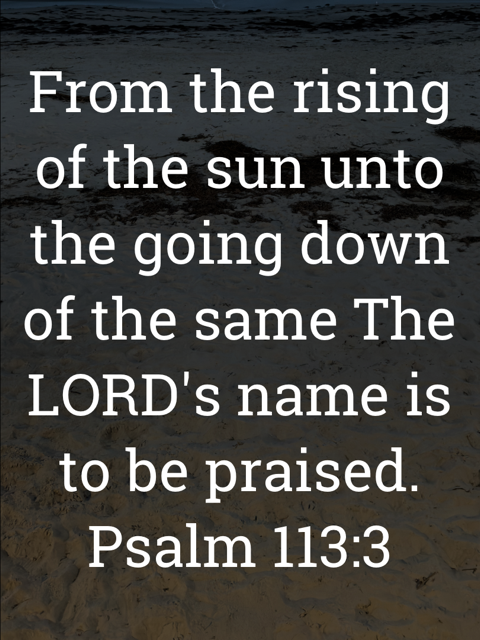
Psalm 113:3, King James Version
Psalm 113:3: “From the rising of the sun unto the going down of the same the LORD’s name is to be praised.”
This is a small verse with a very large horizon. It invites the believer to see every place, every hour, and every ordinary moment as belonging to the praise of the covenant Lord.
Exegetical Commentary
1. The place of Psalm 113 in Scripture
Psalm 113 begins and ends with praise. The whole psalm reads:
113 Praise ye the LORD. Praise, O ye servants of the LORD, praise the name of the LORD.
2 Blessed be the name of the LORD from this time forth and for evermore.
3 From the rising of the sun unto the going down of the same the LORD’s name is to be praised.
4 The LORD is high above all nations, and his glory above the heavens.
5 Who is like unto the LORD our God, who dwelleth on high,
6 Who humbleth himself to behold the things that are in heaven, and in the earth!
7 He raiseth up the poor out of the dust, and lifteth the needy out of the dunghill;
8 That he may set him with princes, even with the princes of his people.
9 He maketh the barren woman to keep house, and to be a joyful mother of children. Praise ye the LORD.
The psalm has a simple and beautiful movement. First, God’s servants are called to praise him. Second, God is praised as the one whose glory is above the nations and the heavens. Third, this exalted God stoops in mercy to lift the poor, the needy, and the barren. The Pulpit Commentary notes this three-part shape: Psalm 113:1-3 calls the servants of the Lord to praise; Psalm 113:4-6 praises God’s heavenly glory; and Psalm 113:7-9 praises his great works on earth. [studylight.org]
Psalm 113 is also associated with the group of psalms often called the Hallel, connected with Israel’s festival worship, including Passover. Enduring Word and The Pulpit Commentary both identify Psalm 113 as part of the Hallel collection used in Jewish festival praise. This gives the psalm a redemptive setting: the people praise the Lord not as a vague deity, but as the covenant God who saves, rules, provides, and raises the lowly. [enduringword.com], [studylight.org]
2. “From the rising of the sun”
The phrase begins in the east, where the sun rises. It describes the whole span of the day and, by implication, the whole breadth of the earth. Praise is not confined to the temple, the synagogue, the church building, or the quiet time chair. The Lord’s name is to be praised wherever the sun shines.
A related text is:
Psalm 50:1: “The mighty God, even the LORD, hath spoken, and called the earth from the rising of the sun unto the going down thereof.” [biblegateway.com]
Psalm 50:1 uses similar language to speak of God’s summons to the whole earth. Psalm 113:3 uses that same wide horizon for worship. The God who calls the whole earth is worthy of praise across the whole earth.
This guards us against a small view of worship. Worship is not merely something Christians do on Sunday. The gathered worship of the church is precious and commanded, but Psalm 113:3 teaches us that the praise of God should stretch across the whole day: morning prayers, honest work, patient parenting, quiet repentance, joyful singing, faithful service, and humble trust.
3. “Unto the going down of the same”
The verse does not only move across geography. It also moves through time. From sunrise to sunset, the Lord remains worthy. Our feelings rise and fall, our plans are interrupted, our bodies grow tired, and our circumstances shift, but the Lord’s worth does not change.
This connects strongly with the previous verse:
Psalm 113:2: “Blessed be the name of the LORD from this time forth and for evermore.” [biblegateway.com]
Psalm 113:2 stretches praise through time: “from this time forth and for evermore.” Psalm 113:3 stretches praise across the world: “from the rising of the sun unto the going down of the same.” The point is clear: no time and no place are outside the proper praise of God.
For the modern Christian, this is deeply practical. The commute, the school run, the hospital waiting room, the work meeting, the kitchen sink, the farm gate, the lecture theatre, the aged-care room, and the lonely evening are all places where the Lord’s name may be praised.
4. “The LORD’s name”
In Scripture, God’s “name” is not a mere label. It speaks of his revealed character, his covenant faithfulness, his holiness, his mercy, and his glory. Psalm 113 does not call us to praise an unknown power, but the Lord who has made himself known.
The psalm itself tells us what this name means. He is exalted:
Psalm 113:4: “The LORD is high above all nations, and his glory above the heavens.” [biblegateway.com]
He is incomparable:
Psalm 113:5: “Who is like unto the LORD our God, who dwelleth on high,” [biblegateway.com]
He is mercifully condescending:
Psalm 113:6: “Who humbleth himself to behold the things that are in heaven, and in the earth!” [biblegateway.com]
He lifts the lowly:
Psalm 113:7-8: “He raiseth up the poor out of the dust, and lifteth the needy out of the dunghill; That he may set him with princes, even with the princes of his people.” [biblegateway.com]
He brings fruitfulness and joy:
Psalm 113:9: “He maketh the barren woman to keep house, and to be a joyful mother of children. Praise ye the LORD.” [biblegateway.com]
So Psalm 113:3 is not empty religious enthusiasm. It is grounded in who God is. Christian theology insists that worship begins with God’s self-revelation. We do not invent the God we praise. We praise the God who has revealed himself in Scripture and supremely in Jesus Christ.
5. The missionary horizon of the verse
Psalm 113:3 also looks outward. It is not enough that Israel should praise the Lord. The Lord’s name is worthy to be praised everywhere.
A strong echo appears in:
Malachi 1:11: “For from the rising of the sun even unto the going down of the same my name shall be great among the Gentiles; and in every place incense shall be offered unto my name, and a pure offering: for my name shall be great among the heathen, saith the LORD of hosts.” [biblegateway.com]
Malachi 1:11 looks to the greatness of God’s name among the nations. Psalm 113:3 says the Lord’s name “is to be praised;” Malachi 1:11 says his name “shall be great among the Gentiles.” Together, they teach that the praise of God has a global purpose.
For Christians, this finds its fulfilment in the gospel going to the nations. The church does not engage in mission because God is needy, lonely, or insecure. We bear witness because the Lord is worthy, sinners need mercy, and Christ is the only Saviour.
Theological Teaching
1. God is sovereign over all times and places
Psalm 113:3 leaves no corner of creation outside God’s claim. From sunrise to sunset, the Lord is God. He is not a tribal deity, not a private religious preference, and not merely the God of church services. He is Lord of Australia, Asia, Africa, Europe, the Americas, the islands, the cities, the bush, the sea, and every unseen place.
This gives great comfort. If the Lord’s praise belongs everywhere, then his presence and rule are not absent from your difficult place.
2. Worship is the proper response to grace
Psalm 113 praises the God who is high and holy, yet who stoops to lift the lowly. The psalm’s mercy language echoes Hannah’s song:
1 Samuel 2:8: “He raiseth up the poor out of the dust, and lifteth up the beggar from the dunghill, to set them among princes, and to make them inherit the throne of glory: for the pillars of the earth are the LORD’S, and he hath set the world upon them.” [biblegateway.com]
God’s greatness does not make him distant from the broken. His Majesty is not cold. His glory shines in mercy. The Lord is so high that he must humble himself even to behold heaven and earth, yet he is so gracious that he raises the poor from the dust.
3. The verse points us to Christ
Psalm 113:3 calls for worldwide praise of the Lord’s name. In the New Testament, this praise gathers around the Lord Jesus Christ, the eternal Son who humbled himself for sinners.
The Passover setting is important. The Gospels tell us:
Matthew 26:30: “And when they had sung an hymn, they went out into the mount of Olives.” [kingjamesb…online.org]
The Hallel psalms are traditionally associated with Passover singing, and commentators connect this tradition with the hymn sung by Jesus and his disciples before going to the Mount of Olives. We should be careful not to claim more than the text states. Matthew 26:30 says they sang a hymn; it does not name Psalm 113. Yet the historical association helps us hear Psalm 113 with Christian wonder: the one who is “high above all nations” would go to the cross to lift sinners from spiritual death. [enduringword.com], [biblestudytools.com]
That spiritual lifting is described in:
Ephesians 2:5-6: “Even when we were dead in sins, hath quickened us together with Christ, by grace ye are saved; And hath raised us up together, and made us sit together in heavenly places in Christ Jesus:” [biblegateway.com]
Psalm 113 speaks of the poor being lifted from dust to sit with princes. Ephesians 2:5-6 shows the greater gospel reality: those dead in sins are made alive with Christ and raised to sit in heavenly places in him. This is grace from beginning to end.
Practical Application for Modern Christian Living
1. Begin and end the day with praise
Psalm 113:3 invites a simple rhythm: praise at sunrise and praise at sunset. This does not need to be complicated. In the morning, acknowledge the Lord before checking messages. In the evening, name his mercies before reviewing your worries.
A simple morning prayer might be: “Lord, your name is to be praised today. Help me live this day before your face.”
A simple evening prayer might be: “Lord, your name is still worthy. Forgive my sins, receive my thanks, and keep me through the night.”
2. Treat ordinary places as places of worship
This verse helps Christians resist the false split between sacred and ordinary life. You can praise the Lord while doing paid work, caring for children, studying, cleaning, travelling, managing pain, resting, or serving quietly.
The question is not only, “Did I sing today?” It is also, “Did my conduct honour the Lord’s name today?”
3. Let God’s global praise shape your prayers
Pray beyond your own needs. Pray for gospel witness in places where Christ is not known. Pray for churches in other nations. Pray for your neighbours. Pray for migrants, refugees, students, and workers in your local community. If the Lord’s name is to be praised from sunrise to sunset, then our prayers should not be narrow or self-absorbed.
4. Praise God in sorrow without pretending sorrow is easy
Psalm 113:7-9 speaks of the poor, the needy, and the barren being lifted. That is good news, but it must be handled pastorally. Not every poor person is lifted out of hardship quickly. Not every couple longing for children receives children. Not every grief is reversed in this life. A faithful pastoral reading must not turn Psalm 113 into a simplistic promise of immediate earthly success.
The psalm teaches God’s character and kingdom direction: the Lord sees the lowly, cares for them, and will finally put all things right. In Christ, the final lifting of the lowly is certain, even when present circumstances remain painful.
5. Honour the Lord’s name by humility
If the high God stoops, his people must not be proud. The worshipper of Psalm 113 should become more tender towards the poor, the lonely, the infertile, the grieving, the elderly, the disabled, the overlooked, and the ashamed. Praise that does not produce mercy is shallow praise.
Meditation Guide on Psalm 113:3
Prepare
Sit quietly. Read the verse aloud slowly:
Psalm 113:3: “From the rising of the sun unto the going down of the same the LORD’s name is to be praised.” [biblegateway.com]
Breathe slowly and remember: the Lord was worthy before you woke, and he will still be worthy when you sleep.
Reflect
Ask yourself:
- Morning: What would it look like to begin my day under the Lord’s name rather than under anxiety, hurry, or self-reliance?
- Midday: Where am I tempted to forget God during ordinary work or responsibilities?
- Evening: What mercy from today should lead me to praise?
- Global: Where in the world, or in my local community, do I long to see the Lord’s name praised?
- Personal: Is there a sorrow in which I need to trust the God who lifts the lowly?
Pray
“Lord God, from the rising of the sun to its going down, your name is to be praised. Teach my heart to worship you in ordinary places and difficult hours. Lift my eyes from myself to your glory. Lift my heart from despair to your mercy. Make me humble, grateful, and faithful in Christ. Amen.”
Practise
Today, pause three times:
- Morning: Praise God for who he is.
- Midday: Thank God for one specific mercy.
- Evening: Confess one sin, receive his grace, and bless his name.
Discover more from Daily bible verses
Subscribe to get the latest posts sent to your email.


You must be logged in to post a comment.