
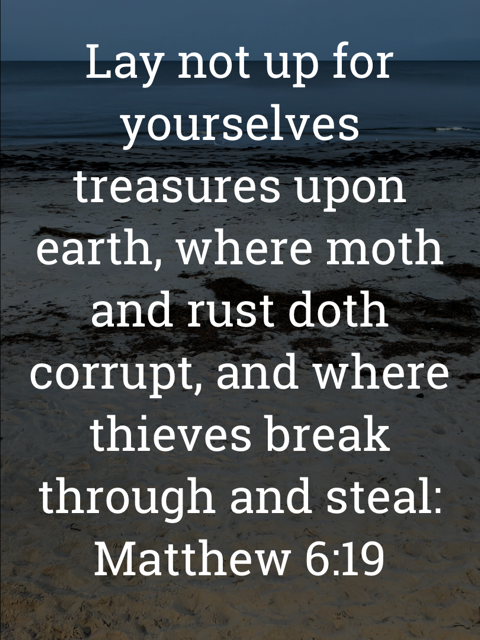
Commentary on Matthew 6:19
Exegetical Insights
To understand Matthew 6:19, we must first place it within its immediate context in Matthew 6.
Matthew 6:19
“Lay not up for yourselves treasures upon earth, where moth and rust doth corrupt, and where thieves break through and steal:”
Contextual Placement
Matthew 6[i]: Our Lord Jesus Christ addresses the motives of the human heart. In the first half of the chapter (Matthew 6:1-18), He addresses religious hypocrisy—giving, praying, and fasting to be seen by men. From verse 19 onwards, He transitions to worldly anxiety and materialism. Having warned against seeking human applause, He now warns against trusting in earthly wealth. Both stem from the same spiritual disease: a failure to rest in the heavenly Father who sees in secret and provides for His children.
Grammatical and Lexical Detail
- “Lay not up for yourselves treasures”: In the original Greek text, this phrase features a vivid cognate accusative: mē thēsaurizete hymin thēsaurous (literally, “Do not treasure up for yourselves treasures”). The verb is a present active imperative with a negative particle, which carries the force of forbidding an ongoing habit or practice. Jesus is prohibiting the habitual hoarding of resources for self-aggrandisement or ultimate security.
- “Upon earth”: Jesus contrasts two locations of trust. The earthly realm (epi tēs gēs) is finite, fallen, and under the curse of decay.
- “Where moth and rust doth corrupt”: In ancient Palestine, wealth was primarily stored in fine garments, agricultural grain, and precious metals.
- Moth (sēs): Devours costly woollen garments.
- Rust (brōsis): Literally means “eating” or “consumption.” It refers to corrosion, vermin, or mildew that consumes stored grain and metals.
- Corrupt (aphanizei): Means to cause to disappear, disfigure, or destroy.
- “And where thieves break through and steal”: The word for “break through” (dioryssousin) literally translates to “dig through.” First-century homes were often constructed of mud-brick or sun-dried clay. A thief did not pick a lock; he literally dug through the wall to enter.
The Lord uses these three vivid illustrations to show the total vulnerability of earthly wealth. Whether by slow environmental decay (moths and corrosion) or sudden human violence (thieves), earthly treasures possess an inherent tendency to perish.
Theological Teaching
From a Christian perspective, Matthew 6:19 delivers deep covenantal and theological truths regarding God, humanity, and salvation.
1. Sovereignty, Providence, and Idolatry
Christian theology emphasises the total sovereignty of God as creator and sustainer of all things. When a person hoards earthly wealth to find ultimate safety, they commit the sin of idolatry. They substitute the creation for the Creator (Romans 1:25). Material wealth promises security and identity, but it is a false god that cannot deliver. As Jesus states further down in the passage:
Matthew 6:24
“No man can serve two masters: for either he will hate the one, and love the other; or else he will hold to the one, and despise the other. Ye cannot serve God and mammon.”
2. The Fallen State of the World
The vulnerability of earthly treasures (moth, rust, and thieves) is a direct consequence of the Fall recorded in Genesis 3. Creation is subjected to futility and corruption. To anchor one’s life, hope, and happiness in a fallen, decaying world is spiritual folly.
3. Covenantal Sonship and Grace
Jesus repeatedly addresses His hearers’ relationship to God as “your heavenly Father” throughout Matthew 6.
Matthew 6:32
“(For after all these things do the Gentiles seek:) for your heavenly Father knoweth that ye have need of all these things.”
We do not hoard out of fear when we realise that God is our loving, sovereign Father who has chosen us by His grace. Regeneration changes what the heart loves. A person born again by the Holy Spirit no longer lives as a spiritual orphan trying to secure their own future, but as an heir of God, freed to trust His divine provision.
Practical Application to Modern Christian Living
High living standards, financial security, and material comfort present subtle spiritual dangers. It is easy for us to embrace a functional materialism while maintaining a Christian exterior. How do we put Matthew 6:19 into practice today?
1. Examine the Motives of Your Heart
Jesus does not forbid owning property, saving prudently for the future, or enjoying the good gifts of God’s creation (Timothy 4:4). What He forbids is the hoarding of wealth for personal security and self-worth. Ask yourself candidly: “Where do I look for my peace when economic instability or interest rates rise? Do I find my worth in my superannuation, property portfolio, or salary—or in Christ?”
2. Practise Open-Handed Stewardship
The antidote to laying up treasures on earth is radically generous stewardship. Because God owns everything and we are merely stewards, our disposable income, time, and talents ought to be invested in kingdom causes—supporting the local gospel church, assisting the poor, and advancing gospel missions across the globe.
3. Cultivate Gospel Contentment
Cultivate a deliberate posture of simplicity and contentment. Resistant to the relentless consumerism pushed through social media and advertising, the believer rests in the sufficiency of Christ. When we realise our eternal inheritance is reserved in heaven for us, we are freed from the rat race of keeping up with our neighbours.
Meditation Guide
Set aside fifteen quiet minutes with your Bible. Begin with a short prayer asking the Holy Spirit to search your heart and illuminate His Word.
Step 1: Read and Recite
Read Matthew 6:19–21 aloud slowly two or three times:
Matthew 6:19
“Lay not up for yourselves treasures upon earth, where moth and rust doth corrupt, and where thieves break through and steal:”
Matthew 6:20
“But lay up for yourselves treasures in heaven, where neither moth nor rust doth corrupt, and where thieves do not break through nor steal:”
Matthew 6:21
“For where your treasure is, there will your heart be also.”
Step 2: Reflect and Ponder
- Visualise the temporal: Picture fine clothes eaten by moths, iron eaten by rust, and a mud wall dug through by a thief. Think about the earthly things you have worked hardest to secure over the last five to ten years. How durable are they really?
- Examine the heart: Jesus says our heart follows our treasure. Look at your recent bank statements, your calendar, and your dominant daily thoughts. What do they reveal about where your heart is resting?
Step 3: Pray
- Confession: Confess any covert idolatry, anxiety, or hoardings of God’s resources. Pray: “Father, forgive me for seeking my ultimate comfort in things that rot and fade, rather than in Your enduring love.”
- Thanksgiving: Thank Christ that through His poverty on the cross, you have been given the eternal, unperishable riches of salvation.
- Petition: Ask for a generous, open-handed heart that delights in storing up treasures in heaven through gospel partnership and loving service.
[i] Matthew 6
King James Version
6 Take heed that ye do not your alms before men, to be seen of them: otherwise ye have no reward of your Father which is in heaven.
2 Therefore when thou doest thine alms, do not sound a trumpet before thee, as the hypocrites do in the synagogues and in the streets, that they may have glory of men. Verily I say unto you, They have their reward.
3 But when thou doest alms, let not thy left hand know what thy right hand doeth:
4 That thine alms may be in secret: and thy Father which seeth in secret himself shall reward thee openly.
5 And when thou prayest, thou shalt not be as the hypocrites are: for they love to pray standing in the synagogues and in the corners of the streets, that they may be seen of men. Verily I say unto you, They have their reward.
6 But thou, when thou prayest, enter into thy closet, and when thou hast shut thy door, pray to thy Father which is in secret; and thy Father which seeth in secret shall reward thee openly.
7 But when ye pray, use not vain repetitions, as the heathen do: for they think that they shall be heard for their much speaking.
8 Be not ye therefore like unto them: for your Father knoweth what things ye have need of, before ye ask him.
9 After this manner therefore pray ye: Our Father which art in heaven, Hallowed be thy name.
10 Thy kingdom come, Thy will be done in earth, as it is in heaven.
11 Give us this day our daily bread.
12 And forgive us our debts, as we forgive our debtors.
13 And lead us not into temptation, but deliver us from evil: For thine is the kingdom, and the power, and the glory, for ever. Amen.
14 For if ye forgive men their trespasses, your heavenly Father will also forgive you:
15 But if ye forgive not men their trespasses, neither will your Father forgive your trespasses.
16 Moreover when ye fast, be not, as the hypocrites, of a sad countenance: for they disfigure their faces, that they may appear unto men to fast. Verily I say unto you, They have their reward.
17 But thou, when thou fastest, anoint thine head, and wash thy face;
18 That thou appear not unto men to fast, but unto thy Father which is in secret: and thy Father, which seeth in secret, shall reward thee openly.
19 Lay not up for yourselves treasures upon earth, where moth and rust doth corrupt, and where thieves break through and steal:
20 But lay up for yourselves treasures in heaven, where neither moth nor rust doth corrupt, and where thieves do not break through nor steal:
21 For where your treasure is, there will your heart be also.
22 The light of the body is the eye: if therefore thine eye be single, thy whole body shall be full of light.
23 But if thine eye be evil, thy whole body shall be full of darkness. If therefore the light that is in thee be darkness, how great is that darkness!
24 No man can serve two masters: for either he will hate the one, and love the other; or else he will hold to the one, and despise the other. Ye cannot serve God and mammon.
25 Therefore I say unto you, Take no thought for your life, what ye shall eat, or what ye shall drink; nor yet for your body, what ye shall put on. Is not the life more than meat, and the body than raiment?
26 Behold the fowls of the air: for they sow not, neither do they reap, nor gather into barns; yet your heavenly Father feedeth them. Are ye not much better than they?
27 Which of you by taking thought can add one cubit unto his stature?
28 And why take ye thought for raiment? Consider the lilies of the field, how they grow; they toil not, neither do they spin:
29 And yet I say unto you, That even Solomon in all his glory was not arrayed like one of these.
30 Wherefore, if God so clothe the grass of the field, which to day is, and to morrow is cast into the oven, shall he not much more clothe you, O ye of little faith?
31 Therefore take no thought, saying, What shall we eat? or, What shall we drink? or, Wherewithal shall we be clothed?
32 (For after all these things do the Gentiles seek:) for your heavenly Father knoweth that ye have need of all these things.
33 But seek ye first the kingdom of God, and his righteousness; and all these things shall be added unto you.
34 Take therefore no thought for the morrow: for the morrow shall take thought for the things of itself. Sufficient unto the day is the evil thereof.
Discover more from Daily bible verses
Subscribe to get the latest posts sent to your email.


You must be logged in to post a comment.