
Commentary on Proverbs 3:7
Proverbs 3
King James Version
3 My son, forget not my law; but let thine heart keep my commandments:
2 For length of days, and long life, and peace, shall they add to thee.
3 Let not mercy and truth forsake thee: bind them about thy neck; write them upon the table of thine heart:
4 So shalt thou find favour and good understanding in the sight of God and man.
5 Trust in the LORD with all thine heart; and lean not unto thine own understanding.
6 In all thy ways acknowledge him, and he shall direct thy paths.
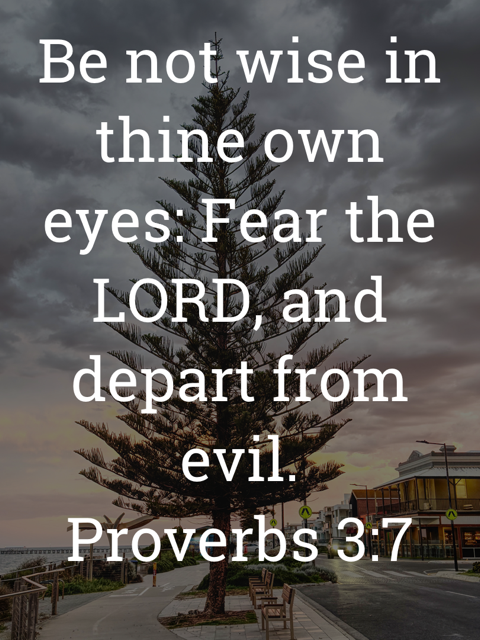
7 Be not wise in thine own eyes: fear the LORD, and depart from evil.
8 It shall be health to thy navel, and marrow to thy bones.
9 Honour the LORD with thy substance, and with the firstfruits of all thine increase:
10 So shall thy barns be filled with plenty, and thy presses shall burst out with new wine.
11 My son, despise not the chastening of the LORD; neither be weary of his correction:
12 For whom the LORD loveth he correcteth; even as a father the son in whom he delighteth.
13 Happy is the man that findeth wisdom, and the man that getteth understanding.
14 For the merchandise of it is better than the merchandise of silver, and the gain thereof than fine gold.
15 She is more precious than rubies: and all the things thou canst desire are not to be compared unto her.
16 Length of days is in her right hand; and in her left hand riches and honour.
17 Her ways are ways of pleasantness, and all her paths are peace.
18 She is a tree of life to them that lay hold upon her: and happy is every one that retaineth her.
19 The LORD by wisdom hath founded the earth; by understanding hath he established the heavens.
20 By his knowledge the depths are broken up, and the clouds drop down the dew.
21 My son, let not them depart from thine eyes: keep sound wisdom and discretion:
22 So shall they be life unto thy soul, and grace to thy neck.
23 Then shalt thou walk in thy way safely, and thy foot shall not stumble.
24 When thou liest down, thou shalt not be afraid: yea, thou shalt lie down, and thy sleep shall be sweet.
25 Be not afraid of sudden fear, neither of the desolation of the wicked, when it cometh.
26 For the LORD shall be thy confidence, and shall keep thy foot from being taken.
27 Withhold not good from them to whom it is due, when it is in the power of thine hand to do it.
28 Say not unto thy neighbour, Go, and come again, and to morrow I will give; when thou hast it by thee.
29 Devise not evil against thy neighbour, seeing he dwelleth securely by thee.
30 Strive not with a man without cause, if he have done thee no harm.
31 Envy thou not the oppressor, and choose none of his ways.
32 For the froward is abomination to the LORD: but his secret is with the righteous.
33 The curse of the LORD is in the house of the wicked: but he blesseth the habitation of the just.
34 Surely he scorneth the scorners: but he giveth grace unto the lowly.
35 The wise shall inherit glory: but shame shall be the promotion of fools.
Scripture text
Proverbs 3:7: “Be not wise in thine own eyes: fear the LORD, and depart from evil.”
Exegesis of the verse
Proverbs 3:7 sits within a fatherly appeal to receive wisdom with the heart, to trust the Lord wholly, and to walk under his direction. The command follows Proverbs 3:5–6: Proverbs 3:5: “Trust in the LORD with all thine heart; and lean not unto thine own understanding.” Proverbs 3:6: “In all thy ways acknowledge him, and he shall direct thy paths.” Verse 7 explains what such trust looks like from the inside: humility before God, reverent worship, and practical repentance.
“Be not wise in thine own eyes” is not an attack on careful thought, learning, or sound judgement. It is a warning against self-sufficient wisdom, the proud habit of treating one’s own view as final. Proverbs later gives the same warning: Proverbs 26:12: “Seest thou a man wise in his own conceit? there is more hope of a fool than of him.” The issue is not intelligence, but autonomy from God.
“Fear the LORD” names the positive alternative. In Proverbs, this is the first principle of true knowledge: Proverbs 1:7: “The fear of the LORD is the beginning of knowledge: but fools despise wisdom and instruction.” It is reverent awe, covenant loyalty, humble dependence, and loving submission to God’s holy character. It is not servile panic, but childlike reverence before the Lord who is wise, good, and sovereign.
“Depart from evil” gives the practical fruit of fearing the Lord. Wisdom is never merely mental. It turns the whole person away from sin and towards obedient life. The same pattern appears in Job: Job 28:28: “And unto man he said, Behold, the fear of the LORD, that is wisdom; and to depart from evil is understanding.” The verse therefore moves in three clear steps: reject self-rule, revere the LORD, and turn away from evil.
Theological teaching
Proverbs 3:7 teaches that true wisdom begins with God, not with the independent self. This is consistent with a Christian understanding of Scripture. Because human hearts are affected by sin, our reasoning needs the light of God’s Word and the renewing work of the Holy Spirit. Scripture warns against prideful self-confidence: Isaiah 5:21: “Woe unto them that are wise in their own eyes, and prudent in their own sight!”
The fear of the LORD is also relational. Believers do not obey God to earn his favour; they obey because God has shown mercy and brought them into covenant fellowship with himself. In Christ, reverent fear and gospel comfort belong together. Hebrews 12:28: “Wherefore we receiving a kingdom which cannot be moved, let us have grace, whereby we may serve God acceptably with reverence and godly fear.”
The verse also teaches sanctification. A person who fears the Lord will not make peace with evil. Grace does not make sin safe; grace trains believers to turn from it. Titus 2:11: “For the grace of God that bringeth salvation hath appeared to all men,” Titus 2:12: “Teaching us that, denying ungodliness and worldly lusts, we should live soberly, righteously, and godly, in this present world.”
Practical application to modern Christian living
- Practise intellectual humility. Bring your opinions, plans, reactions, and assumptions under Scripture. Ask, “What has God said?” before asking, “What do I prefer?”
- Resist spiritual self-confidence. Mature believers still need correction, prayer, fellowship, and the ordinary means of grace. Pride often sounds reasonable to the person who holds it.
- Make repentance specific. To “depart from evil” means naming sin honestly, turning from it decisively, seeking forgiveness, and taking practical steps away from temptation.
- Seek counsel wisely. Being “wise in thine own eyes” can show itself in refusing counsel. God often uses Scripture-shaped brothers and sisters to expose blind spots.
- Let reverence shape daily choices. The fear of the Lord should affect speech, money, work, digital habits, relationships, private thought, and public integrity.
Meditation guide
- Read slowly: Proverbs 3:7: “Be not wise in thine own eyes: fear the LORD, and depart from evil.” Read it aloud twice, pausing after each command.
- Reflect: Where am I most tempted to trust my own judgement more than God’s Word?
- Confess: Name one area where pride, defensiveness, or self-rule has shaped your choices.
- Receive: Remember that Christ receives repentant sinners and teaches his people by grace. Matthew 11:29: “Take my yoke upon you, and learn of me; for I am meek and lowly in heart: and ye shall find rest unto your souls.”
- Respond: Choose one practical step today that helps you depart from evil and walk in reverent obedience.
- Pray: “Lord, make me humble before your Word. Teach me to fear you with reverent love, to distrust proud self-rule, and to turn from evil by your grace. Lead me in the way of Christ. Amen.”
Discover more from Daily bible verses
Subscribe to get the latest posts sent to your email.


You must be logged in to post a comment.