
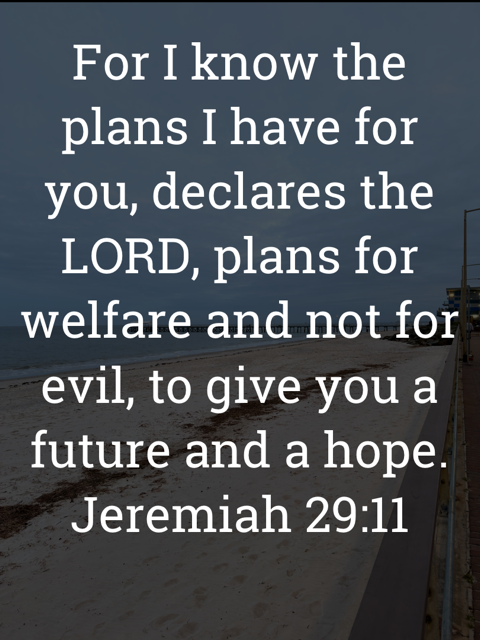
Commentary on Jeremiah 29:11
Jeremiah 29
English Standard Version
Jeremiah’s Letter to the Exiles
29 These are the words of the letter that Jeremiah the prophet sent from Jerusalem to the surviving elders of the exiles, and to the priests, the prophets, and all the people, whom Nebuchadnezzar had taken into exile from Jerusalem to Babylon. 2 This was after King Jeconiah and the queen mother, the eunuchs, the officials of Judah and Jerusalem, the craftsmen, and the metal workers had departed from Jerusalem. 3 The letter was sent by the hand of Elasah the son of Shaphan and Gemariah the son of Hilkiah, whom Zedekiah king of Judah sent to Babylon to Nebuchadnezzar king of Babylon. It said: 4 “Thus says the LORD of hosts, the God of Israel, to all the exiles whom I have sent into exile from Jerusalem to Babylon: 5 Build houses and live in them; plant gardens and eat their produce. 6 Take wives and have sons and daughters; take wives for your sons, and give your daughters in marriage, that they may bear sons and daughters; multiply there, and do not decrease. 7 But seek the welfare of the city where I have sent you into exile, and pray to the LORD on its behalf, for in its welfare you will find your welfare. 8 For thus says the LORD of hosts, the God of Israel: Do not let your prophets and your diviners who are among you deceive you, and do not listen to the dreams that they dream, 9 for it is a lie that they are prophesying to you in my name; I did not send them, declares the LORD.
10 “For thus says the LORD: When seventy years are completed for Babylon, I will visit you, and I will fulfil to you my promise and bring you back to this place. 11 For I know the plans I have for you, declares the LORD, plans for welfare and not for evil, to give you a future and a hope. 12 Then you will call upon me and come and pray to me, and I will hear you. 13 You will seek me and find me, when you seek me with all your heart. 14 I will be found by you, declares the LORD, and I will restore your fortunes and gather you from all the nations and all the places where I have driven you, declares the LORD, and I will bring you back to the place from which I sent you into exile.
15 “Because you have said, ‘The LORD has raised up prophets for us in Babylon,’ 16 thus says the LORD concerning the king who sits on the throne of David, and concerning all the people who dwell in this city, your kinsmen who did not go out with you into exile: 17 ‘Thus says the LORD of hosts, behold, I am sending on them sword, famine, and pestilence, and I will make them like vile figs that are so rotten they cannot be eaten. 18 I will pursue them with sword, famine, and pestilence, and will make them a horror to all the kingdoms of the earth, to be a curse, a terror, a hissing, and a reproach among all the nations where I have driven them, 19 because they did not pay attention to my words, declares the LORD, that I persistently sent to you by my servants the prophets, but you would not listen, declares the LORD.’ 20 Hear the word of the LORD, all you exiles whom I sent away from Jerusalem to Babylon: 21 ’Thus says the LORD of hosts, the God of Israel, concerning Ahab the son of Kolaiah and Zedekiah the son of Maaseiah, who are prophesying a lie to you in my name: Behold, I will deliver them into the hand of Nebuchadnezzar king of Babylon, and he shall strike them down before your eyes. 22 Because of them this curse shall be used by all the exiles from Judah in Babylon: “The LORD make you like Zedekiah and Ahab, whom the king of Babylon roasted in the fire,” 23 because they have done an outrageous thing in Israel, they have committed adultery with their neighbours’ wives, and they have spoken in my name lying words that I did not command them. I am the one who knows, and I am witness, declares the LORD.’”
Shemaiah’s False Prophecy
24 To Shemaiah of Nehelam you shall say: 25 “Thus says the LORD of hosts, the God of Israel: You have sent letters in your name to all the people who are in Jerusalem, and to Zephaniah the son of Maaseiah the priest, and to all the priests, saying, 26 ‘The LORD has made you priest instead of Jehoiada the priest, to have charge in the house of the LORD over every madman who prophesies, to put him in the stocks and neck irons. 27 Now why have you not rebuked Jeremiah of Anathoth who is prophesying to you? 28 For he has sent to us in Babylon, saying, “Your exile will be long; build houses and live in them, and plant gardens and eat their produce.”
29 Zephaniah the priest read this letter in the hearing of Jeremiah the prophet. 30 Then the word of the LORD came to Jeremiah: 31 “Send to all the exiles, saying, ‘Thus says the LORD concerning Shemaiah of Nehelam: Because Shemaiah had prophesied to you when I did not send him, and has made you trust in a lie, 32 therefore thus says the LORD: Behold, I will punish Shemaiah of Nehelam and his descendants. He shall not have anyone living among this people, and he shall not see the good that I will do to my people, declares the LORD, for he has spoken rebellion against the LORD.’”
The ESV® Bible (The Holy Bible, English Standard Version®), © 2001 by Crossway, a publishing ministry of Good News Publishers. ESV Text Edition: 2025.
Jeremiah 29:11. “For I know the plans I have for you, declares the LORD, plans for welfare and not for evil, to give you a future and a hope.”
1. Exegesis
Historical and literary setting. Jeremiah 29 records a letter sent from Jerusalem to Judeans whom Nebuchadnezzar had carried into exile in Babylon. False prophets promised a swift return, but the LORD told the exiles to build houses, raise families, seek Babylon’s welfare, and pray for it because the exile would last seventy years (Jeremiah 29:1–10, 15–23). Jeremiah 29:11 therefore addresses a covenant community under discipline, not individuals promised immediate success.
“For I know.” The opening grounds hope in God’s knowledge and purpose. The future of the exiles is neither hidden from him nor controlled by Babylon. The English Standard Version’s wording, “the plans I have for you,” emphasises God’s deliberate intention. In the wider book, divine judgement is purposeful and deserved, yet it does not cancel God’s covenant mercy (Jeremiah 1:10; 18:1–11; 24:4–7; 30:1–3).
“Plans for welfare and not for evil.” “Welfare” translates the Hebrew word shalom, which can include peace, wholeness, and well-being. Here it contrasts with calamity as the final outcome God intends for his people. It does not mean that the intervening years will be painless. The same chapter calls the exiles to faithful, ordinary life within a long season of displacement.
“A future and a hope.” The promise points first to restoration after the appointed period of exile. The following verses describe renewed prayer, wholehearted seeking, God’s gracious response, and gathering from dispersion (Jeremiah 29:12–14). The “you” is plural: individuals receive comfort as members of God’s people, while the promise reaches its fulfilment on God’s timetable.
Canonical horizon. Jeremiah later announces a new covenant in which God forgives sin and writes his law on the heart (Jeremiah 31:31–34). From a Christian reading of the whole canon, this saving purpose centres on Jesus Christ, the mediator of the new covenant (Luke 22:20; Hebrews 8:6–13; 10:14–18). Jeremiah 29:11 is not a direct guarantee of earthly prosperity, but it accords with the surer Christian hope that God preserves his people and brings them to their promised inheritance (Romans 8:28–39; 1 Peter 1:3–9).
2. Theological Teaching
- God is sovereign and wise. He rules judgment, exile, restoration, and every stage between them. His people may not know the shape or timing of deliverance, but God knows his purpose completely.
- God disciplines without abandoning his covenant people. Judah’s suffering followed persistent rebellion, yet divine discipline served repentance and restoration. Grace does not deny sin’s seriousness; it overcomes sin without compromising God’s holiness.
- God’s promises must be read in context. This promise was given corporately to the exiles and included a seventy-year wait. Responsible interpretation guards against turning it into a slogan for personal advancement.
- Biblical hope rests in God’s redemptive promise. The return from Babylon anticipates the fuller restoration promised in the new covenant. In Jesus Christ, believers have forgiveness, reconciliation with God, the gift of the Holy Spirit, and the certain hope of resurrection.
- Providence includes patient faithfulness. God’s people are called to worship, work, family life, prayer, and neighbourly good while they wait. Trust in providence produces obedience rather than passivity.
3. Practical Application to Modern Christian Living
- Reject shallow prosperity readings. Do not use Jeremiah 29:11 to promise health, wealth, career success, or rapid relief. God may lead his people through prolonged hardship, yet never ceases to work for their ultimate good in Jesus Christ.
- Live faithfully where God has placed you. In an unwanted season, attend to ordinary duties: worship with the church, serve your household, work honestly, love your neighbours, and pray for the community’s welfare (Jeremiah 29:4–7; 1 Timothy 2:1–4).
- Let waiting deepen prayer. The promise leads into seeking God, not merely seeking changed circumstances (Jeremiah 29:12–14). Bring grief and uncertainty to him, confess sin, and ask for a heart that desires him.
- Measure hope by God’s character and final promise. Circumstances fluctuate, but God’s faithfulness does not. Christian confidence rests in union with Jesus Christ and the resurrection to come, not in a predictable earthly timetable (Romans 5:1–5; 2 Corinthians 4:16–18).
- Read personally, but not individualistically. Receive comfort within the communion of saints. Encourage burdened believers, share practical care, and remember that God is forming a people for himself.
4. Meditation Guide
- Become still. Ask the Holy Spirit to help you receive God’s word with humility. Read Jeremiah 29:1–14 slowly,
29 These are the words of the letter that Jeremiah the prophet sent from Jerusalem to the surviving elders of the exiles, and to the priests, the prophets, and all the people, whom Nebuchadnezzar had taken into exile from Jerusalem to Babylon. 2 This was after King Jeconiah and the queen mother, the eunuchs, the officials of Judah and Jerusalem, the craftsmen, and the metal workers had departed from Jerusalem. 3 The letter was sent by the hand of Elasah the son of Shaphan and Gemariah the son of Hilkiah, whom Zedekiah king of Judah sent to Babylon to Nebuchadnezzar king of Babylon. It said: 4 “Thus says the LORD of hosts, the God of Israel, to all the exiles whom I have sent into exile from Jerusalem to Babylon: 5 Build houses and live in them; plant gardens and eat their produce. 6 Take wives and have sons and daughters; take wives for your sons, and give your daughters in marriage, that they may bear sons and daughters; multiply there, and do not decrease. 7 But seek the welfare of the city where I have sent you into exile, and pray to the LORD on its behalf, for in its welfare you will find your welfare. 8 For thus says the LORD of hosts, the God of Israel: Do not let your prophets and your diviners who are among you deceive you, and do not listen to the dreams that they dream, 9 for it is a lie that they are prophesying to you in my name; I did not send them, declares the LORD.
10 “For thus says the LORD: When seventy years are completed for Babylon, I will visit you, and I will fulfil to you my promise and bring you back to this place. 11 For I know the plans I have for you, declares the LORD, plans for welfare and not for evil, to give you a future and a hope. 12 Then you will call upon me and come and pray to me, and I will hear you. 13 You will seek me and find me, when you seek me with all your heart. 14 I will be found by you, declares the LORD, and I will restore your fortunes and gather you from all the nations and all the places where I have driven you, declares the LORD, and I will bring you back to the place from which I sent you into exile.
then reread Jeremiah 29:11.
11 For I know the plans I have for you, declares the LORD, plans for welfare and not for evil, to give you a future and a hope. - Observe. Who speaks? To whom? What hardship continues? What does God promise, and when? Notice how Jeremiah 29:11 is framed by faithful living in verses 4–7 and seeking God in verses 12–14.
- Reflect. Where have you confused biblical hope with quick relief or personal success? What ordinary obedience is God calling you to practise while you wait?
- Rest in Jesus Christ. Consider how the new covenant secures forgiveness and a lasting future for all who trust in him (Jeremiah 31:31–34; Hebrews 10:14–18). Let that certainty interpret your present uncertainty.
- Pray. “Sovereign Lord, forgive me for demanding my timetable and mistaking comfort for your highest good. Help me to trust your wise purpose, seek you wholeheartedly, serve faithfully where I am, and hope in Jesus Christ. Amen.”
- Act. Choose one concrete response today: pray for your community, encourage a suffering believer, complete a neglected duty, seek reconciliation, or ask your church for help.
Unless otherwise indicated, all Scripture quotations are from the ESV® Bible (The Holy Bible, English Standard Version®), © 2001 by Crossway, a publishing ministry of Good News Publishers. ESV Text Edition: 2025. Used by permission. All rights reserved.
Discover more from Daily bible verses
Subscribe to get the latest posts sent to your email.


You must be logged in to post a comment.