
Commentary on Psalm 68:19
Psalm 68
English Standard Version
God Shall Scatter His Enemies
To the choirmaster. A Psalm of David. A Song.
68 God shall arise, his enemies shall be scattered;
and those who hate him shall flee before him!
2 As smoke is driven away, so you shall drive them away;
as wax melts before fire,
so the wicked shall perish before God!
3 But the righteous shall be glad;
they shall exult before God;
they shall be jubilant with joy!
4 Sing to God, sing praises to his name;
lift up a song to him who rides through the deserts;
his name is the LORD;
exult before him!
5 Father of the fatherless and protector of widows
is God in his holy habitation.
6 God settles the solitary in a home;
he leads out the prisoners to prosperity,
but the rebellious dwell in a parched land.
7 O God, when you went out before your people,
when you marched through the wilderness, Selah
8 the earth quaked, the heavens poured down rain,
before God, the One of Sinai,
before God,[a] the God of Israel.
9 Rain in abundance, O God, you shed abroad;
you restored your inheritance as it languished;
10 your flock[b] found a dwelling in it;
in your goodness, O God, you provided for the needy.
11 The Lord gives the word;
the women who announce the news are a great host:
12 “The kings of the armies—they flee, they flee!”
The women at home divide the spoil—
13 though you men lie among the sheepfolds—
the wings of a dove covered with silver,
its pinions with shimmering gold.
14 When the Almighty scatters kings there,
let snow fall on Zalmon.
15 O mountain of God, mountain of Bashan;
O many-peaked[c] mountain, mountain of Bashan!
16 Why do you look with hatred, O many-peaked mountain,
at the mount that God desired for his abode,
yes, where the LORD will dwell forever?
17 The chariots of God are twice ten thousand,
thousands upon thousands;
the LORD is among them; Sinai is now in the sanctuary.
18 You ascended on high,
leading a host of captives in your train
and receiving gifts among men,
even among the rebellious, that the LORD God may dwell there.
19 Blessed be the Lord,
who daily bears us up;
God is our salvation. Selah
20 Our God is a God of salvation,
and to God, the Lord, belong deliverances from death.
21 But God will strike the heads of his enemies,
the hairy crown of him who walks in his guilty ways.
22 The Lord said,
“I will bring them back from Bashan,
I will bring them back from the depths of the sea,
23 that you may strike your feet in their blood,
that the tongues of your dogs may have their portion from the foe.”
24 Your procession is[d] seen, O God,
the procession of my God, my King, into the sanctuary—
25 the singers in front, the musicians last,
between them virgins playing tambourines:
26 “Bless God in the great congregation,
the Lord, O you[e] who are of Israel’s fountain!”
27 There is Benjamin, the least of them, in the lead,
the princes of Judah in their throng,
the princes of Zebulun, the princes of Naphtali.
28 Summon your power, O God,[f]
the power, O God, by which you have worked for us.
29 Because of your temple at Jerusalem
kings shall bear gifts to you.
30 Rebuke the beasts that dwell among the reeds,
the herd of bulls with the calves of the peoples.
Trample underfoot those who lust after tribute;
scatter the peoples who delight in war.[g]
31 Nobles shall come from Egypt;
Cush shall hasten to stretch out her hands to God.
32 O kingdoms of the earth, sing to God;
sing praises to the Lord, Selah
33 to him who rides in the heavens, the ancient heavens;
behold, he sends out his voice, his mighty voice.
34 Ascribe power to God,
whose majesty is over Israel,
and whose power is in the skies.
35 Awesome is God from his[h] sanctuary;
the God of Israel—he is the one who gives power and strength to his people.
Blessed be God!
Psalm 68:8 Or before God, even Sinai before God
Psalm 68:10 Or your congregation
Psalm 68:15 Or hunch-backed; also verse 16
Psalm 68:24 Or has been
Psalm 68:26 The Hebrew for you is plural here
Psalm 68:28 By revocalisation (compare Septuagint); Hebrew Your God has summoned your power
Psalm 68:30 The meaning of the Hebrew verse is uncertain
Psalm 68:35 Septuagint; Hebrew your
The ESV® Bible (The Holy Bible, English Standard Version®), © 2001 by Crossway, a publishing ministry of Good News Publishers. ESV Text Edition: 2025.
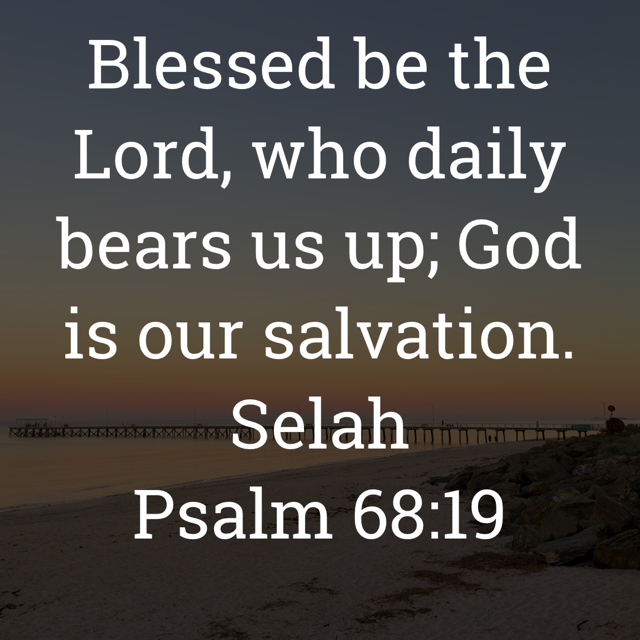
Psalm 68:19. “Blessed be the Lord, who daily bears us up; God is our salvation. Selah”
Literary and Biblical Context
Psalm 68 is a Davidic song of God’s victorious presence. It recalls God arising to scatter his enemies, leading Israel through the wilderness, caring for the vulnerable, triumphing from Sinai to Zion, and summoning the nations to praise him (Psalm 68:1–18, 24–35). Verse 19 stands near the theological centre of the psalm. The divine Warrior who rules in majesty is also the compassionate Lord who sustains his people day after day.
The immediate movement is important. Psalm 68:18 celebrates God’s ascent in victory; Psalm 68:19 turns that victory into praise for his daily care; and Psalm 68:20 declares that escape from death belongs to the Lord. The verse therefore joins God’s cosmic kingship with his personal, covenant faithfulness.
1. Exegesis of Psalm 68:19
“Blessed be the Lord”
The verse begins with worship, not anxiety. “Blessed” calls the congregation to speak well of the Lord because his character and works deserve praise. The title “Lord” presents him as the sovereign ruler whose victory has just been celebrated. Praise is therefore a reasoned response to revelation, not a denial of hardship.
“Who daily bears us up”
The English Standard Version reads the Hebrew verb as God’s sustaining action: he “bears us up.” The expression “day by day” gives this care a steady rhythm. God does not merely intervene at rare moments of crisis; he continually carries his covenant people. The underlying verb can carry the idea of bearing a load, which explains differing translations, but the English Standard Version rightly places the emphasis on God sustaining his people. This fits Psalm 68, where God leads, provides, protects, and strengthens those who depend on him (Psalm 68:5–10, 28, 35).
“God is our salvation”
Salvation is not treated merely as a gift detached from the Giver. God himself is the saving God. In this psalm, salvation includes deliverance from enemies and escape from death (Psalm 68:20–23), yet the whole Book of Psalms also directs hope towards forgiveness, covenant fellowship, righteous rule, and final refuge in the Lord (Psalm 2; Psalm 32; Psalm 46; Psalm 110). The possessive “our” is both personal and corporate: the worshipping people confess together that their safety rests in God.
“Selah”
“Selah” most likely signals a musical or reflective pause. Its precise function is uncertain, so it should not bear doctrinal weight. Here, it invites worshippers to stop and consider the union of daily preservation and divine salvation.
2. Theological Teaching
- Providence: God preserves and governs his creatures and all their actions. His care is continuous, wise, holy, and fatherly, even when his purposes remain hidden (Matthew 6:25–34; Romans 8:28).
- Grace and dependence: God bears his people; they do not bear themselves into his favour. This accords with salvation by grace alone, received through faith alone, rather than earned by human effort (Ephesians 2:8–10).
- Covenant faithfulness: The God who carried Israel remains faithful to his promises. His daily help rests on his character, not on the constancy of our feelings (Deuteronomy 1:31; Isaiah 46:3–4).
- Christ-centred fulfilment: The New Testament applies the preceding verse, Psalm 68:18, to the ascended Christ who gives gifts to his church (Ephesians 4:7–12). Christians therefore read Psalm 68:19 in the light of Christ’s victory, mediation, and continuing care, without collapsing the original Old Testament setting into the later fulfilment.
- Corporate salvation: “Our salvation” reminds believers that grace gathers a people. Christian dependence is personal, but never merely private (1 Peter 2:9–10).
3. Practical Application to Modern Christian Living
- Begin with praise: Name God’s character before rehearsing your fears. Praise reorients the heart towards what is eternally true.
- Receive daily grace: Bring today’s duties, griefs, temptations, and uncertainties to God. Do not demand tomorrow’s strength in advance (Matthew 6:34).
- Reject self-sufficiency: Faithful planning matters, but confidence must rest in the Lord rather than competence, health, money, or control (Proverbs 3:5–6; James 4:13–16).
- Use ordinary means of Grace: God commonly sustains believers through Scripture, prayer, gathered worship, the sacraments, and the fellowship of the church (Acts 2:42; Hebrews 10:24–25).
- Help carry others: Those upheld by God should bear one another’s burdens with patience and practical care (Galatians 6:2). This does not replace God’s work; it is often one means by which he supplies it.
- Face suffering honestly: The verse does not promise an easy life or immediate removal of every burden. It promises the presence and preserving grace of the saving God.
4. Meditation Guide
Settle
Sit quietly for a few moments. Acknowledge that you live before the sovereign and saving God. Ask the Holy Spirit to steady your attention through the written Word.
Read
Read Psalm 68:19 slowly three times.
“Blessed be the Lord, who daily bears us up; God is our salvation. Selah”
On the first reading, notice who God is.
On the second,
“Blessed be the Lord, who daily bears us up; God is our salvation. Selah”
notice what God does.
On the third,
“Blessed be the Lord, who daily bears us up; God is our salvation. Selah”
notice the communal words “us” and “our.”
Reflect
- What burden am I trying to carry as though everything depended on me?
- Where have I seen God sustain me day by day?
- How does God’s victory in Psalm 68 enlarge my view of his ability to preserve me?
- Whose burden might God be calling me to help carry?
Respond
Confess self-reliance. Thank God for one specific evidence of his daily care. Entrust one present burden to him, and ask for grace to obey in the next faithful step.
Pray
Lord God, you are my salvation. I praise you because you rule with power and care for your people with compassion. Forgive my self-reliance. Bear me up today, keep me close to Christ, and make me ready to serve others. Amen.
Remember
Carry this sentence into the day: The God who saves me is the God who sustains me today.
Unless otherwise indicated, all Scripture quotations are from the ESV® Bible (The Holy Bible, English Standard Version®), © 2001 by Crossway, a publishing ministry of Good News Publishers. ESV Text Edition: 2025. Used by permission. All rights reserved.
Discover more from Daily bible verses
Subscribe to get the latest posts sent to your email.


You must be logged in to post a comment.