
Commentary on Romans 3:23–24
The Text (King James Version)
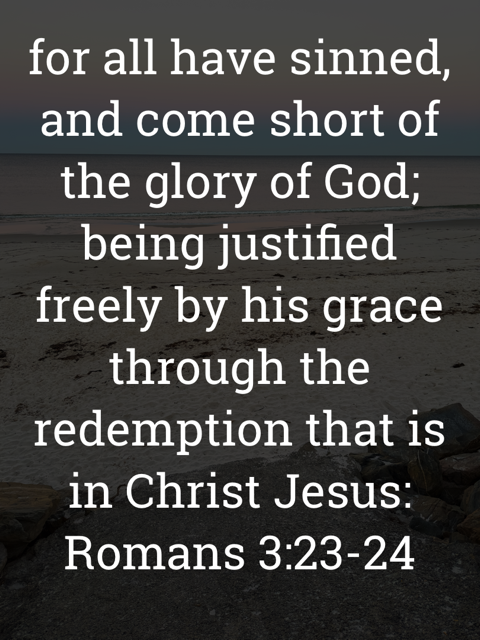
Romans 3:23 — “For all have sinned, and come short of the glory of God.”
Romans 3:24 — “Being justified freely by his grace through the redemption that is in Christ Jesus.”
1. Setting the Scene: Romans 3
Romans 3[i] is the Apostle Paul’s climactic argument that every human being, without exception, stands guilty before God. He has already shown that Gentiles are without excuse (Romans 1) and that Jews, though privileged with the law, are also guilty (Romans 2). In Romans 3, he brings both groups together under one verdict.
Paul writes:
Romans 3:10 — “As it is written, There is none righteous, no, not one.”
Romans 3:19 — “Now we know that what things soever the law saith, it saith to them who are under the law: that every mouth may be stopped, and all the world may become guilty before God.”
The law exposes sin but cannot remove it. Humanity’s universal problem demands a universal solution. That solution is revealed in Romans 3:21–26, where Paul unfolds the heart of the gospel: righteousness from God, given through faith in Jesus Christ.
21 But now the righteousness of God without the law is manifested, being witnessed by the law and the prophets;
22 Even the righteousness of God which is by faith of Jesus Christ unto all and upon all them that believe: for there is no difference:
23 For all have sinned, and come short of the glory of God;
24 Being justified freely by his grace through the redemption that is in Christ Jesus:
25 Whom God hath set forth to be a propitiation through faith in his blood, to declare his righteousness for the remission of sins that are past, through the forbearance of God;
26 To declare, I say, at this time his righteousness: that he might be just, and the justifier of him which believeth in Jesus.
2. Exegetical Commentary on Romans 3:23–24
Verse 23: “For all have sinned, and come short of the glory of God.”
This is one of the clearest and most comprehensive statements about the human condition in all of Scripture.
- “All have sinned” — Sin is not merely wrongdoing; it is rebellion against God, falling short of his perfect standard. Paul’s use of “all” is absolute. No ethnicity, culture, moral background, or religious heritage exempts anyone.
- “Come short of the glory of God” — The phrase points to humanity’s failure to reflect God’s character and holiness. We were created to bear his image, to display his glory in our lives. Instead, we fall short, not by a small margin but by an infinite distance.
Paul’s point is not to crush us but to level the ground. Before God, every person stands in need of mercy.
Verse 24: “Being justified freely by his grace through the redemption that is in Christ Jesus.”
If verse 23 is the diagnosis, verse 24 is the cure.
- “Being justified” — To justify is a legal declaration. God, the righteous judge, pronounces sinners “righteous” in his sight. This is not because of anything we have done but because of what Christ has done.
- “Freely” — The word means “as a gift,” without cost to us. Salvation is not earned, deserved, or achieved. It is given.
- “By his grace” — Grace is God’s undeserved favour. It is not God helping those who help themselves; it is God rescuing those who cannot help themselves.
- “Through the redemption that is in Christ Jesus” — Redemption refers to a price paid to set someone free. In the ancient world it described the freeing of slaves. Christ’s death is the ransom that liberates us from sin’s penalty and power.
Paul’s argument is that justification is entirely God’s work, accomplished through Christ, received by faith, and grounded in grace.
3. Theological Teaching
A. Universal Sinfulness
Romans 3:23 affirms the Christian doctrine of total depravity. This does not mean people are as bad as they could be, but that sin affects every part of human nature. No one can meet God’s standard.
B. Justification by Grace Alone
Romans 3:24 is a cornerstone of Christian theology. Justification is:
- a declaration, not a process
- based on Christ’s work, not ours
- received by faith, not by works
- rooted in grace, not merit
This aligns with the Christian emphasis on sola gratia (grace alone) and solus Christus (Christ alone).
C. Redemption in Christ
Christ’s death is substitutionary. He pays the price we could never pay. Redemption is not a vague spiritual idea; it is a concrete transaction grounded in the cross.
D. The Glory of God
Humanity’s problem is not merely moral failure but falling short of God’s glory. Salvation restores us to a relationship with God and begins the renewal of his image in us.
4. Meditation Guide for Personal and Group Use
A. Reflect on Your Need
Read Romans 3:23 slowly.
For all have sinned, and come short of the glory of God;
Ask yourself:
- Where do I see the reality of sin in my life?
- In what ways do I fall short of God’s glory?
- Do I acknowledge my need for grace, or do I still try to justify myself?
Let the Spirit convict, not condemn. Conviction leads to Christ.
B. Rest in God’s Grace
Meditate on Romans 3:24.
Being justified freely by his grace through the redemption that is in Christ Jesus:
Consider:
- God justifies you freely.
- His grace is not reluctant but abundant.
- Christ’s redemption is complete and final.
Pray:
“Father, thank you that my standing with you does not depend on my performance but on Christ’s finished work.”
C. Respond with Gratitude
Grace produces gratitude, not complacency.
Ask:
- How does God’s grace shape the way I treat others?
- How does justification free me from guilt and striving?
- How can I live today as someone redeemed by Christ?
D. Rejoice in the Gospel
Romans 3:23–24 is not merely a theological statement; it is a song of rescue.
Let it lead you to worship.
5. Application to Modern Christian Living
A. Humility in Community
Since all have sinned, no Christian can boast. This shapes how we relate to one another in church, family, and workplace. We stand on equal ground at the foot of the cross.
B. Confidence in Christ
Justification frees us from the exhausting cycle of self-justification. We do not need to prove ourselves to God or others. Our identity is secure in Christ.
C. Compassion for Others
Understanding universal sinfulness helps us show patience and grace to others. We are all broken people in need of redemption.
D. Motivation for Mission
If all have sinned and Christ alone redeems, then the gospel is urgently needed. This fuels evangelism, prayer, and service.
[i] Romans 3
King James Version
3 What advantage then hath the Jew? or what profit is there of circumcision?
2 Much every way: chiefly, because that unto them were committed the oracles of God.
3 For what if some did not believe? shall their unbelief make the faith of God without effect?
4 God forbid: yea, let God be true, but every man a liar; as it is written, That thou mightest be justified in thy sayings, and mightest overcome when thou art judged.
5 But if our unrighteousness commend the righteousness of God, what shall we say? Is God unrighteous who taketh vengeance? (I speak as a man)
6 God forbid: for then how shall God judge the world?
7 For if the truth of God hath more abounded through my lie unto his glory; why yet am I also judged as a sinner?
8 And not rather, (as we be slanderously reported, and as some affirm that we say,) Let us do evil, that good may come? whose damnation is just.
9 What then? are we better than they? No, in no wise: for we have before proved both Jews and Gentiles, that they are all under sin;
10 As it is written, There is none righteous, no, not one:
11 There is none that understandeth, there is none that seeketh after God.
12 They are all gone out of the way, they are together become unprofitable; there is none that doeth good, no, not one.
13 Their throat is an open sepulchre; with their tongues they have used deceit; the poison of asps is under their lips:
14 Whose mouth is full of cursing and bitterness:
15 Their feet are swift to shed blood:
16 Destruction and misery are in their ways:
17 And the way of peace have they not known:
18 There is no fear of God before their eyes.
19 Now we know that what things soever the law saith, it saith to them who are under the law: that every mouth may be stopped, and all the world may become guilty before God.
20 Therefore by the deeds of the law there shall no flesh be justified in his sight: for by the law is the knowledge of sin.
21 But now the righteousness of God without the law is manifested, being witnessed by the law and the prophets;
22 Even the righteousness of God which is by faith of Jesus Christ unto all and upon all them that believe: for there is no difference:
23 For all have sinned, and come short of the glory of God;
24 Being justified freely by his grace through the redemption that is in Christ Jesus:
25 Whom God hath set forth to be a propitiation through faith in his blood, to declare his righteousness for the remission of sins that are past, through the forbearance of God;
26 To declare, I say, at this time his righteousness: that he might be just, and the justifier of him which believeth in Jesus.
27 Where is boasting then? It is excluded. By what law? of works? Nay: but by the law of faith.
28 Therefore we conclude that a man is justified by faith without the deeds of the law.
29 Is he the God of the Jews only? is he not also of the Gentiles? Yes, of the Gentiles also:
30 Seeing it is one God, which shall justify the circumcision by faith, and uncircumcision through faith.
31 Do we then make void the law through faith? God forbid: yea, we establish the law.
Discover more from Daily bible verses
Subscribe to get the latest posts sent to your email.


You must be logged in to post a comment.