
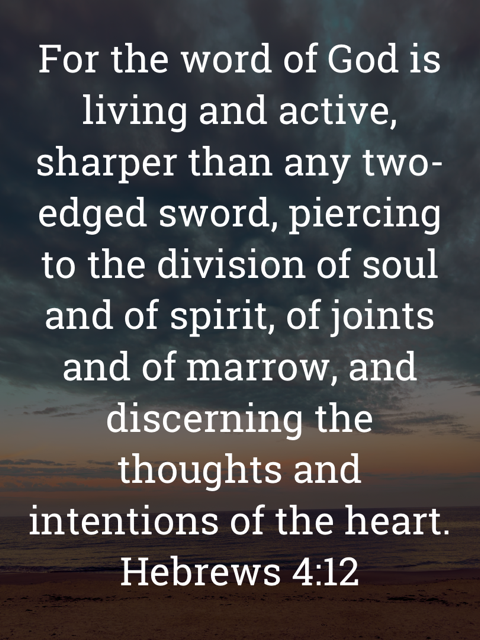
Devotion on Hebrews 4:12
Hebrews 4
English Standard Version
4 Therefore, while the promise of entering his rest still stands, let us fear lest any of you should seem to have failed to reach it. 2 For good news came to us just as to them, but the message they heard did not benefit them, because they were not united by faith with those who listened.[a] 3 For we who have believed enter that rest, as he has said,
“As I swore in my wrath,
‘They shall not enter my rest,’”
although his works were finished from the foundation of the world. 4 For he has somewhere spoken of the seventh day in this way: “And God rested on the seventh day from all his works.” 5 And again in this passage he said,
“They shall not enter my rest.”
6 Since therefore it remains for some to enter it, and those who formerly received the good news failed to enter because of disobedience, 7 again he appoints a certain day, “Today,” saying through David so long afterward, in the words already quoted,
“Today, if you hear his voice,
do not harden your hearts.”
8 For if Joshua had given them rest, God[b] would not have spoken of another day later on. 9 So then, there remains a Sabbath rest for the people of God, 10 for whoever has entered God’s rest has also rested from his works as God did from his.
11 Let us therefore strive to enter that rest, so that no one may fall by the same sort of disobedience. 12 For the word of God is living and active, sharper than any two-edged sword, piercing to the division of soul and of spirit, of joints and of marrow, and discerning the thoughts and intentions of the heart. 13 And no creature is hidden from his sight, but all are naked and exposed to the eyes of him to whom we must give account.
Jesus the Great High Priest
14 Since then we have a great high priest who has passed through the heavens, Jesus, the Son of God, let us hold fast our confession. 15 For we do not have a high priest who is unable to sympathise with our weaknesses, but one who in every respect has been tempted as we are, yet without sin. 16 Let us then with confidence draw near to the throne of grace, that we may receive mercy and find grace to help in time of need.
- Hebrews 4:2 Some manuscripts it did not meet with faith in the hearers
- Hebrews 4:8 Greek he
The ESV® Bible (The Holy Bible, English Standard Version®), © 2001 by Crossway, a publishing ministry of Good News Publishers. ESV Text Edition: 2025.
God’s searching word removes our pretences, but the surrounding passage does not leave us without hope. It directs us to Jesus, our merciful high priest. The faithful response is neither hiding nor despair, but repentance, trust, and perseverance.
1. Exegesis
The passage’s argument. Hebrews 3:7–4:13 draws on Psalm 95:7–11 to warn against hardened unbelief. Hebrews 4:1–10 connects God’s rest with creation and shows that Joshua’s provision of rest was not its final fulfilment. Believers already participate through faith, yet await its completion. Verse 12 explains why the call to persevere in Hebrews 4:11 is urgent: God’s speech exposes whether our response is genuine.
- The opening conjunction: The English Standard Version presents verse 12 as the reason for the preceding exhortation, not an isolated slogan about Bible reading. God’s promise and warning demand a faithful response.
- God’s word: In this context, the expression primarily means God’s authoritative speech, including the scriptural warning and promise just expounded. Scripture remains his present address, as Hebrews 3:7 indicates. The expression need not be read as a direct title for Jesus, although Hebrews 1:1–3 locates God’s definitive revelation in the Son.
- Life and effective action: The English Standard Version’s description emphasises that God’s speech is neither obsolete nor inert. It accomplishes his purposes and confronts hearers with his authority. Hebrews 4:2 nevertheless rules out automatic saving benefit from merely hearing it.
- The sword comparison: God’s word penetrates more searchingly than any physical blade. This is an image of spiritual exposure and judgement, not permission for aggression.
- Soul, spirit, joints, and marrow: The paired terms emphasise the depth of that penetration. Nothing within us escapes God’s scrutiny. The verse does not settle a debate about whether human beings consist of two or three distinct components.
- Inner judgement: The English Standard Version’s concluding emphasis reaches both inward reasoning and underlying purposes. God assesses not only what we do, but why we do it. Hebrews 4:13 makes accountability to God explicit.
Hebrews 4:12–13 exposes us; Hebrews 4:14–16 then directs exposed and needy people to the sinless Son of God. His sympathetic priesthood gives believers a secure basis for seeking mercy. The searching word should lead us towards Christ, not away from him. This is movement from exposure to grace.
2. Theological teaching
- God speaks with authority. Scripture is not merely material for personal inspiration. Through it, God addresses his people, corrects unbelief, and calls for obedient faith. Its authority rests on God, not on our emotional response (Hebrews 3:7–13; 4:12–13).
- Grace produces persevering faith. In Christian theology, God preserves believers through means that include his promises, warnings, and the encouragement of the church. Perseverance does not purchase salvation; it expresses continuing dependence on Christ. The warning remains serious rather than hypothetical (Hebrews 3:12–14; 4:1–3, 11).
- Saving reception requires the Spirit’s work. Mere familiarity with Scripture is not saving faith. The Holy Spirit brings people to receive God’s word with trust and works through it to renew them. This wider biblical teaching supports the application; Hebrews 4:12 itself chiefly stresses searching exposure (Hebrews 4:2; 1 Thessalonians 2:13; 1 Peter 1:23).
- Christ is our sufficient mediator. God’s complete knowledge reveals our need, while Jesus’ sinless priesthood and once-for-all sacrifice supply the answer. Acceptance rests on his saving work, not on successful self-examination or a flawless devotional routine (Hebrews 4:14–16; 7:25; 10:10–14).
3. Practical application
- Read attentively. Read Hebrews 4 as a whole. Ask what God promises, what he warns against, and how the passage directs you to Jesus. Receive Scripture as an address to you, not merely a resource for correcting others.
- Examine motives honestly. Consider whether service conceals a desire for recognition, busyness avoids dependence on God, or outward agreement hides resistance. Confess a specific sin without treating every unwanted thought or feeling as proof of unbelief.
- Respond rather than postpone. Choose one concrete act of obedience: speak truthfully, apologise, honour a commitment, or offer practical care. These are responses to grace, not payments for it.
- Stay connected to the church. Receive faithful preaching, pray with others, and welcome gentle correction. Hebrews addresses a community: perseverance is not a solitary project (Hebrews 3:13; 10:24–25).
- Let conviction lead to confidence in Christ. When Scripture exposes sin, seek mercy rather than withdraw from prayer. If reflection becomes repetitive self-accusation, speak with a trusted pastor. The goal is renewed faith and obedience, not endless inward scrutiny (Hebrews 4:14–16).
4. Meditation Guide
Set aside about ten minutes. Keep your Bible open, and allow the passage—not your feelings alone—to guide reflection.
- Prepare. Ask the Holy Spirit for understanding, honesty, and confidence in Jesus.
- Read. Read Hebrews 4:1–16,
4 Therefore, while the promise of entering his rest still stands, let us fear lest any of you should seem to have failed to reach it. 2 For good news came to us just as to them, but the message they heard did not benefit them, because they were not united by faith with those who listened. 3 For we who have believed enter that rest, as he has said,
“As I swore in my wrath,
‘They shall not enter my rest,’”
although his works were finished from the foundation of the world. 4 For he has somewhere spoken of the seventh day in this way: “And God rested on the seventh day from all his works.” 5 And again in this passage he said,
“They shall not enter my rest.”
6 Since therefore it remains for some to enter it, and those who formerly received the good news failed to enter because of disobedience, 7 again he appoints a certain day, “Today,” saying through David so long afterward, in the words already quoted,
“Today, if you hear his voice,
do not harden your hearts.”
8 For if Joshua had given them rest, God would not have spoken of another day later on. 9 So then, there remains a Sabbath rest for the people of God, 10 for whoever has entered God’s rest has also rested from his works as God did from his.
11 Let us therefore strive to enter that rest, so that no one may fall by the same sort of disobedience. 12 For the word of God is living and active, sharper than any two-edged sword, piercing to the division of soul and of spirit, of joints and of marrow, and discerning the thoughts and intentions of the heart. 13 And no creature is hidden from his sight, but all are naked and exposed to the eyes of him to whom we must give account.
14 Since then we have a great high priest who has passed through the heavens, Jesus, the Son of God, let us hold fast our confession. 15 For we do not have a high priest who is unable to sympathise with our weaknesses, but one who in every respect has been tempted as we are, yet without sin. 16 Let us then with confidence draw near to the throne of grace, that we may receive mercy and find grace to help in time of need.
then return to Hebrews 4:11–16.
11 Let us therefore strive to enter that rest, so that no one may fall by the same sort of disobedience. 12 For the word of God is living and active, sharper than any two-edged sword, piercing to the division of soul and of spirit, of joints and of marrow, and discerning the thoughts and intentions of the heart. 13 And no creature is hidden from his sight, but all are naked and exposed to the eyes of him to whom we must give account.
14 Since then we have a great high priest who has passed through the heavens, Jesus, the Son of God, let us hold fast our confession. 15 For we do not have a high priest who is unable to sympathise with our weaknesses, but one who in every respect has been tempted as we are, yet without sin. 16 Let us then with confidence draw near to the throne of grace, that we may receive mercy and find grace to help in time of need.
Notice the movement from persevering faith, through exposure, to priestly mercy. - Consider. What does God’s searching knowledge reveal about the limits of outward appearances? Where am I resisting his promise or warning?
- Confess. Name one clear instance of disobedience. Avoid trying to catalogue every possible fault. Remember that God’s knowledge is complete even when yours is not.
- Look to Christ. Reflect on Hebrews 4:14–16. Ask how Jesus’ sinlessness, sympathy, and priesthood answer your need. Your hope rests in him, not in the intensity of your remorse.
- Respond. Identify one act of faithful obedience for today and one way to encourage another believer.
Prayer: Father, you know me completely. Expose the unbelief and self-deception I would rather conceal. By your Spirit, lead me to repent and trust your Son. Thank you for his sufficient sacrifice and compassionate priesthood. Help me receive your word, encourage your people, and obey with humble confidence. Amen.
Unless otherwise indicated, all Scripture quotations are from the ESV® Bible (The Holy Bible, English Standard Version®), © 2001 by Crossway, a publishing ministry of Good News Publishers. ESV Text Edition: 2025. Used by permission. All rights reserved.
Discover more from Daily bible verses
Subscribe to get the latest posts sent to your email.


You must be logged in to post a comment.