
Devotion on Hebrews 4:16
Hebrews 4
English Standard Version
4 Therefore, while the promise of entering his rest still stands, let us fear lest any of you should seem to have failed to reach it. 2 For good news came to us just as to them, but the message they heard did not benefit them, because they were not united by faith with those who listened.[a] 3 For we who have believed enter that rest, as he has said,
“As I swore in my wrath,
‘They shall not enter my rest,’”
although his works were finished from the foundation of the world. 4 For he has somewhere spoken of the seventh day in this way: “And God rested on the seventh day from all his works.” 5 And again in this passage he said,
“They shall not enter my rest.”
6 Since therefore it remains for some to enter it, and those who formerly received the good news failed to enter because of disobedience, 7 again he appoints a certain day, “Today,” saying through David so long afterward, in the words already quoted,
“Today, if you hear his voice,
do not harden your hearts.”
8 For if Joshua had given them rest, God[b] would not have spoken of another day later on. 9 So then, there remains a Sabbath rest for the people of God, 10 for whoever has entered God’s rest has also rested from his works as God did from his.
11 Let us therefore strive to enter that rest, so that no one may fall by the same sort of disobedience. 12 For the word of God is living and active, sharper than any two-edged sword, piercing to the division of soul and of spirit, of joints and of marrow, and discerning the thoughts and intentions of the heart. 13 And no creature is hidden from his sight, but all are naked and exposed to the eyes of him to whom we must give account.
Jesus the Great High Priest
14 Since then we have a great high priest who has passed through the heavens, Jesus, the Son of God, let us hold fast our confession. 15 For we do not have a high priest who is unable to sympathise with our weaknesses, but one who in every respect has been tempted as we are, yet without sin. 16 Let us then with confidence draw near to the throne of grace, that we may receive mercy and find grace to help in time of need.
- Hebrews 4:2 Some manuscripts it did not meet with faith in the hearers
- Hebrews 4:8 Greek he
The ESV® Bible (The Holy Bible, English Standard Version®), © 2001 by Crossway, a publishing ministry of Good News Publishers. ESV Text Edition: 2025.
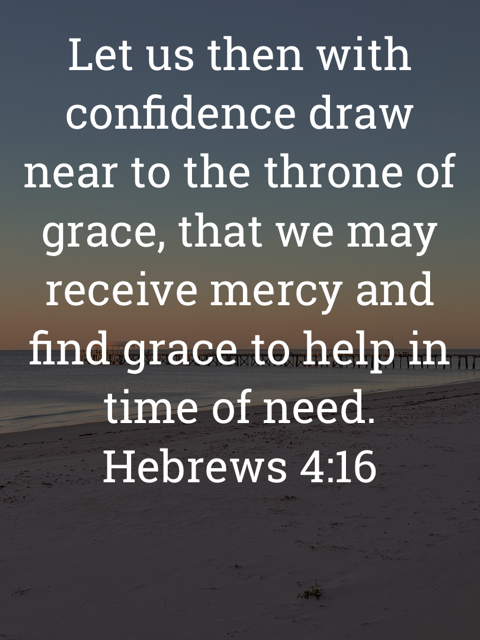
Hebrews 4:16. “Let us then with confidence draw near to the throne of grace, that we may receive mercy and find grace to help in time of need.”
1. Exegesis
The chapter and book. Hebrews calls believers to persevere in Jesus rather than turn away under pressure. Hebrews 3:7–4:11 uses Israel’s unbelief to warn against missing God’s promised rest. Believers already enter that rest through faith, yet its fullness remains ahead; the call to diligence is not a command to earn salvation. God’s searching word exposes the heart, and everyone must answer to him (Hebrews 4:12–13). The answer to this exposure is not concealment, but the heavenly priesthood of Jesus (Hebrews 4:14–16).
“Let us then.” The invitation follows from the preceding argument: Jesus is the exalted Son of God and a high priest who understands human weakness through real temptation, without himself sinning (Hebrews 4:14–15). His compassion does not excuse sin; his sinlessness makes him the dependable Saviour sinners need. The plural invitation addresses the believing community, not merely isolated individuals.
“With confidence draw near.” In the English Standard Version, confidence describes how believers approach God. It is not self-confidence, entitlement, or confidence in the intensity of prayer. It rests on Christ’s mediation. Drawing near is priestly language for access to God, expressed especially in prayer and worship. Hebrews 10:19–22 later makes its basis explicit: Jesus’ blood opens the way. Assurance of access in Christ is not in our worthiness.
“The throne of grace.” God remains the sovereign, holy ruler before whom we are accountable. Grace does not abolish his justice: Christ’s sacrifice provides the ground of reconciliation (Hebrews 9:11–14). The sanctuary background in Hebrews 9:1–7 helps explain the significance of access, but the verse does not explicitly identify the throne with the earthly mercy seat.
“Receive mercy and find grace to help in time of need.” These verbs describe receiving, not earning. Mercy is God’s compassion towards the needy, including sinners who seek forgiveness; grace is his undeserved favour supplying help. They overlap rather than form a rigid division between past forgiveness and future strength. The English Standard Version’s final phrase promises help appropriate to need, not immediate removal of every difficulty. Reverent, dependent prayer and timely help; urgency of responding while God calls.
2. Theological Teaching
Christ alone is our mediator. Jesus is truly God and truly human, with no sin of his own. His completed sacrifice and continuing intercession secure access to God; no additional mediator or sacrifice is needed (Hebrews 7:24–28; Hebrews 10:10–22).
Grace grounds acceptance and growth. In Christian theology, justification means God’s gracious acceptance of sinners on the basis of Christ’s righteousness, received through faith, not earned by obedience. Hebrews 4:16 does not state this entire doctrine, but its invitation accords with it. Sanctification, the ongoing growth of believers in holiness, is also dependent on grace: Christ’s decisive offering does not make obedience unnecessary (Hebrews 10:14).
Assurance encourages perseverance. God preserves his people through Christ, while calling them genuinely to trust, pray, and obey. The warnings in Hebrews are not cancelled by its promises. Drawing near is one way believers depend on God’s preserving grace rather than on themselves (Hebrews 4:1–16; Hebrews 7:25; Hebrews 10:35–39). Weak feelings of assurance do not make Christ’s priesthood weak.
3. Practical Application
- When guilt leads to avoidance: confess honestly, ask for mercy through Jesus, and take a concrete step of repentance. Do not wait to make yourself worthy before praying.
- When temptation grows: pray before the crisis, identify the pressure, and seek trustworthy Christian support. Grace supplies help for obedience, not permission to continue in sin.
- When work, caregiving, illness, or grief feels overwhelming: ask for specific help and endurance. Receiving help may involve ordinary care and support; continuing hardship is not proof that God has rejected you.
- When faith becomes private or distracted: make space for Scripture, prayer, and gathered worship. Pray with others and offer practical encouragement, remembering the community addressed by the invitation (Hebrews 10:24–25).
Devotional focus: bring your actual need to God because Christ is sufficient, not because you feel sufficient. The promise sustains faithful endurance; it is not a guarantee of prosperity or a trouble-free life (Hebrews 10:32–36).
4. Meditation Guide
Use these steps slowly, alone or with another Christian. Begin by reading Hebrews 4,
4 Therefore, while the promise of entering his rest still stands, let us fear lest any of you should seem to have failed to reach it. 2 For good news came to us just as to them, but the message they heard did not benefit them, because they were not united by faith with those who listened. 3 For we who have believed enter that rest, as he has said,
“As I swore in my wrath,
‘They shall not enter my rest,’”
although his works were finished from the foundation of the world. 4 For he has somewhere spoken of the seventh day in this way: “And God rested on the seventh day from all his works.” 5 And again in this passage he said,
“They shall not enter my rest.”
6 Since therefore it remains for some to enter it, and those who formerly received the good news failed to enter because of disobedience, 7 again he appoints a certain day, “Today,” saying through David so long afterward, in the words already quoted,
“Today, if you hear his voice,
do not harden your hearts.”
8 For if Joshua had given them rest, God would not have spoken of another day later on. 9 So then, there remains a Sabbath rest for the people of God, 10 for whoever has entered God’s rest has also rested from his works as God did from his.
11 Let us therefore strive to enter that rest, so that no one may fall by the same sort of disobedience. 12 For the word of God is living and active, sharper than any two-edged sword, piercing to the division of soul and of spirit, of joints and of marrow, and discerning the thoughts and intentions of the heart. 13 And no creature is hidden from his sight, but all are naked and exposed to the eyes of him to whom we must give account.
14 Since then we have a great high priest who has passed through the heavens, Jesus, the Son of God, let us hold fast our confession. 15 For we do not have a high priest who is unable to sympathise with our weaknesses, but one who in every respect has been tempted as we are, yet without sin. 16 Let us then with confidence draw near to the throne of grace, that we may receive mercy and find grace to help in time of need.
then return to Hebrews 4:14–16.
14 Since then we have a great high priest who has passed through the heavens, Jesus, the Son of God, let us hold fast our confession. 15 For we do not have a high priest who is unable to sympathise with our weaknesses, but one who in every respect has been tempted as we are, yet without sin. 16 Let us then with confidence draw near to the throne of grace, that we may receive mercy and find grace to help in time of need.
- Notice: how does the invitation follow the warning and the description of Jesus? What makes confidence possible?
- Examine: where am I hiding, hardening my heart, or relying on myself? Name one sin, weakness, or burden without making excuses.
- Remember: consider Jesus’ sinless compassion and continuing intercession (Hebrews 4:15; Hebrews 7:25). How does this challenge my picture of God’s willingness to receive me?
- Pray: ask for mercy and the particular help you need. Include someone else who is struggling.
- Respond: choose one act of obedience today, such as seeking forgiveness, resisting a temptation, or encouraging a weary believer. Return to the verse when anxiety or shame returns.
Suggested prayer: Father, you know my need and see my sin. Thank you that Jesus opens the way to you. Forgive me, strengthen my trust, and help me obey. Give me patience in hardship and compassion for others. I come through Jesus, not through my own goodness. Amen.
Unless otherwise indicated, all Scripture quotations are from the ESV® Bible (The Holy Bible, English Standard Version®), © 2001 by Crossway, a publishing ministry of Good News Publishers. ESV Text Edition: 2025. Used by permission. All rights reserved.
Discover more from Daily bible verses
Subscribe to get the latest posts sent to your email.


You must be logged in to post a comment.