
Commentary on Deuteronomy 31:8
Deuteronomy 31
King James Version
31 And Moses went and spake these words unto all Israel.
2 And he said unto them, I am an hundred and twenty years old this day; I can no more go out and come in: also the LORD hath said unto me, Thou shalt not go over this Jordan.
3 The LORD thy God, he will go over before thee, and he will destroy these nations from before thee, and thou shalt possess them: and Joshua, he shall go over before thee, as the LORD hath said.
4 And the LORD shall do unto them as he did to Sihon and to Og, kings of the Amorites, and unto the land of them, whom he destroyed.
5 And the LORD shall give them up before your face, that ye may do unto them according unto all the commandments which I have commanded you.
6 Be strong and of a good courage, fear not, nor be afraid of them: for the LORD thy God, he it is that doth go with thee; he will not fail thee, nor forsake thee.
7 And Moses called unto Joshua, and said unto him in the sight of all Israel, Be strong and of a good courage: for thou must go with this people unto the land which the LORD hath sworn unto their fathers to give them; and thou shalt cause them to inherit it.
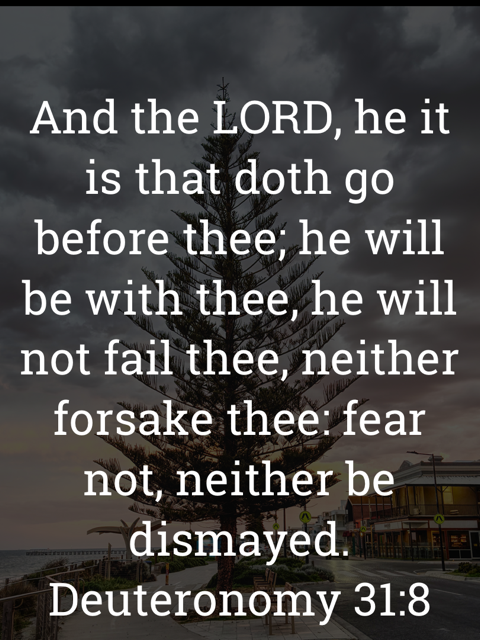
8 And the LORD, he it is that doth go before thee; he will be with thee, he will not fail thee, neither forsake thee: fear not, neither be dismayed.
9 And Moses wrote this law, and delivered it unto the priests the sons of Levi, which bare the ark of the covenant of the LORD, and unto all the elders of Israel.
10 And Moses commanded them, saying, At the end of every seven years, in the solemnity of the year of release, in the feast of tabernacles,
11 When all Israel is come to appear before the LORD thy God in the place which he shall choose, thou shalt read this law before all Israel in their hearing.
12 Gather the people together, men and women, and children, and thy stranger that is within thy gates, that they may hear, and that they may learn, and fear the LORD your God, and observe to do all the words of this law:
13 And that their children, which have not known any thing, may hear, and learn to fear the LORD your God, as long as ye live in the land whither ye go over Jordan to possess it.
14 And the LORD said unto Moses, Behold, thy days approach that thou must die: call Joshua, and present yourselves in the tabernacle of the congregation, that I may give him a charge. And Moses and Joshua went, and presented themselves in the tabernacle of the congregation.
15 And the LORD appeared in the tabernacle in a pillar of a cloud: and the pillar of the cloud stood over the door of the tabernacle.
16 And the LORD said unto Moses, Behold, thou shalt sleep with thy fathers; and this people will rise up, and go a whoring after the gods of the strangers of the land, whither they go to be among them, and will forsake me, and break my covenant which I have made with them.
17 Then my anger shall be kindled against them in that day, and I will forsake them, and I will hide my face from them, and they shall be devoured, and many evils and troubles shall befall them; so that they will say in that day, Are not these evils come upon us, because our God is not among us?
18 And I will surely hide my face in that day for all the evils which they shall have wrought, in that they are turned unto other gods.
19 Now therefore write ye this song for you, and teach it the children of Israel: put it in their mouths, that this song may be a witness for me against the children of Israel.
20 For when I shall have brought them into the land which I sware unto their fathers, that floweth with milk and honey; and they shall have eaten and filled themselves, and waxen fat; then will they turn unto other gods, and serve them, and provoke me, and break my covenant.
21 And it shall come to pass, when many evils and troubles are befallen them, that this song shall testify against them as a witness; for it shall not be forgotten out of the mouths of their seed: for I know their imagination which they go about, even now, before I have brought them into the land which I sware.
22 Moses therefore wrote this song the same day, and taught it the children of Israel.
23 And he gave Joshua the son of Nun a charge, and said, Be strong and of a good courage: for thou shalt bring the children of Israel into the land which I sware unto them: and I will be with thee.
24 And it came to pass, when Moses had made an end of writing the words of this law in a book, until they were finished,
25 That Moses commanded the Levites, which bare the ark of the covenant of the LORD, saying,
26 Take this book of the law, and put it in the side of the ark of the covenant of the LORD your God, that it may be there for a witness against thee.
27 For I know thy rebellion, and thy stiff neck: behold, while I am yet alive with you this day, ye have been rebellious against the LORD; and how much more after my death?
28 Gather unto me all the elders of your tribes, and your officers, that I may speak these words in their ears, and call heaven and earth to record against them.
29 For I know that after my death ye will utterly corrupt yourselves, and turn aside from the way which I have commanded you; and evil will befall you in the latter days; because ye will do evil in the sight of the LORD, to provoke him to anger through the work of your hands.
30 And Moses spake in the ears of all the congregation of Israel the words of this song, until they were ended.
Key text: Deuteronomy 31:8. “And the LORD, he it is that doth go before thee; he will be with thee, he will not fail thee, neither forsake thee: fear not, neither be dismayed.”
1. Passage setting
Deuteronomy 31 stands at a solemn turning point. Moses is one hundred and twenty years old, Israel is on the edge of the promised land, and Joshua is being publicly commissioned to lead the people after Moses. The chapter holds together comfort and warning: the Lord will go before His people, yet Israel is also warned that covenant rebellion will bring judgement. The promise of Deuteronomy 31:8 is first spoken to Joshua, but it rests on God’s covenant faithfulness, not Joshua’s personal strength.
Deuteronomy 31:6. “Be strong and of a good courage, fear not, nor be afraid of them: for the LORD thy God, he it is that doth go with thee; he will not fail thee, nor forsake thee.” Deuteronomy 31:7. “And Moses called unto Joshua, and said unto him in the sight of all Israel, Be strong and of a good courage: for thou must go with this people unto the land which the LORD hath sworn unto their fathers to give them; and thou shalt cause them to inherit it.”
2. Exegesis of Deuteronomy 31:8
- “And the LORD, he it is that doth go before thee” teaches that the Lord is not merely sending Joshua; He is leading Joshua. The promised land will not be gained by human courage alone. God Himself goes ahead as the covenant Lord who prepares, rules, and fulfils His word.
- “He will be with thee” gives personal assurance. Joshua will face enemies, responsibility, uncertainty, and the loss of Moses’ leadership, but he will not face them alone.
- “He will not fail thee, neither forsake thee” is covenant language of steadfast divine faithfulness. The Lord will not loosen His hold on His servant, and He will not abandon His people.
- “Fear not, neither be dismayed” is not a call to pretend danger is unreal. It is a command to interpret danger through the promise of God’s presence.
3. Theological teaching
- God’s presence is covenantal. The Lord binds Himself to His people by promise. His faithfulness does not depend on the permanence of human leaders.
- God’s sovereignty comforts His servants. The Lord goes before Joshua, so Joshua’s obedience rests on God’s rule over future events.
- God’s word outlasts every ministry. In the same chapter, Moses writes the law and gives instructions for its public reading. The people must be governed by God’s word, not merely by memory of Moses.
- Christ fulfils the deepest hope of this promise. The Lord’s promise never to leave or forsake His people is taken up for believers in Hebrews 13:5: “Let your conversation be without covetousness; and be content with such things as ye have: for he hath said, I will never leave thee, nor forsake thee.” In Christ, God’s presence is secured by grace, not by our merit.
4. Practical application to modern Christian living
- Face transitions with faith. Leadership changes, ageing, loss, illness, retirement, grief, or new responsibilities can make the future feel unstable. Deuteronomy 31:8 directs believers to trust the Lord who remains constant.
- Practise courage as obedience. Courage is not self-confidence. It is daily obedience because God is present, faithful, and sovereign.
- Let Scripture steady your heart. Moses placed written revelation before Israel. Christians should receive the Bible as God’s living word, shaping thought, prayer, worship, and action.
- Do not confuse God’s presence with an easy path. Joshua still had battles to fight. The promise is not that life will be painless, but that God will not abandon His people.
- Encourage others with God-centred assurance. Moses strengthened Joshua before all Israel. Christian encouragement should point people beyond personality, skill, and circumstance to the Lord’s faithful presence.
5. Meditation guide
- Read slowly: Deuteronomy 31:8.
“And the LORD, he it is that doth go before thee; he will be with thee, he will not fail thee, neither forsake thee: fear not, neither be dismayed.”
Notice each promise before noticing the command not to fear. - Reflect: Where am I tempted to think I must go ahead of God, rather than follow Him?
- Remember: The Lord goes before His people, stays with His people, and does not forsake His people.
- Repent: Confess self-reliance, fear-driven decisions, and neglect of Scripture.
- Pray: “Lord, teach me to obey without panic, to trust without presumption, and to walk today in the confidence of Your faithful presence.”
- Act: Identify one concrete act of obedience you have delayed because of fear, then take the next faithful step.
Discover more from Daily bible verses
Subscribe to get the latest posts sent to your email.


You must be logged in to post a comment.