
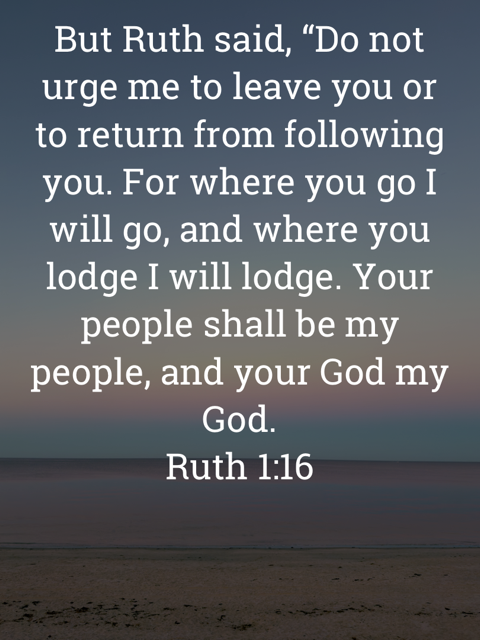
Ruth 1:16
Ruth 1
English Standard Version
Naomi Widowed
1 In the days when the judges ruled there was a famine in the land, and a man of Bethlehem in Judah went to sojourn in the country of Moab, he and his wife and his two sons. 2 The name of the man was Elimelech and the name of his wife Naomi, and the names of his two sons were Mahlon and Chilion. They were Ephrathites from Bethlehem in Judah. They went into the country of Moab and remained there. 3 But Elimelech, the husband of Naomi, died, and she was left with her two sons. 4 These took Moabite wives; the name of the one was Orpah and the name of the other Ruth. They lived there about ten years, 5 and both Mahlon and Chilion died, so that the woman was left without her two sons and her husband.
Ruth’s Loyalty to Naomi
6 Then she arose with her daughters-in-law to return from the country of Moab, for she had heard in the fields of Moab that the LORD had visited his people and given them food. 7 So she set out from the place where she was with her two daughters-in-law, and they went on the way to return to the land of Judah. 8 But Naomi said to her two daughters-in-law, “Go, return each of you to her mother’s house. May the LORD deal kindly with you, as you have dealt with the dead and with me. 9 The LORD grant that you may find rest, each of you in the house of her husband!” Then she kissed them, and they lifted up their voices and wept. 10 And they said to her, “No, we will return with you to your people.” 11 But Naomi said, “Turn back, my daughters; why will you go with me? Have I yet sons in my womb that they may become your husbands? 12 Turn back, my daughters; go your way, for I am too old to have a husband. If I should say I have hope, even if I should have a husband this night and should bear sons, 13 would you therefore wait till they were grown? Would you therefore refrain from marrying? No, my daughters, for it is exceedingly bitter to me for your sake that the hand of the LORD has gone out against me.” 14 Then they lifted up their voices and wept again. And Orpah kissed her mother-in-law, but Ruth clung to her.
15 And she said, “See, your sister-in-law has gone back to her people and to her gods; return after your sister-in-law.” 16 But Ruth said, “Do not urge me to leave you or to return from following you. For where you go I will go, and where you lodge I will lodge. Your people shall be my people, and your God my God. 17 Where you die I will die, and there will I be buried. May the LORD do so to me and more also if anything but death parts me from you.” 18 And when Naomi saw that she was determined to go with her, she said no more.
Naomi and Ruth Return
19 So the two of them went on until they came to Bethlehem. And when they came to Bethlehem, the whole town was stirred because of them. And the women said, “Is this Naomi?” 20 She said to them, “Do not call me Naomi;[a] call me Mara,[b] for the Almighty has dealt very bitterly with me. 21 I went away full, and the LORD has brought me back empty. Why call me Naomi, when the LORD has testified against me and the Almighty has brought calamity upon me?”
22 So Naomi returned, and Ruth the Moabite her daughter-in-law with her, who returned from the country of Moab. And they came to Bethlehem at the beginning of barley harvest.
Ruth 1:20 Naomi means pleasant
Ruth 1:20 Mara means bitter
The ESV® Bible (The Holy Bible, English Standard Version®), © 2001 by Crossway, a publishing ministry of Good News Publishers. ESV Text Edition: 2025.
Ruth 1:16. “But Ruth said, ‘Do not urge me to leave you or to return from following you. For where you go I will go, and where you lodge I will lodge. Your people shall be my people, and your God my God.’”
Ruth speaks these words at a point of painful decision. Naomi, widowed and bereaved, is returning from Moab to Bethlehem after hearing that the Lord has again provided food for his people. Orpah turns back, but Ruth clings to Naomi. Her declaration is therefore not romantic sentiment. It is a costly pledge of loyalty, belonging, and faith in the God of Israel.
1. Exegesis of Ruth 1:16
Literary setting
Ruth 1 opens in the dark days of the judges, amid famine, migration, widowhood, and death. Naomi urges Ruth and Orpah to return to Moab, where they might find security and remarriage. Ruth’s reply follows Orpah’s departure and Naomi’s renewed command to return. Against every visible prospect, Ruth chooses Naomi’s road and Naomi’s God. Her commitment is sharpened by the chapter’s movement from emptiness towards the first hint of harvest at Bethlehem.
The opening contrast, “But Ruth said,” sets Ruth’s resolve against Naomi’s urging and Orpah’s return. “Do not urge me” is a respectful but firm refusal. The paired clauses, “where you go I will go” and “where you lodge I will lodge,” cover the journey and the settled life beyond it. Ruth accepts not only a destination, but also Naomi’s uncertain condition.
The final pair deepens the vow: “Your people shall be my people, and your God my God.” Ruth embraces a new communal and religious identity. The concise English Standard Version wording preserves the solemn force of the Hebrew clauses. Verse 17 extends the pledge to death and burial and invokes the Lord as witness, showing that verse 16 is covenant-like in seriousness, although it is not itself the covenant of grace.
Ruth’s words embody steadfast love, even though the Hebrew term often translated as steadfast love does not occur in this verse. Her loyalty later receives explicit recognition from Boaz and is gathered into the book’s pattern of faithful kindness, providence, and redemption (Ruth 2:11–12; 3:10). Ruth moves from Moabite outsider to a member of Israel’s community, takes refuge under the Lord’s wings, and enters the line of David (Ruth 2:12; 4:13–22). The book shows God quietly advancing his saving purposes through ordinary faithfulness.
2. Theological teaching
- Saving faith changes allegiance. Ruth’s confession joins trust in the Lord with identification among his people. Faith is not bare admiration; it turns from former securities and rests under God’s rule and mercy (Ruth 2:12; Psalm 2:12).
- Grace welcomes the outsider. Ruth contributes no Israelite ancestry or social power. God receives and uses a Moabite widow, anticipating the gathering of the nations into one people through Jesus Christ (Matthew 1:5; Ephesians 2:11–22).
- Providence often works quietly. Ruth cannot yet see Boaz, Obed, David, or the place she will have in the Messiah’s genealogy. The Lord nevertheless governs famine, return, harvest, human decisions, and family restoration without ceasing to be holy or making human choices unreal (Ruth 1:6, 22; 2:3; 4:13–17; Romans 8:28).
- Steadfast love reflects God’s character. Ruth’s costly fidelity mirrors, in creaturely form, the Lord’s covenant faithfulness. Her obedience does not earn salvation; it is the fitting fruit of her new allegiance (Deuteronomy 7:9; Ruth 3:10; James 2:17–18).
- Redemption reaches its fulfilment in Christ. Boaz later acts as a family redeemer, but Jesus Christ is the greater Redeemer who willingly identifies with his people, pays the price of their freedom, and brings them into God’s household (Ruth 4:9–10; Galatians 4:4–7; Titus 2:14).
3. Practical application to modern Christian living
- Let commitment become concrete. Faithful love stays present, shares burdens, and keeps godly promises when convenience disappears. Ask where your words need to become patient, dependable action.
- Belong actively to God’s people. Ruth’s confession joins God and his people. Christians should resist isolated discipleship and commit themselves to the worship, teaching, fellowship, and service of a faithful local church (Acts 2:42; Hebrews 10:24–25).
- Welcome those who seem outside. Churches should receive repentant believers without favouritism based on ethnicity, nationality, wealth, or social history. The gospel creates one household while honouring lawful cultural differences (James 2:1–9; Revelation 7:9–10).
- Trust God in bitter seasons. Naomi interprets her story through severe loss, yet the chapter ends at the barley harvest. Lament may speak honestly, but it must not declare the final meaning of God’s providence before his work is complete (Ruth 1:20–22; Psalm 13; Romans 5:3–5).
- Count the cost of discipleship. Ruth leaves homeland, familiar gods, and visible security. Christians do not earn grace by sacrifice, but following Christ may require costly obedience, sustained by the greater worth of knowing him (Luke 14:25–33; Philippians 3:7–11).
4. Meditation guide
- Read. Slowly read Ruth 1:6–18,
6 Then she arose with her daughters-in-law to return from the country of Moab, for she had heard in the fields of Moab that the LORD had visited his people and given them food. 7 So she set out from the place where she was with her two daughters-in-law, and they went on the way to return to the land of Judah. 8 But Naomi said to her two daughters-in-law, “Go, return each of you to her mother’s house. May the LORD deal kindly with you, as you have dealt with the dead and with me. 9 The LORD grant that you may find rest, each of you in the house of her husband!” Then she kissed them, and they lifted up their voices and wept. 10 And they said to her, “No, we will return with you to your people.” 11 But Naomi said, “Turn back, my daughters; why will you go with me? Have I yet sons in my womb that they may become your husbands? 12 Turn back, my daughters; go your way, for I am too old to have a husband. If I should say I have hope, even if I should have a husband this night and should bear sons, 13 would you therefore wait till they were grown? Would you therefore refrain from marrying? No, my daughters, for it is exceedingly bitter to me for your sake that the hand of the LORD has gone out against me.” 14 Then they lifted up their voices and wept again. And Orpah kissed her mother-in-law, but Ruth clung to her.
15 And she said, “See, your sister-in-law has gone back to her people and to her gods; return after your sister-in-law.” 16 But Ruth said, “Do not urge me to leave you or to return from following you. For where you go I will go, and where you lodge I will lodge. Your people shall be my people, and your God my God. 17 Where you die I will die, and there will I be buried. May the LORD do so to me and more also if anything but death parts me from you.” 18 And when Naomi saw that she was determined to go with her, she said no more.
then reread Ruth 1:16 aloud.
16 But Ruth said, “Do not urge me to leave you or to return from following you. For where you go I will go, and where you lodge I will lodge. Your people shall be my people, and your God my God.
Notice the losses behind Ruth, the uncertainty ahead, and the repeated words of commitment. - Observe. List what Ruth promises concerning place, people, and God. Consider how verse 17 confirms the permanence and sacred seriousness of her words.
17 Where you die I will die, and there will I be buried. May the LORD do so to me and more also if anything but death parts me from you.” - Reflect. Where are you tempted to follow Christ only while the path is comfortable? Where might God be calling you to steadfast love that is patient, truthful, and costly?
- Remember the gospel. Ruth’s loyalty is admirable, but your hope rests finally in Jesus Christ, whose obedience did not fail and whose redeeming love secures his people (John 10:27–29; Romans 8:31–39).
- Pray. Ask the Lord for undivided allegiance, faithful love for his people, courage in uncertainty, and confidence in his quiet providence.
- Act. Choose one specific act of covenant-shaped faithfulness today: keep a neglected promise, support a burdened believer, welcome a newcomer, or seek reconciliation without compromising truth.
Prayer
Faithful Lord, you receive sinners by grace and place us among your people. Turn my heart from false securities. Give me steadfast faith in Jesus Christ, loyal love towards others, and patient trust when your providence is hard to understand. Keep me close to you and make my obedience a grateful fruit of your redeeming mercy. Amen.
Unless otherwise indicated, all Scripture quotations are from the ESV® Bible (The Holy Bible, English Standard Version®), © 2001 by Crossway, a publishing ministry of Good News Publishers. ESV Text Edition: 2025. Used by permission. All rights reserved.
Discover more from Daily bible verses
Subscribe to get the latest posts sent to your email.


You must be logged in to post a comment.