
Devotion on Isaiah 26:3
Isaiah 26
English Standard Version
You Keep Him in Perfect Peace
26 In that day this song will be sung in the land of Judah:
“We have a strong city;
he sets up salvation
as walls and bulwarks.
2 Open the gates,
that the righteous nation that keeps faith may enter in.
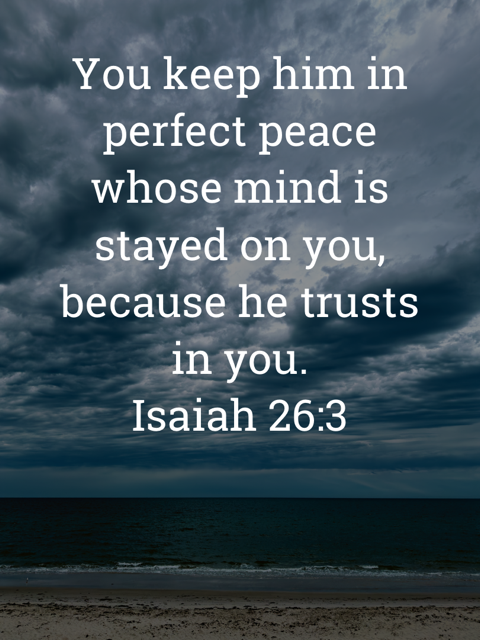
3 You keep him in perfect peace
whose mind is stayed on you,
because he trusts in you.
4 Trust in the LORD forever,
for the LORD God is an everlasting rock.
5 For he has humbled
the inhabitants of the height,
the lofty city.
He lays it low, lays it low to the ground,
casts it to the dust.
6 The foot tramples it,
the feet of the poor,
the steps of the needy.”
7 The path of the righteous is level;
you make level the way of the righteous.
8 In the path of your judgments,
O LORD, we wait for you;
your name and remembrance
are the desire of our soul.
9 My soul yearns for you in the night;
my spirit within me earnestly seeks you.
For when your judgments are in the earth,
the inhabitants of the world learn righteousness.
10 If favour is shown to the wicked,
he does not learn righteousness;
in the land of uprightness he deals corruptly
and does not see the majesty of the LORD.
11 O LORD, your hand is lifted up,
but they do not see it.
Let them see your zeal for your people, and be ashamed.
Let the fire for your adversaries consume them.
12 O LORD, you will ordain peace for us,
for you have indeed done for us all our works.
13 O LORD our God,
other lords besides you have ruled over us,
but your name alone we bring to remembrance.
14 They are dead, they will not live;
they are shades, they will not arise;
to that end you have visited them with destruction
and wiped out all remembrance of them.
15 But you have increased the nation, O LORD,
you have increased the nation; you are glorified;
you have enlarged all the borders of the land.
16 O LORD, in distress they sought you;
they poured out a whispered prayer
when your discipline was upon them.
17 Like a pregnant woman
who writhes and cries out in her pangs
when she is near to giving birth,
so were we because of you, O LORD;
18 we were pregnant, we writhed,
but we have given birth to wind.
We have accomplished no deliverance in the earth,
and the inhabitants of the world have not fallen.
19 Your dead shall live; their bodies shall rise.
You who dwell in the dust, awake and sing for joy!
For your dew is a dew of light,
and the earth will give birth to the dead.
20 Come, my people, enter your chambers,
and shut your doors behind you;
hide yourselves for a little while
until the fury has passed by.
21 For behold, the LORD is coming out from his place
to punish the inhabitants of the earth for their iniquity,
and the earth will disclose the blood shed on it,
and will no more cover its slain.
The ESV® Bible (The Holy Bible, English Standard Version®), © 2001 by Crossway, a publishing ministry of Good News Publishers. ESV Text Edition: 2025.
Isaiah 26:3: “You keep him in perfect peace whose mind is stayed on you, because he trusts in you.”
1. Exegesis
Literary context
Isaiah 26 opens a song that “will be sung in the land of Judah” on a future day of deliverance. It follows the vision of worldwide judgment in Isaiah 24 and the promised feast, the destruction of death, and the wiping away of tears in Isaiah 25. The song contrasts two cities. The first is the lofty city of the proud, which God brings down to the dust (Isaiah 26:5-6). The second is the strong city of the righteous, whose protection is the salvation God himself provides (Isaiah 26:1-2). Verse 3 stands at the centre of the opening movement and gives the reason the righteous city is secure: its people are kept in peace because they trust in the Lord.
The rest of the chapter develops the same theme. The righteous wait for God along the path of his judgments (Isaiah 26:7-9). The wicked do not learn righteousness even when shown grace (Isaiah 26:10-11). The people confess that every work they have done was done by the Lord, and that other masters have ruled them but cannot now rise (Isaiah 26:12-15). They then admit their own helplessness, and God promises that his dead will live (Isaiah 26:16-19). Finally, they are told to shelter until his wrath has passed (Isaiah 26:20-21). Peace in verse 3 is therefore not peace in an easy world. It is peace given to people who still wait, still suffer, and still need rescue.
Word-by-word observations
“You keep.” The English Standard Version supplies the verb “keep”, which carries the sense of guarding or watching over, the way a sentry protects a city. God is the active subject. The peace is kept by him; it is not manufactured by the believer. This fits the picture of the city whose walls are God’s salvation in Isaiah 26:1.
“Perfect peace.” The Hebrew repeats the word for peace, shalom, so that it reads literally “peace, peace”. In Hebrew, repetition expresses fullness or intensity, so the English Standard Version rightly translates it as “perfect peace”. Shalom means far more than a calm feeling. It means wholeness, welfare, security, and right relationship with God. It is the same fullness that Isaiah promises in Isaiah 9:6-7, Isaiah 32:17, and Isaiah 54:10.
“Whose mind is stayed on you.” The Hebrew noun behind “mind” points to the settled inclination, purpose, or framework of thought and desire. The participle “stayed” means supported, propped up, or leaned upon. The English Standard Version therefore presents a person whose whole inner orientation rests on God, as a weary traveller rests on a strong staff. The same thought of leaning on God appears in Isaiah 10:20 and Isaiah 50:10. A literal alternative reading, “a steadfast mind you keep in peace”, makes the same point: God preserves a mind that has been fixed on him.
“Because he trusts in you.” The final clause gives the ground. Trust is the instrument by which the person leans on God, and the Lord is the object that makes such trust worthwhile. Isaiah 26:4 immediately commands trust in the Lord for ever because he is an everlasting rock. The singular “him” allows the verse to apply both to each believer and to the faithful community of Judah. The contrast with trusting in alliances and human strength is a major theme of Isaiah, as seen in Isaiah 7:1-9, Isaiah 30:15, and Isaiah 31:1-3.
2. Theological Teaching
God keeps; the believer rests
Christian theology confesses that salvation, from first to last, is the work of God. Isaiah 26:3 displays this order. The Lord is the one who keeps, and the believer is the one who is kept. Even the trust that anchors the mind is, in Christian understanding, a gift of grace, as Ephesians 2:8-9 and Philippians 1:6 teach. Isaiah 26:12 makes the same confession in the song itself: peace is established for us, and all our works are done by the Lord. Believers do trust, and they are commanded to trust, but they are never the ultimate cause of their own security.
Peace grounded in the gospel
The peace of Isaiah 26:3 is ultimately the peace won by the Prince of Peace. Isaiah 53:5 says the chastisement that brought us peace was upon the suffering servant. In the New Testament, Romans 5:1 declares that those justified by faith have peace with God through Jesus Christ, and Colossians 1:19-20 shows that this peace was made by the blood of the cross. Peace with God is the foundation; the inward peace of a steady mind is its fruit. Jesus gives this peace to his disciples in John 14:27 and John 16:33, and Philippians 4:6-7 describes the peace of God guarding hearts and minds in Christ Jesus, which is the New Testament echo of the guarding promise in Isaiah 26:3.
The faithfulness of God and the perseverance of the saints
The believer’s mind is steadfast because the Lord is an everlasting rock (Isaiah 26:4). The ground of peace lies in the unchanging character and covenant promises of God, not in the strength of the believer’s feelings. This accords with the Christian doctrines of perseverance and assurance. Assurance rests on the promises of God, the work of Christ, and the witness of the Holy Spirit (Romans 8:15-16 and 1 John 5:13). It does not rest on a flawless record of calm.
Peace within a world of judgment and hope
Isaiah 26 places this peace between the judgment of the proud city and the hope of resurrection. The song looks beyond death to the day when the Lord’s people will rise (Isaiah 26:19; compare Isaiah 25:8 and 1 Corinthians 15:54-57). Perfect peace is therefore both a present gift and a pledge of the final peace of the new creation, described in Revelation 21:3-4. Believers experience it now in part, and they will know it fully when Christ returns.
3. Practical Application to Modern Christian Living
Face anxiety with trust, not denial. Isaiah 26:3 does not promise a life without trouble. Isaiah 26:16-18 is honest about distress. The promise is that God keeps his people in the middle of trouble. Bring worries to the Lord in prayer, as Philippians 4:6-7 and 1 Peter 5:7 invite, and name them honestly rather than pretending to be calm.
Fix the mind on God’s character and promises. In an age of constant notifications, news cycles, and social comparison, the mind is easily scattered. Build daily habits of Scripture reading, prayer, and Sunday worship that return your attention to who God is, as Romans 12:2 and Colossians 3:1-2 encourage. A stayed mind is formed by regular practice, supported by the church, and sustained by the Holy Spirit.
Trust God in uncertainty at work, in the family, and in health. Redundancy, financial pressure, illness, and strained relationships are real. Remember that the Lord is a rock, not a changing circumstance (Isaiah 26:4). Make decisions wisely and take practical steps, but release the outcomes to him, as Proverbs 3:5-6 and Psalm 62:8 teach.
Receive help from others and from professionals. Persistent anxiety or depression is not always a lack of faith. Pastors, trusted friends, doctors, and counsellors can be means God uses to keep his people. Isaiah 26:3 and wise medical care are not rivals.
Be a source of peace to others. Those kept in peace are sent to share it. Seek reconciliation, speak gently, and point people to Christ, as Matthew 5:9 and Romans 12:18 urge.
4. Meditation Guide
Set aside about twenty minutes in a quiet place. Read slowly, pause often, and pray through each step. Open your Bible to Isaiah 26 and read the whole song aloud once before beginning.
- Settle (two minutes). Sit still, breathe slowly, and ask the Holy Spirit to quiet your thoughts and open your heart to the Word.
- Read (three minutes). Read Isaiah 26:1-4 twice.
26 In that day this song will be sung in the land of Judah:
“We have a strong city;
he sets up salvation
as walls and bulwarks.
2 Open the gates,
that the righteous nation that keeps faith may enter in.
3 You keep him in perfect peace
whose mind is stayed on you,
because he trusts in you.
4 Trust in the LORD forever,
for the LORD God is an everlasting rock.
Notice who acts in the verse and what the person who is kept actually does. - Reflect on “you keep” (three minutes). Ask: where am I trying to hold my life together by my own strength? Thank God that he is the keeper, and read Psalm 121 as a prayer of assurance.
- Reflect on “perfect peace” (three minutes). Consider the fullness of peace with God through Christ, using Romans 5:1-5 and John 14:27. Ask which part of your life most needs this wholeness.
- Reflect on “mind stayed on you” (three minutes). Identify the thoughts that most often pull you away. Offer each one to God, and bring to mind one promise, such as Isaiah 41:10, to lean on in its place.
- Reflect on “because he trusts in you” (three minutes). Ask: what would it look like to trust God with my present worry? Confess any unbelief, and ask for the gift of faith, as in Mark 9:24.
- Pray and respond (three minutes). Pray in your own words, thanking God for his faithfulness. Write down one concrete act of trust you will take this week, and one person you will encourage with the same peace.
Questions for a small group: What does Isaiah 26:3 teach about who is responsible for our peace? How does the context of Isaiah 26 change the way we read this verse? What practical habits help a mind stay on God?
Unless otherwise indicated, all Scripture quotations are from the ESV® Bible (The Holy Bible, English Standard Version®), © 2001 by Crossway, a publishing ministry of Good News Publishers. ESV Text Edition: 2025. Used by permission. All rights reserved.
Discover more from Daily bible verses
Subscribe to get the latest posts sent to your email.


You must be logged in to post a comment.