
Devotion on Joshua 1:8
Joshua 1
English Standard Version
God Commissions Joshua
1 After the death of Moses the servant of the LORD, the LORD said to Joshua the son of Nun, Moses’ assistant, 2 “Moses my servant is dead. Now therefore arise, go over this Jordan, you and all this people, into the land that I am giving to them, to the people of Israel. 3 Every place that the sole of your foot will tread upon I have given to you, just as I promised to Moses. 4 From the wilderness and this Lebanon as far as the great river, the river Euphrates, all the land of the Hittites to the Great Sea toward the going down of the sun shall be your territory. 5 No man shall be able to stand before you all the days of your life. Just as I was with Moses, so I will be with you. I will not leave you or forsake you. 6 Be strong and courageous, for you shall cause this people to inherit the land that I swore to their fathers to give them. 7 Only be strong and very courageous, being careful to do according to all the law that Moses my servant commanded you. Do not turn from it to the right hand or to the left, that you may have good success[a] wherever you go. 8 This Book of the Law shall not depart from your mouth, but you shall meditate on it day and night, so that you may be careful to do according to all that is written in it. For then you will make your way prosperous, and then you will have good success. 9 Have I not commanded you? Be strong and courageous. Do not be frightened, and do not be dismayed, for the LORD your God is with you wherever you go.”
Joshua Assumes Command
10 And Joshua commanded the officers of the people, 11 “Pass through the midst of the camp and command the people, ‘Prepare your provisions, for within three days you are to pass over this Jordan to go in to take possession of the land that the LORD your God is giving you to possess.’”
12 And to the Reubenites, the Gadites, and the half-tribe of Manasseh Joshua said, 13 ”Remember the word that Moses the servant of the LORD commanded you, saying, ‘The LORD your God is providing you a place of rest and will give you this land.’ 14 Your wives, your little ones, and your livestock shall remain in the land that Moses gave you beyond the Jordan, but all the men of valour among you shall pass over armed before your brothers and shall help them, 15 until the LORD gives rest to your brothers as he has to you, and they also take possession of the land that the LORD your God is giving them. Then you shall return to the land of your possession and shall possess it, the land that Moses the servant of the LORD gave you beyond the Jordan toward the sunrise.”
16 And they answered Joshua, “All that you have commanded us we will do, and wherever you send us we will go. 17 Just as we obeyed Moses in all things, so we will obey you. Only may the LORD your God be with you, as he was with Moses! 18 Whoever rebels against your commandment and disobeys your words, whatever you command him, shall be put to death. Only be strong and courageous.”
- Joshua 1:7 Or may act wisely
The ESV® Bible (The Holy Bible, English Standard Version®), © 2001 by Crossway, a publishing ministry of Good News Publishers. ESV Text Edition: 2025.
1. Exegesis
Context in the Book of Joshua
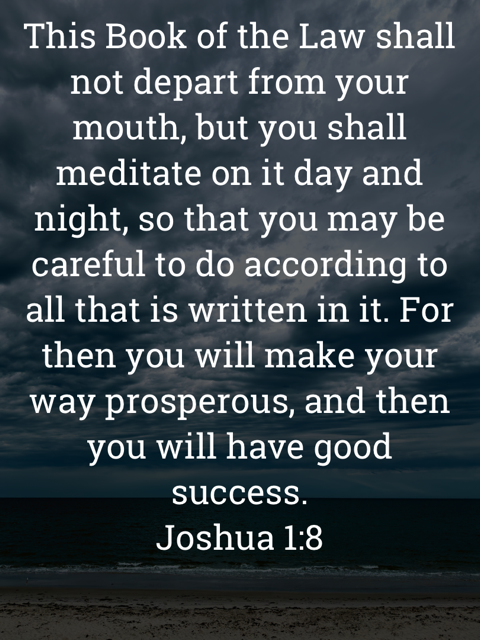
Joshua 1:8. “This Book of the Law shall not depart from your mouth, but you shall meditate on it day and night, so that you may be careful to do according to all that is written in it. For then you will make your way prosperous, and then you will have good success.”
The book opens after the death of Moses, “the servant of the Lord”. Israel stands on the east bank of the Jordan, and Joshua inherits a task that Moses could not finish. Joshua 1:1–9 is the Lord’s commission to Joshua, and Joshua 1:10–18 shows the people committing themselves to follow him. The commission has three parts: the promise of the land and of the Lord’s presence (Joshua 1:2–5), the charge to be strong and courageous (Joshua 1:6–7 and 1:9), and the means by which that courage is sustained, which is the written word (Joshua 1:7–8). Verse 8 therefore sits at the centre of the commission. The Lord does not give Joshua a battle plan. He gives him a book.
Phrase-by-phrase reading
“This Book of the Law.” The phrase points to the written Torah given through Moses, which was Israel’s Scripture at that time (Deuteronomy 31:9–13 and 31:24–26). Joshua is placed under the authority of a text, not the other way round. Even the nation’s commander must be a listener first. The same expectation was set for Israel’s future king (Deuteronomy 17:18–20).
“Shall not depart from your mouth.” In the ancient world, reading was usually aloud. The phrase therefore covers reading, reciting, and speaking the law, including teaching it to others. Joshua’s speech as leader must be shaped by Scripture (Deuteronomy 6:6–9).
“You shall meditate on it day and night.” The Hebrew verb behind “meditate” (hāgâ) describes a low murmuring, a quiet repeating of words. Biblical meditation is not emptying the mind. It is filling the mind with God’s revealed word, turning it over, and speaking it back to God and to oneself. The same pairing of “day and night” appears for the blessed person in Psalm 1:2, and Psalm 119 develops it at length (see Psalm 119:15 and 119:97). “Day and night” means constant orientation, not a literal rule to do nothing else.
“So that you may be careful to do according to all that is written in it.” The purpose of meditation is obedience. The English Standard Version phrase “be careful to do” carries the sense of watchful, deliberate keeping, and the word “all” excludes selective obedience (compare Joshua 23:6). Meditation without doing would be incomplete, and doing without meditation would be shallow.
“For then you will make your way prosperous, and then you will have good success.” The two promises are linked to obedience by the repeated word “then”. The verb for “make prosperous” (ṣālaḥ) means to advance or push through to the intended end, and the English Standard Version’s “have good success” (from śākal) carries the sense of acting wisely and therefore succeeding. The success is defined by God’s purposes for Joshua, namely entering and settling the land. It is covenant blessing within the promises already made, not a general promise of wealth or ease (compare Deuteronomy 28 and 1 Kings 2:3).
Key observations from the chapter
Three features of Joshua 1 shape the interpretation. First, the command rests on grace: the land is given before obedience is asked (Joshua 1:2–3 and 1:6). Second, the promise of God’s presence (Joshua 1:5 and 1:9) is the ground of courage, and the word is the means by which that presence is known. Third, the people repeat the same standard in their reply (Joshua 1:16–18), showing that the whole community stands under the same word.
2. Theological Teaching
The sufficiency and authority of Scripture
Christian theology confesses that Scripture is the Word of God written, and that it is sufficient for faith and life (2 Timothy 3:16–17). Joshua 1:8 shows this principle in an early form. The Lord guides his people by a written word, and he does not add to it with fresh techniques or private revelations. Joshua is called away from every other confidence and bound to the law, so that he would act under God’s direction and not by his own judgement.
Grace before obedience
The verse must not be read as a formula for earning God’s favour. The land is a gift promised to Abraham and now delivered (Joshua 1:2–6), and Joshua’s obedience is the fruit of a relationship God has already established. Christian teaching on the covenant of grace holds that obedience is the response of the redeemed, and not the price of redemption (Ephesians 2:8–10). The “then” of verse 8 describes the path along which God’s promise is realised. It does not turn the promise into a wage.
The word, the Spirit, and the heart
Meditation is a means of grace that the Spirit uses. Word is to be received with diligence, preparation, and prayer, with faith and love, and then stored in the heart and practised in life. Without the Spirit’s work, the word remains external (1 Corinthians 2:12–14; Psalm 119:18). With it, the word transforms the mind (Romans 12:2; John 17:17).
Joshua and the greater Joshua
Joshua’s name is the Hebrew form of “Jesus”, and the book pictures the rest that God gives his people (Hebrews 4:8–9). Joshua succeeded imperfectly, because the people and their leaders often failed to keep the law (Joshua 7; Judges 2:10–11). Jesus is the one who perfectly kept the whole law (Matthew 5:17; Romans 8:3–4), who bore the curse that rested on those who did not (Galatians 3:10–13), and who is himself the fulfilment of the Scriptures (Luke 24:44; John 5:39). Christians therefore read Joshua 1:8 in Christ. We meditate on the word not to achieve a righteousness of our own but to know the one who fulfilled it, and to grow in the obedience his Spirit now produces in us (Romans 8:4).
What “success” means
The promise of prosperity and good success is covenantal and Christ-centred. For Israel it was tied to the land. For the church, it is the fruitfulness and stability of a life rooted in Christ (Psalm 1:3; John 15:7–8; 2 Peter 1:3–8), and it is not a promise of health, wealth, or worldly achievement. Faithful believers may suffer (2 Timothy 3:12), yet God works all things for their good (Romans 8:28).
3. Practical Application to Modern Christian Living
- Put Scripture before strategy. In decisions about work, family, money, and ministry, ask first what God has said, and then use the planning tools, advice, and experience that wisdom requires (Proverbs 3:5–6).
- Build a daily rhythm. “Day and night” does not require constant study, but it does call for regular, unhurried time in the word, such as a morning reading, an evening recall, and brief moments of remembering during the day (Psalm 119:147–148).
- Let the word be on your lips. Read aloud, pray the Scriptures, and speak them with family and friends. Teach children at home (Deuteronomy 6:6–7) and encourage one another with the word in the church (Colossians 3:16).
- Memorise and revisit. Choose a short passage each week and repeat it until it comes to mind without effort. Scripture stored in the heart guards against sin and anxiety (Psalm 119:11; Philippians 4:6–8).
- Practise what you read. End each time of meditation with one specific act of obedience, whether a conversation to have, a habit to change, or a person to serve (James 1:22–25).
- Redefine success. Measure your life by faithfulness to Christ and not by income, status, or visible results. Be encouraged that God’s purposes for you are secure in him (Joshua 1:9; Romans 8:28–30).
- Meditate within the church. Private meditation does not replace the public reading and preaching of the word, the sacraments, and the fellowship of believers (Acts 2:42; 1 Timothy 4:13).
- Beware of distortions. Christian meditation is different from emptying the mind or seeking an experience. Test every impression by Scripture (Acts 17:11), and do not treat verse 8 as a guarantee of material prosperity.
4. Meditation Guide
Set aside about twenty to thirty minutes, preferably in a quiet place. Keep a notebook beside you.
- Prepare (two minutes). Pray for the Spirit’s help to understand and obey, using Psalm 119:18 as your pattern. Ask that your heart would be humble and willing.
18 Open my eyes, that I may behold
wondrous things out of your law.
Read (five minutes). Read Joshua 1:1–9 slowly and aloud.
1 After the death of Moses the servant of the LORD, the LORD said to Joshua the son of Nun, Moses’ assistant, 2 “Moses my servant is dead. Now therefore arise, go over this Jordan, you and all this people, into the land that I am giving to them, to the people of Israel. 3 Every place that the sole of your foot will tread upon I have given to you, just as I promised to Moses. 4 From the wilderness and this Lebanon as far as the great river, the river Euphrates, all the land of the Hittites to the Great Sea toward the going down of the sun shall be your territory. 5 No man shall be able to stand before you all the days of your life. Just as I was with Moses, so I will be with you. I will not leave you or forsake you. 6 Be strong and courageous, for you shall cause this people to inherit the land that I swore to their fathers to give them. 7 Only be strong and very courageous, being careful to do according to all the law that Moses my servant commanded you. Do not turn from it to the right hand or to the left, that you may have good success wherever you go. 8 This Book of the Law shall not depart from your mouth, but you shall meditate on it day and night, so that you may be careful to do according to all that is written in it. For then you will make your way prosperous, and then you will have good success. 9 Have I not commanded you? Be strong and courageous. Do not be frightened, and do not be dismayed, for the LORD your God is with you wherever you go.”
Then read Joshua 1:8 three times, giving emphasis to a different phrase each time: “shall not depart from your mouth”, “meditate on it day and night”, and “be careful to do”.
8 This Book of the Law shall not depart from your mouth, but you shall meditate on it day and night, so that you may be careful to do according to all that is written in it. For then you will make your way prosperous, and then you will have good success.
8 This Book of the Law shall not depart from your mouth, but you shall meditate on it day and night, so that you may be careful to do according to all that is written in it. For then you will make your way prosperous, and then you will have good success.
8 This Book of the Law shall not depart from your mouth, but you shall meditate on it day and night, so that you may be careful to do according to all that is written in it. For then you will make your way prosperous, and then you will have good success. - Observe (five minutes). Write down what the verse says. Who is speaking, and who is being addressed? What is commanded, what is the purpose, and what is promised? Note how verse 8 connects to the courage and presence of God in verses 5 to 9.
- Connect (five minutes). Read Psalm 1:1–3, Deuteronomy 6:6–9, and Luke 24:44–45. Ask how Christ is the fulfilment of the law and how he opens our minds to understand it.
- Reflect (five minutes). Consider these questions:
- What do I turn to first when I face a difficult decision?
- Where am I tempted to treat success as something I can secure for myself?
- How does knowing that Christ has kept the law for me change my reason for obeying it?
- Which part of Scripture have I read but not yet obeyed?
- Respond in prayer (three minutes). Confess where you have neglected the word or trusted yourself. Give thanks for the grace shown in Christ. Ask for strength to obey.
- Resolve (two minutes). Write one specific act of obedience for today and one phrase from the verse to repeat through the day.
Weekly pattern. On the first day, read and observe. On the second and third days, reflect on the verse in the context of Joshua 1. On the fourth day, study the connections to Psalm 1 and the fulfilment in Christ. On the fifth day, memorise the verse. On the sixth day, speak it to another person. On the seventh day, review what changed in your living, and give thanks.
Unless otherwise indicated, all Scripture quotations are from the ESV® Bible (The Holy Bible, English Standard Version®), © 2001 by Crossway, a publishing ministry of Good News Publishers. ESV Text Edition: 2025. Used by permission. All rights reserved.


You must be logged in to post a comment.