
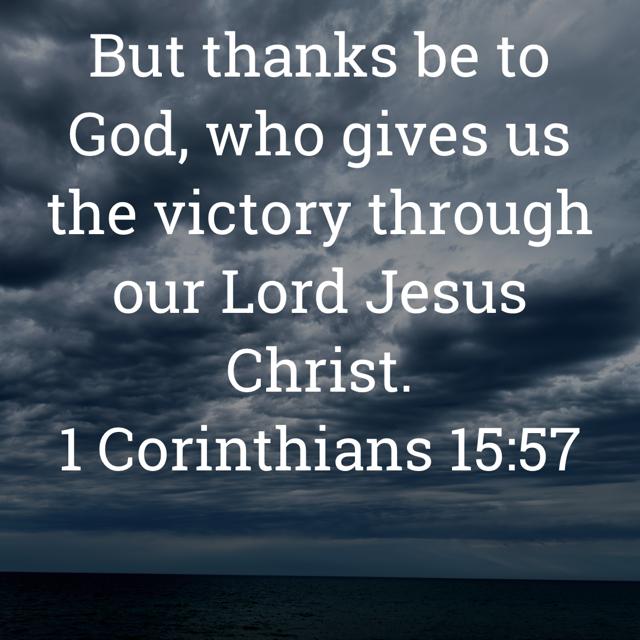
Devotion on 1 Corinthians 15:57
1 Corinthians 15
English Standard Version
The Resurrection of Christ
15 Now I would remind you, brothers,[a] of the gospel I preached to you, which you received, in which you stand, 2 and by which you are being saved, if you hold fast to the word I preached to you—unless you believed in vain.
3 For I delivered to you as of first importance what I also received: that Christ died for our sins in accordance with the Scriptures, 4 that he was buried, that he was raised on the third day in accordance with the Scriptures, 5 and that he appeared to Cephas, then to the twelve. 6 Then he appeared to more than five hundred brothers at one time, most of whom are still alive, though some have fallen asleep. 7 Then he appeared to James, then to all the apostles. 8 Last of all, as to one untimely born, he appeared also to me. 9 For I am the least of the apostles, unworthy to be called an apostle, because I persecuted the church of God. 10 But by the grace of God I am what I am, and his grace toward me was not in vain. On the contrary, I worked harder than any of them, though it was not I, but the grace of God that is with me. 11 Whether then it was I or they, so we preach and so you believed.
The Resurrection of the Dead
12 Now if Christ is proclaimed as raised from the dead, how can some of you say that there is no resurrection of the dead? 13 But if there is no resurrection of the dead, then not even Christ has been raised. 14 And if Christ has not been raised, then our preaching is in vain and your faith is in vain. 15 We are even found to be misrepresenting God, because we testified about God that he raised Christ, whom he did not raise if it is true that the dead are not raised. 16 For if the dead are not raised, not even Christ has been raised. 17 And if Christ has not been raised, your faith is futile and you are still in your sins. 18 Then those also who have fallen asleep in Christ have perished. 19 If in Christ we have hope[b] in this life only, we are of all people most to be pitied.
20 But in fact Christ has been raised from the dead, the firstfruits of those who have fallen asleep. 21 For as by a man came death, by a man has come also the resurrection of the dead. 22 For as in Adam all die, so also in Christ shall all be made alive. 23 But each in his own order: Christ the firstfruits, then at his coming those who belong to Christ. 24 Then comes the end, when he delivers the kingdom to God the Father after destroying every rule and every authority and power. 25 For he must reign until he has put all his enemies under his feet. 26 The last enemy to be destroyed is death. 27 For “God[c] has put all things in subjection under his feet.” But when it says, “all things are put in subjection,” it is plain that he is excepted who put all things in subjection under him. 28 When all things are subjected to him, then the Son himself will also be subjected to him who put all things in subjection under him, that God may be all in all.
29 Otherwise, what do people mean by being baptised on behalf of the dead? If the dead are not raised at all, why are people baptised on their behalf? 30 Why are we in danger every hour? 31 I protest, brothers, by my pride in you, which I have in Christ Jesus our Lord, I die every day! 32 What do I gain if, humanly speaking, I fought with beasts at Ephesus? If the dead are not raised, “Let us eat and drink, for tomorrow we die.” 33 Do not be deceived: “Bad company ruins good morals.”[d] 34 Wake up from your drunken stupor, as is right, and do not go on sinning. For some have no knowledge of God. I say this to your shame.
The Resurrection Body
35 But someone will ask, “How are the dead raised? With what kind of body do they come?” 36 You foolish person! What you sow does not come to life unless it dies. 37 And what you sow is not the body that is to be, but a bare kernel, perhaps of wheat or of some other grain. 38 But God gives it a body as he has chosen, and to each kind of seed its own body. 39 For not all flesh is the same, but there is one kind for humans, another for animals, another for birds, and another for fish. 40 There are heavenly bodies and earthly bodies, but the glory of the heavenly is of one kind, and the glory of the earthly is of another. 41 There is one glory of the sun, and another glory of the moon, and another glory of the stars; for star differs from star in glory.
42 So is it with the resurrection of the dead. What is sown is perishable; what is raised is imperishable. 43 It is sown in dishonour; it is raised in glory. It is sown in weakness; it is raised in power. 44 It is sown a natural body; it is raised a spiritual body. If there is a natural body, there is also a spiritual body. 45 Thus it is written, “The first man Adam became a living being”;[e] the last Adam became a life-giving spirit. 46 But it is not the spiritual that is first but the natural, and then the spiritual. 47 The first man was from the earth, a man of dust; the second man is from heaven. 48 As was the man of dust, so also are those who are of the dust, and as is the man of heaven, so also are those who are of heaven. 49 Just as we have borne the image of the man of dust, we shall[f] also bear the image of the man of heaven.
Mystery and Victory
50 I tell you this, brothers: flesh and blood cannot inherit the kingdom of God, nor does the perishable inherit the imperishable. 51 Behold! I tell you a mystery. We shall not all sleep, but we shall all be changed, 52 in a moment, in the twinkling of an eye, at the last trumpet. For the trumpet will sound, and the dead will be raised imperishable, and we shall be changed. 53 For this perishable body must put on the imperishable, and this mortal body must put on immortality. 54 When the perishable puts on the imperishable, and the mortal puts on immortality, then shall come to pass the saying that is written:
“Death is swallowed up in victory.”
55 ”O death, where is your victory?
O death, where is your sting?”
56 The sting of death is sin, and the power of sin is the law. 57 But thanks be to God, who gives us the victory through our Lord Jesus Christ.
58 Therefore, my beloved brothers, be steadfast, immovable, always abounding in the work of the Lord, knowing that in the Lord your labour is not in vain.
- 1 Corinthians 15:1 Or brothers and sisters; also verses 6, 31, 50, 58
- 1 Corinthians 15:19 Or we have hoped
- 1 Corinthians 15:27 Greek he
- 1 Corinthians 15:33 Probably from Menander’s comedy Thais
- 1 Corinthians 15:45 Greek a living soul
- 1 Corinthians 15:49 Some manuscripts let us
The ESV® Bible (The Holy Bible, English Standard Version®), © 2001 by Crossway, a publishing ministry of Good News Publishers. ESV Text Edition: 2025.
This guide reads 1 Corinthians 15:57 as the doxological climax of the longest and most carefully argued chapter in the letter. Unless otherwise noted, quotations and translation labels follow the English Standard Version, and supporting passages are given by reference only, so that you can open your Bible and read them for yourself.
1. Exegesis of the Verse
The text
1 Corinthians 15:57: “But thanks be to God, who gives us the victory through our Lord Jesus Christ.”
Context within 1 Corinthians 15
Paul writes to a church troubled by division, pride, and confused thinking about the body. In 1 Corinthians 15:1–11 he restates the gospel he received: Christ died for our sins, was buried, was raised on the third day, and appeared to many witnesses, all according to the Scriptures. In 1 Corinthians 15:12–34, he argues that denying the resurrection of the dead undoes the resurrection of Christ, empties preaching and faith, and leaves believers still in their sins. Christ is the firstfruits, the last Adam who reigns until every enemy is placed under his feet, and the last enemy is death. In 1 Corinthians 15:35–49, he explains the nature of the resurrection body, contrasting the natural body with the spiritual body and the first Adam with the last Adam. In 1 Corinthians 15:50–55, he discloses a mystery: at the last trumpet the dead will be raised imperishable, and the living will be changed, so that death is swallowed up in victory, drawing on Isaiah 25:8 and Hosea 13:14. Verse 56 then explains why death is so fearsome, and verse 57 breaks into thanksgiving.
Verse-by-verse reading
“But thanks be to God.” The contrasting word “but” turns from the grim diagnosis of verse 56, which names sin as the sting of death and the law as the power of sin, to a celebration. Paul uses the same short formula of thanksgiving in Romans 6:17, Romans 7:25, 2 Corinthians 2:14, 2 Corinthians 8:16, and 2 Corinthians 9:15. Its focus is the character of God rather than the strength of the believer. Gratitude is the right response to a gift, not to a wage.
“Who gives us.” The Greek participle is in the present tense, which describes the Father’s continuing character as the giver of victory. The victory is already secured in Christ’s death and resurrection; it is being applied to believers now, and it will be openly displayed at the resurrection. The word “us” is plural and inclusive, so the victory belongs to the whole people of God and not to a spiritual elite.
“The victory.” The noun picks up the repeated use of the same word in verses 54 and 55, where death is swallowed up in victory and robbed of its own. In the Old Testament background, victory belongs to the Lord, who defeats his enemies. Verse 56 explains the means: sin supplied death’s sting, the law exposed and condemned sin, and Christ has met both. He bore the curse of the law on behalf of his people (Galatians 3:13) and so removed the guilt that gave death its terror (Romans 8:1–4). The victory is therefore judicial first, since condemnation is removed, and then bodily, since death itself will be undone.
“Through our Lord Jesus Christ.” Paul gives the full title. “Lord” confesses his divine authority, “Jesus” recalls his real human history, and “Christ” identifies him as the promised Messiah. The phrase “through” marks Christ as the sole mediator of the victory. Verse 58 begins with “Therefore”, drawing out the consequence: because the victory is certain, believers are to be steadfast, immovable, and always abounding in the work of the Lord, knowing that their labour is not in vain.
2. Theological Teaching
Salvation is grace from first to last
The verb “gives” fits the Christian confession that salvation is by grace alone, through faith alone, in Christ alone, to the glory of God alone. Victory is not earned by moral effort, religious discipline, or the keeping of the law. Verse 56 shows that the law cannot rescue us, because it exposes sin without removing it (Romans 3:19–20; Romans 7:7–13). God supplies what the law demands in his Son (Romans 8:3–4).
The work of Christ as victor
Christ conquers as the last Adam. Adam brought sin and death into the world, and Christ brings righteousness and life (Romans 5:12–21; 1 Corinthians 15:21–22, 45). His atoning death bears the penalty of sin, his resurrection vindicates him and declares the debt paid (Romans 4:25), and his present reign continues until the last enemy is destroyed (1 Corinthians 15:24–28). Colossians 2:13–15 adds that he disarmed the rulers and authorities and triumphed over them at the cross. Christian theologians stress that Christ’s resurrection is the beginning of the new creation and that believers share in it through union with him.
Already and not yet
The present tense of the verse holds together two truths. Believers already share Christ’s victory through justification, adoption, and the indwelling Spirit, who is the down payment of the inheritance (Romans 8:11; Ephesians 1:13–14). They do not yet possess its fullness, because death still takes believers and the body still waits for redemption (Romans 8:23). The victory will be completed at Christ’s return, when the dead in Christ are raised and the perishable puts on the imperishable.
Divine sovereignty and human responsibility
God gives the victory, yet verse 58 calls believers to stand firm and to labour. Christian theology teaches that the grace that justifies also sanctifies, so assurance of the victory produces obedience rather than complacency (Philippians 2:12–13). Paul’s thanksgiving reminds us that we have nothing that we have not received, and that every part of our triumph belongs to God.
3. Practical Application to Modern Christian Living
- Face death and grief with hope. Funerals, diagnoses, and bereavement are real sorrows, but they are not final. Grieve honestly, and speak the hope of the resurrection to one another (1 Thessalonians 4:13–18).
- Deal with guilt through the gospel. Many Christians still carry shame as though the law has the last word. Bring your sin to God in repentance, and rest in the verdict that is already yours in Christ (Romans 8:1; 1 John 1:9).
- Fight sin with confidence, not despair. Sin has lost its governing power over you, even though it still troubles you. Use the ordinary means of grace: the Word, prayer, the sacraments, fellowship, and the Lord’s Day (Romans 6:11–14).
- Practise thanksgiving as a habit. Begin and end the day with specific thanks for what God has given through Christ. Gratitude is a protection against anxiety, comparison, and entitlement (Philippians 4:6–7).
- Persevere in ordinary work. Because the resurrection guarantees that labour in the Lord is never wasted, faithful parenting, employment, study, service in the congregation, and quiet acts of mercy all matter (1 Corinthians 15:58; Colossians 3:23–24).
- Witness with humility and boldness. Neighbours who fear death, suffering, or failure need to hear that Christ has dealt with all three. Share this hope with gentleness and respect (1 Peter 3:15).
- Gather for worship. Verse 57 is a doxology. Corporate singing, confession, and the Lord’s Supper rehearse the victory and lift weary believers (Hebrews 10:24–25).
4. Meditation Guide
Set aside about twenty minutes in a quiet place. Read slowly, pause often, and pray your responses.
Step one: Prepare (two minutes)
Be still and ask the Holy Spirit to open your heart to the Word. Read 1 Corinthians 15:57 aloud twice, emphasising a different phrase each time.
57 But thanks be to God, who gives us the victory through our Lord Jesus Christ.
57 But thanks be to God, who gives us the victory through our Lord Jesus Christ.
Step two: Read in context (four minutes)
Read 1 Corinthians 15:50–58 slowly. Notice the movement from the problem of sin and death to thanksgiving and then to action.
50 I tell you this, brothers: flesh and blood cannot inherit the kingdom of God, nor does the perishable inherit the imperishable. 51 Behold! I tell you a mystery. We shall not all sleep, but we shall all be changed, 52 in a moment, in the twinkling of an eye, at the last trumpet. For the trumpet will sound, and the dead will be raised imperishable, and we shall be changed. 53 For this perishable body must put on the imperishable, and this mortal body must put on immortality. 54 When the perishable puts on the imperishable, and the mortal puts on immortality, then shall come to pass the saying that is written:
“Death is swallowed up in victory.”
55 ”O death, where is your victory?
O death, where is your sting?”
56 The sting of death is sin, and the power of sin is the law. 57 But thanks be to God, who gives us the victory through our Lord Jesus Christ.
58 Therefore, my beloved brothers, be steadfast, immovable, always abounding in the work of the Lord, knowing that in the Lord your labour is not in vain.
Step three: Reflect (eight minutes)
- Why does Paul turn to thanksgiving rather than argument at this point, and what does that teach me about how to respond to hard truths?
- Where do I still try to earn victory over sin, fear, or failure by my own effort? Read Romans 7:24–25 and Romans 8:1–2.
- What does the title “our Lord Jesus Christ” tell me about who gives the victory, and what he has done to secure it?
- Which fear about death, loss, or the future do I need to bring to the risen Christ today? Read Isaiah 25:8 and Revelation 21:4.
- How might knowing my labour is not in vain change one particular task or relationship this week? Read 1 Corinthians 15:58.
Step four: Respond in prayer (four minutes)
Thank God by name for three specific gifts that come to you through Christ. Confess any sin or unbelief that has come to mind. Ask for steadfast faith and for strength to serve faithfully.
Step five: Rest and resolve (two minutes)
Write one sentence of thanksgiving and one concrete act of obedience for the coming week. Close by praying the Lord’s Prayer, or by singing or reading a hymn of resurrection hope.
Unless otherwise indicated, all Scripture quotations are from the ESV® Bible (The Holy Bible, English Standard Version®), © 2001 by Crossway, a publishing ministry of Good News Publishers. ESV Text Edition: 2025. Used by permission. All rights reserved.


You must be logged in to post a comment.