
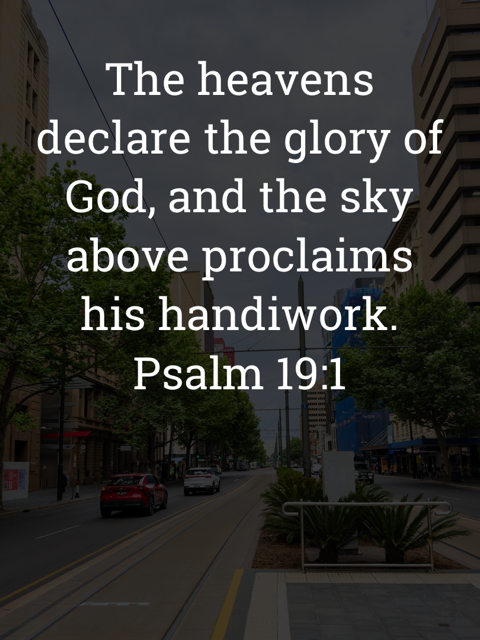
Devotion on Psalm 19:1
Psalm 19
English Standard Version
The Law of the LORD Is Perfect
To the choirmaster. A Psalm of David.
19 The heavens declare the glory of God,
and the sky above[a] proclaims his handiwork.
2 Day to day pours out speech,
and night to night reveals knowledge.
3 There is no speech, nor are there words,
whose voice is not heard.
4 Their voice[b] goes out through all the earth,
and their words to the end of the world.
In them he has set a tent for the sun,
5 which comes out like a bridegroom leaving his chamber,
and, like a strong man, runs its course with joy.
6 Its rising is from the end of the heavens,
and its circuit to the end of them,
and there is nothing hidden from its heat.
7 The law of the LORD is perfect,[c]
reviving the soul;
the testimony of the LORD is sure,
making wise the simple;
8 the precepts of the LORD are right,
rejoicing the heart;
the commandment of the LORD is pure,
enlightening the eyes;
9 the fear of the LORD is clean,
enduring forever;
the rules[d] of the LORD are true,
and righteous altogether.
10 More to be desired are they than gold,
even much fine gold;
sweeter also than honey
and drippings of the honeycomb.
11 Moreover, by them is your servant warned;
in keeping them there is great reward.
12 Who can discern his errors?
Declare me innocent from hidden faults.
13 Keep back your servant also from presumptuous sins;
let them not have dominion over me!
Then I shall be blameless,
and innocent of great transgression.
14 Let the words of my mouth and the meditation of my heart
be acceptable in your sight,
O LORD, my rock and my redeemer.
Psalm 19:1 Hebrew the expanse; compare Genesis 1:6–8
Psalm 19:4 Or Their measuring line
Psalm 19:7 Or blameless
Psalm 19:9 Or just decrees
The ESV® Bible (The Holy Bible, English Standard Version®), © 2001 by Crossway, a publishing ministry of Good News Publishers. ESV Text Edition: 2025.
Psalm 19:1. “The heavens declare the glory of God, and the sky above proclaims his handiwork.”
Context and main idea
Psalm 19 is a psalm of David that traces God’s self-disclosure from creation, to Scripture, and then to the worshipper’s heart. The heavens bear a universal, wordless witness to the Creator in Psalm 19:1–6. The written word reveals God’s character and will with saving and sanctifying clarity in Psalm 19:7–11. The psalm then leads David to self-examination, repentance, and prayer in Psalm 19:12–14.
Main idea: The ordered beauty and vastness of the heavens continually testify that the living God is glorious, wise, and powerful; therefore, every person should honour the Creator, and every Christian should receive creation’s witness through the clearer light of Scripture.
1. Exegesis of Psalm 19:1
“The heavens declare.” The plural “heavens” directs attention to the whole visible expanse above. “Declare” presents creation as an active witness. The heavens do not merely suggest that God may exist; they continually announce something true about him. Psalm 19:2–4 develops this thought: their testimony is constant, non-verbal, and worldwide.
“The glory of God.” God’s glory is the radiant display of his worth, majesty, power, wisdom, and goodness. Creation is not God, and it must not be worshipped. Rather, it is God’s workmanship and points beyond itself to him. This accords with Genesis 1:1, Psalm 8:1–4, Psalm 50:6, Romans 1:19–20, and Acts 14:15–17.
“The sky above proclaims.” The English Standard Version footnote gives “the expanse” as the underlying sense, recalling Genesis 1:6–8. “Proclaims” parallels “declare,” reinforcing the certainty and continuity of creation’s testimony. Hebrew poetry often places two corresponding lines together so that each sharpens the other.
“His handiwork.” The sky is the work of God’s hands. This human-like expression does not imply that God has a physical body; it communicates deliberate craftsmanship. The heavens show order, scale, beauty, and dependence. They are creatures, not rivals to their Maker.
Within the whole psalm, verse 1 begins a movement from the cosmic to the personal. Creation reveals God’s glory, Scripture reveals his covenant instruction, and both expose the worshipper’s need for cleansing and redemption. The final prayer to “my rock and my redeemer” in Psalm 19:14 shows that true contemplation should end in humble trust, not detached admiration.
2. Theological teaching
- God truly reveals himself in creation. Christian theology calls this general revelation. It reaches all people and gives real knowledge of God’s power and divine nature, leaving humanity without excuse, but it does not by itself announce the saving work of Christ. See Romans 1:18–23.
- Creation is distinct from the Creator. Psalm 19 rejects both atheism and idolatry. The heavens are neither self-made nor divine. They are dependent works that display their Maker’s glory. See Genesis 1:14–18 and Isaiah 40:25–26.
- General revelation and special revelation belong together. Psalm 19:7–11 turns from the heavens to the word of the Lord. Scripture interprets creation rightly, reveals God’s covenant will, exposes sin, and makes known the Redeemer. See Romans 10:14–17, 2 Timothy 3:15–17, and Hebrews 1:1–3.
- Sin distorts our response to revelation. The problem is not that creation says nothing, but that fallen people suppress the truth. We need the Holy Spirit to renew our minds so that wonder becomes worship rather than self-glory or idolatry. See Romans 1:21–25 and 2 Corinthians 4:4–6.
- All creation finds its goal in Christ. The Son is the agent, sustainer, and heir of creation. The glory announced by the heavens should lead Christians to adore the Father through the Son, in the power of the Holy Spirit. See John 1:1–3, Colossians 1:15–17, and Hebrews 1:2–3.
3. Practical application to modern Christian living
- Recover attentive wonder. Step away regularly from screens and hurry. Look carefully at the sky, weather, light, and seasons, and deliberately praise the God who made them.
- Let wonder lead to the word. Do not treat nature as a substitute for Scripture or gathered worship. Allow creation’s broad testimony to prompt deeper reading of God’s written revelation.
- Resist modern idolatries. Scientific explanation describes created processes, but it does not remove the Creator. Reject both the worship of nature and the proud belief that human knowledge makes God unnecessary.
- Practise grateful stewardship. Because the world is God’s handiwork, use its resources with gratitude, restraint, care, and love for neighbours. Stewardship is worship, not an attempt to save ourselves.
- Witness with humility. Creation provides common ground for conversations about order, beauty, dependence, and purpose. Speak respectfully, while recognising that people need the gospel of Jesus Christ, not merely an argument for a creator.
- Move from observation to repentance. The God whose glory fills the heavens also sees the hidden heart. Pray through Psalm 19:12–14, confess sin, and rest in Christ, the Redeemer.
4. Meditation guide
- Be still. Sit where you can see the sky, or recall it clearly. Ask God to quiet distraction and make you attentive to his word.
- Read. Slowly read Psalm 19:1 three times.
19 The heavens declare the glory of God,
and the sky above proclaims his handiwork.
19 The heavens declare the glory of God,
and the sky above proclaims his handiwork.
19 The heavens declare the glory of God,
and the sky above proclaims his handiwork.
Emphasise, in turn, “heavens,” “glory of God,” and “his handiwork.” - Observe. What does the verse say creation is doing? What does it reveal about God? What does it not reveal apart from Scripture?
- Adore. Praise God for one aspect of his glory displayed in creation: majesty, wisdom, power, order, generosity, or beauty.
- Examine. Ask: Have I ignored God’s witness, worshipped created things, used creation carelessly, or allowed busyness to dull wonder?
- Look to Christ. Remember that the One through whom all things were made is also the Redeemer who reconciles sinners to God. Reflect on Colossians 1:15–20.
- Pray. “Creator and Redeemer, open my eyes to your glory, guard me from idolatry, shape me by your word, forgive my hidden faults, and make my thoughts and words pleasing to you. Amen.”
- Respond. Choose one concrete act today: give thanks, spend time in creation, care for part of God’s world, read the rest of Psalm 19, or speak gently to someone about the Creator.
Unless otherwise indicated, all Scripture quotations are from the ESV® Bible (The Holy Bible, English Standard Version®), © 2001 by Crossway, a publishing ministry of Good News Publishers. ESV Text Edition: 2025. Used by permission. All rights reserved.
Discover more from Daily bible verses
Subscribe to get the latest posts sent to your email.


You must be logged in to post a comment.