
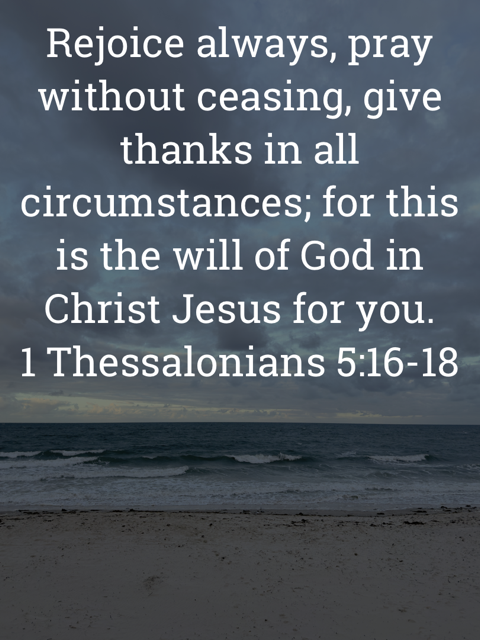
Devotion on 1 Thessalonians 5:16–18
1 Thessalonians 5
English Standard Version
The Day of the Lord
5 Now concerning the times and the seasons, brothers,[a] you have no need to have anything written to you. 2 For you yourselves are fully aware that the day of the Lord will come like a thief in the night. 3 While people are saying, “There is peace and security,” then sudden destruction will come upon them as labour pains come upon a pregnant woman, and they will not escape. 4 But you are not in darkness, brothers, for that day to surprise you like a thief. 5 For you are all children[b] of light, children of the day. We are not of the night or of the darkness. 6 So then let us not sleep, as others do, but let us keep awake and be sober. 7 For those who sleep, sleep at night, and those who get drunk, are drunk at night. 8 But since we belong to the day, let us be sober, having put on the breastplate of faith and love, and for a helmet the hope of salvation. 9 For God has not destined us for wrath, but to obtain salvation through our Lord Jesus Christ, 10 who died for us so that whether we are awake or asleep we might live with him. 11 Therefore encourage one another and build one another up, just as you are doing.
Final Instructions and Benediction
12 We ask you, brothers, to respect those who labour among you and are over you in the Lord and admonish you, 13 and to esteem them very highly in love because of their work. Be at peace among yourselves. 14 And we urge you, brothers, admonish the idle,[c] encourage the fainthearted, help the weak, be patient with them all. 15 See that no one repays anyone evil for evil, but always seek to do good to one another and to everyone. 16 Rejoice always, 17 pray without ceasing, 18 give thanks in all circumstances; for this is the will of God in Christ Jesus for you. 19 Do not quench the Spirit. 20 Do not despise prophecies, 21 but test everything; hold fast what is good. 22 Abstain from every form of evil.
23 Now may the God of peace himself sanctify you completely, and may your whole spirit and soul and body be kept blameless at the coming of our Lord Jesus Christ. 24 He who calls you is faithful; he will surely do it.
25 Brothers, pray for us.
26 Greet all the brothers with a holy kiss.
27 I put you under oath before the Lord to have this letter read to all the brothers.
28 The grace of our Lord Jesus Christ be with you.
- 1 Thessalonians 5:1 Or brothers and sisters; also verses 4, 12, 14, 25, 26, 27
- 1 Thessalonians 5:5 Or sons; twice in this verse
- 1 Thessalonians 5:14 Or disorderly, or undisciplined
The ESV® Bible (The Holy Bible, English Standard Version®), © 2001 by Crossway, a publishing ministry of Good News Publishers. ESV Text Edition: 2025.
Introduction
Paul’s three short commands in 1 Thessalonians 5:16–18 are among the most quoted and most struggled-with verses in the New Testament. In the English Standard Version they read: “Rejoice always, pray without ceasing, give thanks in all circumstances; for this is the will of God in Christ Jesus for you.”
1. Exegesis
Context in the letter and the chapter
Paul wrote to a young congregation in Thessalonica that was suffering opposition (1 Thessalonians 1:6; 2:14; 3:3–4). The letter moves from thanksgiving and remembrance (chapters 1 to 3) to holy living (4:1–12) and the hope of Christ’s return (4:13 to 5:11). Chapter 5 then closes with brief, rapid instructions. Verses 12 to 15 address life together: respect leaders, be at peace, admonish the idle, encourage the fainthearted, help the weak, and be patient with everyone. Verses 16 to 18 turn from conduct towards one another to the posture of the whole heart before God. Verses 19 to 22 concern the Spirit and prophecy, and verses 23 to 24 give the foundation for all of it: the God of peace sanctifies his people, and the one who calls them is faithful and will do it.
The three commands therefore sit between a call to love one another and a call to honour the Spirit. They are not a private spiritual extra; they describe the ordinary life of a church that is watching for the Lord’s return (1 Thessalonians 5:1–11).
Verse 16: “Rejoice always”
The Greek pantote chairete is a present-tense plural command, addressed to the whole congregation as a continuing habit. “Always” (pantote) removes any exemption for hard seasons. This joy is not a temperament or a mood. Paul has already described the Thessalonians as receiving the word in much affliction, with the joy of the Holy Spirit (1 Thessalonians 1:6), and he rejoices before God because of them (1 Thessalonians 3:9). Joy here is a Spirit-given gladness in God and his saving work that can exist alongside sorrow. Compare the same pairing in Philippians 4:4 and 2 Corinthians 6:10.
Verse 17: “Pray without ceasing”
The adverb adialeiptōs means “without interruption” and was used of something that recurs constantly, such as a persistent cough, rather than of something that never pauses at all. Paul uses it of his own prayers for the Thessalonians (1 Thessalonians 1:2–3; 2:13), so it is a pattern he models, not an impossible ideal. It describes a life lived in continual dependence on God, with regular, deliberate times of prayer and a steady readiness to turn to him. Compare Luke 18:1, Romans 12:12, and Colossians 4:2.
Verse 18: “Give thanks in all circumstances”
The English Standard Version renders en panti as “in all circumstances”, and this rendering is important. Paul does not command thanks for everything, as though evil were good. He commands thanks within every situation, because God remains present, sovereign, and good in each one. Compare the different emphasis of Ephesians 5:20, which speaks of thanks for all things in the context of the Father’s gifts. Thanksgiving is the verb of a heart that trusts God’s character when circumstances give no obvious reason to do so (compare Romans 8:28 and Habakkuk 3:17–18).
The reason: “this is the will of God in Christ Jesus for you”
The word “this” most naturally gathers all three commands. The “will of God” (thelēma theou) is his revealed, moral will, not his hidden purposes, and it recalls 1 Thessalonians 4:3, where sanctification is God’s will. The phrase “in Christ Jesus” places the commands inside the believer’s union with Christ: they are possible and fitting because the Thessalonians belong to him. “For you” is personal and gracious. God’s will is not first a demand to be met by effort but a purpose he intends to fulfil in his people, as the promise of 1 Thessalonians 5:23–24 makes plain.
2. Theological Teaching
Joy, prayer, and thanksgiving are commanded and enabled
Christian theology holds that God commands what he also graciously supplies. Joy is listed among the fruit of the Spirit (Galatians 5:22–23), so the command to rejoice is answered by the Spirit’s work in those united to Christ. Paul’s commands arise from the believer’s new life and are not a condition for earning favour. The ground of these commands is the gospel: “in Christ Jesus”.
Prayer as the centre of the three
Prayer is the chief part of the thankfulness God requires. Prayer, then, sits at the centre of the three commands: continual prayer fuels continual joy and thanksgiving. Prayer is the chief exercise of faith, by which we receive daily the benefits of God. The Spirit helps believers in their weakness and intercedes for them (Romans 8:26–27), so prayer is never unaccompanied.
Providence and thanksgiving
Giving thanks in all circumstances rests on the doctrine of providence. God upholds, directs, and governs all things for his glory and for the good of his people. Because nothing is outside his rule, a believer can thank him within suffering without calling suffering good (Genesis 50:20; James 1:2–4). Thanksgiving is the response of faith to a Father who does not waste affliction.
The will of God and sanctification
The phrase “the will of God” links these verses to sanctification (1 Thessalonians 4:3; 5:23–24). Sanctification is the work of God’s free grace by which we are renewed in the whole person and enabled more and more to die to sin and live to righteousness. Rejoicing, praying, and giving thanks are therefore marks of a life being made holy, not an additional religious program. They also anticipate the day of the Lord, for which the church is to be awake and sober (1 Thessalonians 5:4–10).
3. Practical Application to Modern Christian Living
- Distinguish joy from happiness. Joy does not require denying grief. Lament and rejoicing can sit together, as the Psalms show (Psalm 42; Psalm 43). Name your sorrow honestly to God, and then name the reasons for gladness that suffering cannot remove: forgiveness, adoption, and the promise of Christ’s return.
- Build rhythms of prayer. Constant prayer grows from regular prayer. Set fixed times in the morning and evening, then add short “arrow” prayers through the day: before a meeting, in traffic, while waiting for a message, or when anxiety rises. Pray together with your household and your church, not only alone.
- Practise thanksgiving as a discipline. Keep a simple written list of daily mercies. Thank God by name for people, provision, and the gospel. In difficulty, give thanks for what remains true of God, and ask him for help for what you cannot yet thank him.
- Resist distraction. Constant notifications and digital noise erode attention. Decide on screen-free moments, such as the first ten minutes of the day, for prayer and Scripture.
- Care for those who struggle. This command is not a slogan for the grieving or depressed. Believers who live with anxiety, depression, or loss need patience, practical help, and, where appropriate, professional care (1 Thessalonians 5:14). A person can obey this passage in weakness by simply continuing to bring their pain to God.
- Rejoice, pray, and give thanks as a church. Use public worship, small groups, and shared meals to practise these habits together, because verses 16 to 18 are addressed to the whole congregation.
4. Meditation Guide
Set aside about twenty minutes a day for five days, or use one movement each day. Begin each session by asking the Holy Spirit to open your heart to the word.
Day 1: Read and settle
Read 1 Thessalonians 5:12–24 slowly, twice.
12 We ask you, brothers, to respect those who labour among you and are over you in the Lord and admonish you, 13 and to esteem them very highly in love because of their work. Be at peace among yourselves. 14 And we urge you, brothers, admonish the idle, encourage the fainthearted, help the weak, be patient with them all. 15 See that no one repays anyone evil for evil, but always seek to do good to one another and to everyone. 16 Rejoice always, 17 pray without ceasing, 18 give thanks in all circumstances; for this is the will of God in Christ Jesus for you. 19 Do not quench the Spirit. 20 Do not despise prophecies, 21 but test everything; hold fast what is good. 22 Abstain from every form of evil.
23 Now may the God of peace himself sanctify you completely, and may your whole spirit and soul and body be kept blameless at the coming of our Lord Jesus Christ. 24 He who calls you is faithful; he will surely do it.
Notice who is addressed, what is commanded, and what God promises at the end. Write down one sentence that summarises the passage in your own words.
Day 2: Rejoice always
Read 1 Thessalonians 1:6 and Philippians 4:4–7. Ask: What reasons for joy do I have in Christ that do not depend on my circumstances today? Where am I confusing joy with comfort? Pray, naming your joys and sorrows together before God.
Day 3: Pray without ceasing
Read Luke 18:1–8 and Romans 8:26–27.
18 And he told them a parable to the effect that they ought always to pray and not lose heart. 2 He said, “In a certain city there was a judge who neither feared God nor respected man. 3 And there was a widow in that city who kept coming to him and saying, ‘Give me justice against my adversary.’ 4 For a while he refused, but afterward he said to himself, ‘Though I neither fear God nor respect man, 5 yet because this widow keeps bothering me, I will give her justice, so that she will not beat me down by her continual coming.’” 6 And the Lord said, “Hear what the unrighteous judge says. 7 And will not God give justice to his elect, who cry to him day and night? Will he delay long over them? 8 I tell you, he will give justice to them speedily. Nevertheless, when the Son of Man comes, will he find faith on earth?”
26 Likewise the Spirit helps us in our weakness. For we do not know what to pray for as we ought, but the Spirit himself intercedes for us with groanings too deep for words. 27 And he who searches hearts knows what is the mind of the Spirit, because[or that] the Spirit intercedes for the saints according to the will of God.
Ask: What keeps me from praying throughout the day? Who or what can I bring to God right now? Choose three moments tomorrow when you will pause for a short prayer.
Day 4: Give thanks in all circumstances
Read Habakkuk 3:17–19 and Romans 8:28–39. Ask: What is difficult in my life at present, and what is still true of God in it? Write five specific thanksgivings, including at least one given in the midst of difficulty.
17 Though the fig tree should not blossom,
nor fruit be on the vines,
the produce of the olive fail
and the fields yield no food,
the flock be cut off from the fold
and there be no herd in the stalls,
18 yet I will rejoice in the LORD;
I will take joy in the God of my salvation.
19 God, the Lord, is my strength;
he makes my feet like the deer’s;
he makes me tread on my high places.
28 And we know that for those who love God all things work together for good,[Some manuscripts God works all things together for good, or God works in all things for the good] for those who are called according to his purpose. 29 For those whom he foreknew he also predestined to be conformed to the image of his Son, in order that he might be the firstborn among many brothers. 30 And those whom he predestined he also called, and those whom he called he also justified, and those whom he justified he also glorified.
God’s Everlasting Love
31 What then shall we say to these things? If God is for us, who can be[or who is] against us? 32 He who did not spare his own Son but gave him up for us all, how will he not also with him graciously give us all things? 33 Who shall bring any charge against God’s elect? It is God who justifies. 34 Who is to condemn? Christ Jesus is the one who died—more than that, who was raised—who is at the right hand of God, who indeed is interceding for us.[Or Is it Christ Jesus who died… for us?] 35 Who shall separate us from the love of Christ? Shall tribulation, or distress, or persecution, or famine, or nakedness, or danger, or sword? 36 As it is written,
“For your sake we are being killed all the day long;
we are regarded as sheep to be slaughtered.”
37 No, in all these things we are more than conquerors through him who loved us. 38 For I am sure that neither death nor life, nor angels nor rulers, nor things present nor things to come, nor powers, 39 nor height nor depth, nor anything else in all creation, will be able to separate us from the love of God in Christ Jesus our Lord.
Day 5: The will of God in Christ Jesus
Read 1 Thessalonians 5:23–24
23 Now may the God of peace himself sanctify you completely, and may your whole spirit and soul and body be kept blameless at the coming of our Lord Jesus Christ. 24 He who calls you is faithful; he will surely do it.
and Philippians 2:12–13.
12 Therefore, my beloved, as you have always obeyed, so now, not only as in my presence but much more in my absence, work out your own salvation with fear and trembling, 13 for it is God who works in you, both to will and to work for his good pleasure.
Ask: How does it change my approach to these commands to know that God is faithful and will complete what he has begun? Confess where you have relied on your own strength. Close by thanking God that his will for you is gracious, and that it is “in Christ Jesus”.
A short closing prayer
Father, thank you for calling me to joy, prayer, and gratitude through your Son. Teach me to rejoice in you when life is hard, to turn to you in every moment, and to give thanks within every circumstance, trusting that you are faithful and will finish your work in me. Amen.
Unless otherwise indicated, all Scripture quotations are from the ESV® Bible (The Holy Bible, English Standard Version®), © 2001 by Crossway, a publishing ministry of Good News Publishers. ESV Text Edition: 2025. Used by permission. All rights reserved.
Discover more from Daily bible verses
Subscribe to get the latest posts sent to your email.


You must be logged in to post a comment.