
Devotion on 1 Corinthians 15:58
1 Corinthians 15
English Standard Version
The Resurrection of Christ
15 Now I would remind you, brothers,[a] of the gospel I preached to you, which you received, in which you stand, 2 and by which you are being saved, if you hold fast to the word I preached to you—unless you believed in vain.
3 For I delivered to you as of first importance what I also received: that Christ died for our sins in accordance with the Scriptures, 4 that he was buried, that he was raised on the third day in accordance with the Scriptures, 5 and that he appeared to Cephas, then to the twelve. 6 Then he appeared to more than five hundred brothers at one time, most of whom are still alive, though some have fallen asleep. 7 Then he appeared to James, then to all the apostles. 8 Last of all, as to one untimely born, he appeared also to me. 9 For I am the least of the apostles, unworthy to be called an apostle, because I persecuted the church of God. 10 But by the grace of God I am what I am, and his grace toward me was not in vain. On the contrary, I worked harder than any of them, though it was not I, but the grace of God that is with me. 11 Whether then it was I or they, so we preach and so you believed.
The Resurrection of the Dead
12 Now if Christ is proclaimed as raised from the dead, how can some of you say that there is no resurrection of the dead? 13 But if there is no resurrection of the dead, then not even Christ has been raised. 14 And if Christ has not been raised, then our preaching is in vain and your faith is in vain. 15 We are even found to be misrepresenting God, because we testified about God that he raised Christ, whom he did not raise if it is true that the dead are not raised. 16 For if the dead are not raised, not even Christ has been raised. 17 And if Christ has not been raised, your faith is futile and you are still in your sins. 18 Then those also who have fallen asleep in Christ have perished. 19 If in Christ we have hope[b] in this life only, we are of all people most to be pitied.
20 But in fact Christ has been raised from the dead, the firstfruits of those who have fallen asleep. 21 For as by a man came death, by a man has come also the resurrection of the dead. 22 For as in Adam all die, so also in Christ shall all be made alive. 23 But each in his own order: Christ the firstfruits, then at his coming those who belong to Christ. 24 Then comes the end, when he delivers the kingdom to God the Father after destroying every rule and every authority and power. 25 For he must reign until he has put all his enemies under his feet. 26 The last enemy to be destroyed is death. 27 For “God[c] has put all things in subjection under his feet.” But when it says, “all things are put in subjection,” it is plain that he is excepted who put all things in subjection under him. 28 When all things are subjected to him, then the Son himself will also be subjected to him who put all things in subjection under him, that God may be all in all.
29 Otherwise, what do people mean by being baptised on behalf of the dead? If the dead are not raised at all, why are people baptised on their behalf? 30 Why are we in danger every hour? 31 I protest, brothers, by my pride in you, which I have in Christ Jesus our Lord, I die every day! 32 What do I gain if, humanly speaking, I fought with beasts at Ephesus? If the dead are not raised, “Let us eat and drink, for tomorrow we die.” 33 Do not be deceived: “Bad company ruins good morals.”[d] 34 Wake up from your drunken stupor, as is right, and do not go on sinning. For some have no knowledge of God. I say this to your shame.
The Resurrection Body
35 But someone will ask, “How are the dead raised? With what kind of body do they come?” 36 You foolish person! What you sow does not come to life unless it dies. 37 And what you sow is not the body that is to be, but a bare kernel, perhaps of wheat or of some other grain. 38 But God gives it a body as he has chosen, and to each kind of seed its own body. 39 For not all flesh is the same, but there is one kind for humans, another for animals, another for birds, and another for fish. 40 There are heavenly bodies and earthly bodies, but the glory of the heavenly is of one kind, and the glory of the earthly is of another. 41 There is one glory of the sun, and another glory of the moon, and another glory of the stars; for star differs from star in glory.
42 So is it with the resurrection of the dead. What is sown is perishable; what is raised is imperishable. 43 It is sown in dishonour; it is raised in glory. It is sown in weakness; it is raised in power. 44 It is sown a natural body; it is raised a spiritual body. If there is a natural body, there is also a spiritual body. 45 Thus it is written, “The first man Adam became a living being”;[e] the last Adam became a life-giving spirit. 46 But it is not the spiritual that is first but the natural, and then the spiritual. 47 The first man was from the earth, a man of dust; the second man is from heaven. 48 As was the man of dust, so also are those who are of the dust, and as is the man of heaven, so also are those who are of heaven. 49 Just as we have borne the image of the man of dust, we shall[f] also bear the image of the man of heaven.
Mystery and Victory
50 I tell you this, brothers: flesh and blood cannot inherit the kingdom of God, nor does the perishable inherit the imperishable. 51 Behold! I tell you a mystery. We shall not all sleep, but we shall all be changed, 52 in a moment, in the twinkling of an eye, at the last trumpet. For the trumpet will sound, and the dead will be raised imperishable, and we shall be changed. 53 For this perishable body must put on the imperishable, and this mortal body must put on immortality. 54 When the perishable puts on the imperishable, and the mortal puts on immortality, then shall come to pass the saying that is written:
“Death is swallowed up in victory.”
55 ”O death, where is your victory?
O death, where is your sting?”
56 The sting of death is sin, and the power of sin is the law. 57 But thanks be to God, who gives us the victory through our Lord Jesus Christ.
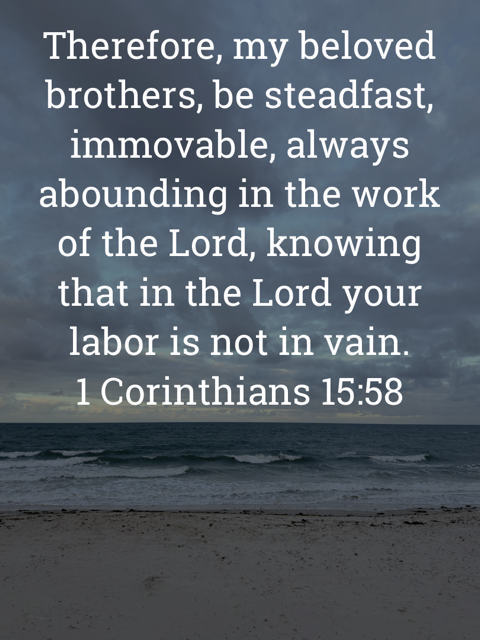
58 Therefore, my beloved brothers, be steadfast, immovable, always abounding in the work of the Lord, knowing that in the Lord your labour is not in vain.
- 1 Corinthians 15:1 Or brothers and sisters; also verses 6, 31, 50, 58
- 1 Corinthians 15:19 Or we have hoped
- 1 Corinthians 15:27 Greek he
- 1 Corinthians 15:33 Probably from Menander’s comedy Thais
- 1 Corinthians 15:45 Greek a living soul
- 1 Corinthians 15:49 Some manuscripts let us
The ESV® Bible (The Holy Bible, English Standard Version®), © 2001 by Crossway, a publishing ministry of Good News Publishers. ESV Text Edition: 2025.
1 Corinthians 15:58. Therefore, my beloved brothers, be steadfast, immovable, always abounding in the work of the Lord, knowing that in the Lord your labour is not in vain.
1. Exegesis
The place of the verse in the chapter
1 Corinthians 15:58 is the only command in a chapter that is otherwise a sustained argument. Paul first recalls the gospel he received and preached, namely that Christ died for our sins, was buried, and was raised on the third day, as the Scriptures foretold (1 Corinthians 15:1–11). He then shows that denying the resurrection of the dead dismantles the gospel, the apostolic witness, and Christian hope (1 Corinthians 15:12–34). Next he explains the nature of the resurrection body (1 Corinthians 15:35–49) and proclaims the transformation of believers at Christ’s return, when death is swallowed up in victory (1 Corinthians 15:50–57). Verse 58 is the pastoral conclusion of all of this.
Key words and phrases
- “Therefore.” The Greek word (hōste) marks a conclusion drawn from the whole chapter, not only from the verses immediately before it. Christian duty rests on the accomplished and promised triumph of Christ. Obedience follows from the gospel, as it does throughout Paul’s letters.
- “My beloved brothers.” Paul turns from argument to affection. The Greek term (adelphoi) addresses the whole congregation, so the English Standard Version footnote “brothers and sisters” is helpful. The Corinthians had been proud and divided (1 Corinthians 1:10–17; 3:1–4), yet Paul still addresses them as family in Christ.
- “Be steadfast, immovable.” The first word (hedraios) describes someone seated firmly, and the second (ametakinētos) describes someone who cannot be shifted. Together they describe stability of belief. The Corinthians were being unsettled by teaching that denied the bodily resurrection, so Paul calls them to hold fast to the gospel in which they stand (1 Corinthians 15:1–2).
- “Always abounding in the work of the Lord.” Stability is not passivity. The verb (perisseuō) means to overflow or to have more than enough, and “always” excludes seasonal commitment. The “work of the Lord” is the work the Lord assigns and in which he is the ultimate author. It includes gospel proclamation, service of the church, and faithful obedience in every calling (1 Corinthians 15:10; 16:10).
- “Knowing.” This participle gives the ground of the command. Paul does not ask for effort on the basis of vague optimism. The resurrection gives believers certain knowledge that shapes how they live (2 Corinthians 4:13–14).
- “In the Lord your labour is not in vain.” The Greek word for labour (kopos) means toil to the point of weariness. The word for “vain” (kenos) means empty or hollow, and it deliberately echoes earlier uses in this chapter, where Paul says that if Christ has not been raised, faith, preaching, and grace would be empty and futile (1 Corinthians 15:2, 10, 14). Because Christ is risen, no labour offered “in the Lord” is wasted. The phrase “in the Lord” matters, because the value of the work comes from union with the risen Christ and not from the worker or the visible result.
Summary of the meaning
Because Christ has been raised, and because believers will be raised in him, Paul calls the Corinthians to stand firm in the gospel and to give themselves fully to the Lord’s work, confident that nothing done in union with Christ will be lost.
2. Theological Teaching
The resurrection of Christ is the foundation of Christian hope
Paul calls Christ “the firstfruits” of those who have died (1 Corinthians 15:20–23). Christian theology has long taught that the resurrection is God’s public declaration that the work of Christ is complete and accepted (Romans 1:4; 4:25). For Paul, the resurrection is not only a proof of Christ’s claims but the beginning of the age to come, in which believers already share through union with him (Ephesians 2:4–6; Colossians 3:1–4).
Grace and labour belong together
Verse 58 does not teach that effort earns salvation. Paul has just said that it is by the grace of God that he is what he is, and that this grace was not in vain, because he laboured more than all the other apostles, yet he credits that labour to the grace of God at work in him (1 Corinthians 15:10). This is the Christian pattern of justification by grace alone through faith alone, followed by sanctification and good works as its fruit (Ephesians 2:8–10; Philippians 2:12–13).
Perseverance and assurance
The command to be steadfast sits alongside the promise that God will keep his people (John 10:27–30; Philippians 1:6; 1 Peter 1:3–5). In Christian teaching, God’s preservation of believers does not make their perseverance optional. He preserves them through means, including the call to stand firm. Paul’s command is therefore one of the means by which God sustains his people.
The meaning of “not in vain”
The promise is general and gracious, not a guarantee of visible success. Scripture teaches that the Lord will faithfully remember and reward service done in his name (1 Corinthians 3:8–14; Hebrews 6:10; Revelation 14:13). Any reward is a gift of grace and not a wage earned (Luke 17:10; Romans 4:4–5). Work done in the Lord is gathered into the new creation, even when its fruit is unseen in this life.
The glory of God as the goal
Because victory comes through our Lord Jesus Christ (1 Corinthians 15:57), the end of all faithful labour is thanksgiving and the glory of God (1 Corinthians 10:31; Colossians 3:23–24).
3. Practical Application to Modern Christian Living
- Stand firm in an unstable age. Constant opinion, online argument, and cultural pressure unsettle many believers. Anchor your confidence in the historical resurrection of Jesus, and keep returning to the gospel in the Scriptures, the preaching of the word, and the Lord’s Supper (1 Corinthians 15:1–4; 11:23–26).
- Serve in ordinary, hidden places. The work of the Lord includes teaching children, visiting the lonely, setting up chairs, giving generously, and praying faithfully. None of it is small to the risen Christ (1 Corinthians 12:22–26; Matthew 25:34–40).
- Work with integrity in your vocation. Employment, study, homemaking, and caring for family can all be done “as for the Lord”, not only church activities (Colossians 3:23–24; Ephesians 6:5–8).
- Persevere through discouragement and fatigue. When results are slow, or when ministry, parenting, or caring for a sick relative seems fruitless, remember that the Lord’s measure is faithfulness, not visible success (1 Corinthians 4:1–5; Galatians 6:9). Rest is also part of faithful stewardship (Mark 6:31).
- Grieve with hope. Those who have lost loved ones can face death knowing that it has been defeated, and that the dead in Christ will be raised (1 Thessalonians 4:13–18).
- Guard against two errors. Avoid busyness that tries to earn God’s favour, and avoid passivity that uses grace as an excuse for neglecting service (Romans 6:1–4; James 2:14–26).
4. Meditation Guide
Set aside about twenty minutes. Meditation in the Christian tradition is Scripture-centred and prayerful. It is not emptying the mind but filling it with the truth of God’s word (Psalm 1:1–3; Joshua 1:8).
Step 1: Prepare
Find a quiet place, ask the Holy Spirit to open your heart to the word, and confess any distraction or anxiety to the Lord (Psalm 119:18).
Step 2: Read
Read 1 Corinthians 15:50–58 slowly twice.
50 I tell you this, brothers: flesh and blood cannot inherit the kingdom of God, nor does the perishable inherit the imperishable. 51 Behold! I tell you a mystery. We shall not all sleep, but we shall all be changed, 52 in a moment, in the twinkling of an eye, at the last trumpet. For the trumpet will sound, and the dead will be raised imperishable, and we shall be changed. 53 For this perishable body must put on the imperishable, and this mortal body must put on immortality. 54 When the perishable puts on the imperishable, and the mortal puts on immortality, then shall come to pass the saying that is written:
“Death is swallowed up in victory.”
55 ”O death, where is your victory?
O death, where is your sting?”
56 The sting of death is sin, and the power of sin is the law. 57 But thanks be to God, who gives us the victory through our Lord Jesus Christ.
58 Therefore, my beloved brothers, be steadfast, immovable, always abounding in the work of the Lord, knowing that in the Lord your labour is not in vain.
Then read 1 Corinthians 15:1–11 to recall the gospel on which the verse rests.
15 Now I would remind you, brothers, of the gospel I preached to you, which you received, in which you stand, 2 and by which you are being saved, if you hold fast to the word I preached to you—unless you believed in vain.
3 For I delivered to you as of first importance what I also received: that Christ died for our sins in accordance with the Scriptures, 4 that he was buried, that he was raised on the third day in accordance with the Scriptures, 5 and that he appeared to Cephas, then to the twelve. 6 Then he appeared to more than five hundred brothers at one time, most of whom are still alive, though some have fallen asleep. 7 Then he appeared to James, then to all the apostles. 8 Last of all, as to one untimely born, he appeared also to me. 9 For I am the least of the apostles, unworthy to be called an apostle, because I persecuted the church of God. 10 But by the grace of God I am what I am, and his grace toward me was not in vain. On the contrary, I worked harder than any of them, though it was not I, but the grace of God that is with me. 11 Whether then it was I or they, so we preach and so you believed.
Step 3: Reflect
- What does the word “therefore” tell me about why I can stand firm?
- Where do I feel unsettled at present, and how does the resurrection of Christ speak into that?
- What is the “work of the Lord” that he has placed in front of me this week?
- Where am I tempted to think my labour is in vain, and what does “in the Lord” change?
- How does 1 Corinthians 15:10 keep me from both pride and idleness?
Step 4: Pray
Thank the Father for raising Jesus and for the victory given through him (1 Corinthians 15:57). Confess where you have been unstable, careless, or proud. Ask for strength to serve in one specific task, and entrust its results to the Lord.
Step 5: Respond
Choose one concrete act of service for the week, and one person you will encourage with the hope of the resurrection. Memorise 1 Corinthians 15:58 and repeat it each morning.
Unless otherwise indicated, all Scripture quotations are from the ESV® Bible (The Holy Bible, English Standard Version®), © 2001 by Crossway, a publishing ministry of Good News Publishers. ESV Text Edition: 2025. Used by permission. All rights reserved.


You must be logged in to post a comment.