
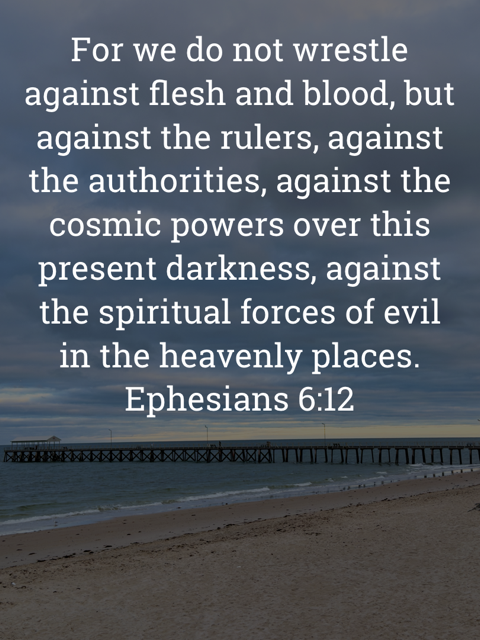
Devotion on Ephesians 6:12
Ephesians 6
English Standard Version
Children and Parents
6 Children, obey your parents in the Lord, for this is right. 2 “Honour your father and mother” (this is the first commandment with a promise), 3 “that it may go well with you and that you may live long in the land.” 4 Fathers, do not provoke your children to anger, but bring them up in the discipline and instruction of the Lord.
Bondservants and Masters
5 Bondservants,[a] obey your earthly masters[b] with fear and trembling, with a sincere heart, as you would Christ, 6 not by the way of eye-service, as people-pleasers, but as bondservants of Christ, doing the will of God from the heart, 7 rendering service with a good will as to the Lord and not to man, 8 knowing that whatever good anyone does, this he will receive back from the Lord, whether he is a bondservant or is free. 9 Masters, do the same to them, and stop your threatening, knowing that he who is both their Master[c] and yours is in heaven, and that there is no partiality with him.
The Whole Armour of God
10 Finally, be strong in the Lord and in the strength of his might. 11 Put on the whole armour of God, that you may be able to stand against the schemes of the devil. 12 For we do not wrestle against flesh and blood, but against the rulers, against the authorities, against the cosmic powers over this present darkness, against the spiritual forces of evil in the heavenly places. 13 Therefore take up the whole armour of God, that you may be able to withstand in the evil day, and having done all, to stand firm. 14 Stand therefore, having fastened on the belt of truth, and having put on the breastplate of righteousness, 15 and, as shoes for your feet, having put on the readiness given by the gospel of peace. 16 In all circumstances take up the shield of faith, with which you can extinguish all the flaming darts of the evil one; 17 and take the helmet of salvation, and the sword of the Spirit, which is the word of God, 18 praying at all times in the Spirit, with all prayer and supplication. To that end, keep alert with all perseverance, making supplication for all the saints, 19 and also for me, that words may be given to me in opening my mouth boldly to proclaim the mystery of the gospel, 20 for which I am an ambassador in chains, that I may declare it boldly, as I ought to speak.
Final Greetings
21 So that you also may know how I am and what I am doing, Tychicus the beloved brother and faithful minister in the Lord will tell you everything. 22 I have sent him to you for this very purpose, that you may know how we are, and that he may encourage your hearts.
23 Peace be to the brothers,[d] and love with faith, from God the Father and the Lord Jesus Christ. 24 Grace be with all who love our Lord Jesus Christ with love incorruptible.
- Ephesians 6:5 For the contextual rendering of the Greek word doulos, see Preface; also verse 6; likewise for bondservant in verse 8
- Ephesians 6:5 Or your masters according to the flesh
- Ephesians 6:9 Greek Lord
- Ephesians 6:23 Or brothers and sisters
The ESV® Bible (The Holy Bible, English Standard Version®), © 2001 by Crossway, a publishing ministry of Good News Publishers. ESV Text Edition: 2025.
Ephesians 6:12. “For we do not wrestle against flesh and blood, but against the rulers, against the authorities, against the cosmic powers over this present darkness, against the spiritual forces of evil in the heavenly places.”
1. Exegesis
Context. Paul writes Ephesians as a letter that moves from what God has done in Christ (chapters 1 to 3) to how the redeemed should live (chapters 4 to 6). Ephesians 6:10 to 20 is the climax. It follows teaching on unity, holiness, marriage, family, and work, and it shows that all of these are lived out in a spiritual conflict. The command in Ephesians 6:10 to be strong “in the Lord” sets the foundation: the strength belongs to Christ, not to the believer.
“For we do not wrestle.” The English Standard Version uses “wrestle” for a Greek word describing close, personal combat. The opening “For” links this verse to Ephesians 6:11, explaining why the whole armour of God is needed. “We” is corporate: the entire church fights together, not isolated individuals.
“Not against flesh and blood.” This phrase means human beings in their frailty. Paul does not deny that people oppose the gospel, as his own imprisonment shows in Ephesians 6:20. He teaches that people are not the ultimate enemy. They are often captives of a deeper power, as Ephesians 2:1 to 3 explains.
“The rulers, the authorities, the cosmic powers over this present darkness, the spiritual forces of evil.” The English Standard Version gives four descriptions of hostile spiritual beings. “Rulers” and “authorities” appear in Ephesians 1:21 and 3:10, where Christ is shown to be far above them all. “Cosmic powers over this present darkness” describes dominion over a fallen world that is spiritually blind, a theme found in Ephesians 2:2 and 5:8. “Spiritual forces of evil” stresses that their nature is spiritual and their character is wicked. The piling up of terms shows that the enemy is real, organised, and formidable, without giving a detailed map of the demonic realm.
“In the heavenly places.” In Ephesians, this phrase marks the unseen realm where Christ reigns (Ephesians 1:3 and 1:20) and where believers are seated with him (Ephesians 2:6). The same realm is where the church displays God’s wisdom to the powers (Ephesians 3:10). The conflict is therefore real, but it takes place under Christ’s lordship, and the outcome is already secured.
2. Theological Teaching
The reality of a personal enemy. Christian theology affirms that Satan and his angels are created beings who fell. Ephesians 6:12 guards against two errors: dismissing the spiritual realm as myth, and becoming fascinated with demons. Scripture treats the enemy seriously but never as an equal of God.
The sovereignty of God over the conflict. The powers are real, yet they are subject to Christ, who is seated far above every power (Ephesians 1:20 to 22). Colossians 2:15 and Romans 8:38 to 39 confirm this. The believer fights from victory, not for victory.
Human sin and spiritual bondage. The doctrine of total depravity explains why “flesh and blood” are not the ultimate problem. People are dead in trespasses and follow the ruler of the present age until God makes them alive (Ephesians 2:1 to 5). Evangelism and opposition to evil are therefore ministries of mercy as well as truth.
Union with Christ and the means of grace. The believer stands “in the Lord” (Ephesians 6:10), not in personal willpower. The weapons in Ephesians 6:13 to 18 are truth, righteousness, the gospel, faith, salvation, the word of God, and prayer. These are the ordinary means of grace, given and used within the church.
Perseverance. God’s people are called to stand firm (Ephesians 6:13 and 6:14). The Christian doctrine of the perseverance of the saints teaches that God preserves them, and that they persevere by using the means he provides.
3. Practical Application
- Look beneath the surface of conflict. When facing hostility, division, or temptation, ask what spiritual forces may be at work, and respond with patience, truth, and prayer rather than bitterness (Romans 12:17 to 21).
- Reject both complacency and fear. Modern life can lull believers into spiritual carelessness, while anxiety about unseen powers can paralyse. Rest in Christ’s victory and remain alert (1 Peter 5:8 and 5:9).
- Guard the gospel in daily habits. Lies about identity, success, and pleasure spread through screens, workplaces, and friendships. Answer them with the truth of Scripture, regular church attendance, and honest confession (Ephesians 4:25 to 27).
- Pray together. Ephesians 6:18 to 20 shows that prayer for one another and for gospel boldness is central. Join a small group or prayer meeting, and pray for your pastors and missionaries.
- Love difficult people. Because people are not the real enemy, believers can serve, forgive, and speak graciously to opponents (Matthew 5:43 to 45).
4. Meditation Guide
Set aside about twenty minutes. Read slowly, pause often, and pray between steps.
- Prepare. Quieten your mind and ask the Holy Spirit to open the Scriptures (Psalm 119:18).
18 Open my eyes, that I may behold
wondrous things out of your law. - Read. Read Ephesians 6:10 to 20 aloud twice, noticing every command and every reason given.
10 Finally, be strong in the Lord and in the strength of his might. 11 Put on the whole armour of God, that you may be able to stand against the schemes of the devil. 12 For we do not wrestle against flesh and blood, but against the rulers, against the authorities, against the cosmic powers over this present darkness, against the spiritual forces of evil in the heavenly places. 13 Therefore take up the whole armour of God, that you may be able to withstand in the evil day, and having done all, to stand firm. 14 Stand therefore, having fastened on the belt of truth, and having put on the breastplate of righteousness, 15 and, as shoes for your feet, having put on the readiness given by the gospel of peace. 16 In all circumstances take up the shield of faith, with which you can extinguish all the flaming darts of the evil one; 17 and take the helmet of salvation, and the sword of the Spirit, which is the word of God, 18 praying at all times in the Spirit, with all prayer and supplication. To that end, keep alert with all perseverance, making supplication for all the saints, 19 and also for me, that words may be given to me in opening my mouth boldly to proclaim the mystery of the gospel, 20 for which I am an ambassador in chains, that I may declare it boldly, as I ought to speak.
10 Finally, be strong in the Lord and in the strength of his might. 11 Put on the whole armour of God, that you may be able to stand against the schemes of the devil. 12 For we do not wrestle against flesh and blood, but against the rulers, against the authorities, against the cosmic powers over this present darkness, against the spiritual forces of evil in the heavenly places. 13 Therefore take up the whole armour of God, that you may be able to withstand in the evil day, and having done all, to stand firm. 14 Stand therefore, having fastened on the belt of truth, and having put on the breastplate of righteousness, 15 and, as shoes for your feet, having put on the readiness given by the gospel of peace. 16 In all circumstances take up the shield of faith, with which you can extinguish all the flaming darts of the evil one; 17 and take the helmet of salvation, and the sword of the Spirit, which is the word of God, 18 praying at all times in the Spirit, with all prayer and supplication. To that end, keep alert with all perseverance, making supplication for all the saints, 19 and also for me, that words may be given to me in opening my mouth boldly to proclaim the mystery of the gospel, 20 for which I am an ambassador in chains, that I may declare it boldly, as I ought to speak. - Reflect. Consider: Who do I tend to treat as my real enemy? Where am I trying to stand in my own strength? Which of the four descriptions of the powers has Christ already placed beneath his feet (Ephesians 1:20 to 22)?
- Recall the victory. Meditate on Colossians 2:13–15 and Romans 8:31–39. Give thanks that your standing does not depend on your performance.
13 And you, who were dead in your trespasses and the uncircumcision of your flesh, God made alive together with him, having forgiven us all our trespasses, 14 by cancelling the record of debt that stood against us with its legal demands. This he set aside, nailing it to the cross. 15 He disarmed the rulers and authorities[Probably demonic rulers and authorities] and put them to open shame, by triumphing over them in him.[Or in it (that is, the cross)]
31 What then shall we say to these things? If God is for us, who can be[Or who is] against us? 32 He who did not spare his own Son but gave him up for us all, how will he not also with him graciously give us all things? 33 Who shall bring any charge against God’s elect? It is God who justifies. 34 Who is to condemn? Christ Jesus is the one who died—more than that, who was raised—who is at the right hand of God, who indeed is interceding for us.[Or Is it Christ Jesus who died… for us?] 35 Who shall separate us from the love of Christ? Shall tribulation, or distress, or persecution, or famine, or nakedness, or danger, or sword? 36 As it is written,
“For your sake we are being killed all the day long;
we are regarded as sheep to be slaughtered.”
37 No, in all these things we are more than conquerors through him who loved us. 38 For I am sure that neither death nor life, nor angels nor rulers, nor things present nor things to come, nor powers, 39 nor height nor depth, nor anything else in all creation, will be able to separate us from the love of God in Christ Jesus our Lord. - Respond. Name one area of present struggle. Choose one piece of armour from Ephesians 6:14 to 17 that you need, and pray for it specifically.
- Intercede. Pray by name for two fellow believers and for one person who opposes the gospel (Ephesians 6:18 to 20).
- Resolve. Write one practical step for this week, such as setting a regular time for Scripture, reconciling with someone, or joining in corporate prayer. Close by praying the Lord’s Prayer.
Unless otherwise indicated, all Scripture quotations are from the ESV® Bible (The Holy Bible, English Standard Version®), © 2001 by Crossway, a publishing ministry of Good News Publishers. ESV Text Edition: 2025. Used by permission. All rights reserved.
Discover more from Daily bible verses
Subscribe to get the latest posts sent to your email.


You must be logged in to post a comment.