
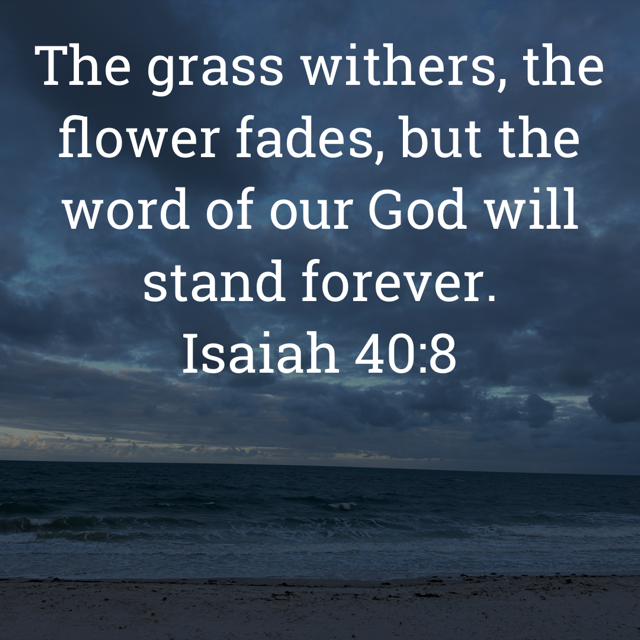
Devotion on Isaiah 40:8
Isaiah 40
English Standard Version
Comfort for God’s People
40 Comfort, comfort my people, says your God.
2 Speak tenderly to Jerusalem,
and cry to her
that her warfare[a] is ended,
that her iniquity is pardoned,
that she has received from the LORD’s hand
double for all her sins.
3 A voice cries:[b]
“In the wilderness prepare the way of the LORD;
make straight in the desert a highway for our God.
4 Every valley shall be lifted up,
and every mountain and hill be made low;
the uneven ground shall become level,
and the rough places a plain.
5 And the glory of the LORD shall be revealed,
and all flesh shall see it together,
for the mouth of the LORD has spoken.”
The Word of God Stands Forever
6 A voice says, “Cry!”
And I said,[c] “What shall I cry?”
All flesh is grass,
and all its beauty[d] is like the flower of the field.
7 The grass withers, the flower fades
when the breath of the LORD blows on it;
surely the people are grass.
8 The grass withers, the flower fades,
but the word of our God will stand forever.
The Greatness of God
9 Go on up to a high mountain,
O Zion, herald of good news;[e]
lift up your voice with strength,
O Jerusalem, herald of good news;[f]
lift it up, fear not;
say to the cities of Judah,
“Behold your God!”
10 Behold, the LORD God comes with might,
and his arm rules for him;
behold, his reward is with him,
and his recompense before him.
11 He will tend his flock like a shepherd;
he will gather the lambs in his arms;
he will carry them in his bosom,
and gently lead those that are with young.
12 Who has measured the waters in the hollow of his hand
and marked off the heavens with a span,
enclosed the dust of the earth in a measure
and weighed the mountains in scales
and the hills in a balance?
13 Who has measured[g] the Spirit of the LORD,
or what man shows him his counsel?
14 Whom did he consult,
and who made him understand?
Who taught him the path of justice,
and taught him knowledge,
and showed him the way of understanding?
15 Behold, the nations are like a drop from a bucket,
and are accounted as the dust on the scales;
behold, he takes up the coastlands like fine dust.
16 Lebanon would not suffice for fuel,
nor are its beasts enough for a burnt offering.
17 All the nations are as nothing before him,
they are accounted by him as less than nothing and emptiness.
18 To whom then will you liken God,
or what likeness compare with him?
19 An idol! A craftsman casts it,
and a goldsmith overlays it with gold
and casts for it silver chains.
20 He who is too impoverished for an offering
chooses wood[h] that will not rot;
he seeks out a skilful craftsman
to set up an idol that will not move.
21 Do you not know? Do you not hear?
Has it not been told you from the beginning?
Have you not understood from the foundations of the earth?
22 It is he who sits above the circle of the earth,
and its inhabitants are like grasshoppers;
who stretches out the heavens like a curtain,
and spreads them like a tent to dwell in;
23 who brings princes to nothing,
and makes the rulers of the earth as emptiness.
24 Scarcely are they planted, scarcely sown,
scarcely has their stem taken root in the earth,
when he blows on them, and they wither,
and the tempest carries them off like stubble.
25 To whom then will you compare me,
that I should be like him? says the Holy One.
26 Lift up your eyes on high and see:
who created these?
He who brings out their host by number,
calling them all by name;
by the greatness of his might
and because he is strong in power,
not one is missing.
27 Why do you say, O Jacob,
and speak, O Israel,
“My way is hidden from the LORD,
and my right is disregarded by my God”?
28 Have you not known? Have you not heard?
The LORD is the everlasting God,
the Creator of the ends of the earth.
He does not faint or grow weary;
his understanding is unsearchable.
29 He gives power to the faint,
and to him who has no might he increases strength.
30 Even youths shall faint and be weary,
and young men shall fall exhausted;
31 but they who wait for the LORD shall renew their strength;
they shall mount up with wings like eagles;
they shall run and not be weary;
they shall walk and not faint.
- Isaiah 40:2 Or hardship
- Isaiah 40:3 Or A voice of one crying
- Isaiah 40:6 Revocalisation based on Dead Sea Scroll, Septuagint, Vulgate; Masoretic Text And someone says
- Isaiah 40:6 Or all its constancy
- Isaiah 40:9 Or O herald of good news to Zion
- Isaiah 40:9 Or O herald of good news to Jerusalem
- Isaiah 40:13 Or has directed
- Isaiah 40:20 Or He chooses valuable wood
The ESV® Bible (The Holy Bible, English Standard Version®), © 2001 by Crossway, a publishing ministry of Good News Publishers. ESV Text Edition: 2025.
Isaiah 40:8 reads: “The grass withers, the flower fades, but the word of our God will stand forever.”
1. Exegesis
Context in the book of Isaiah
Isaiah 1–39 is largely a message of judgement, and it closes in Isaiah 39 with the announcement that Babylon will carry Judah into exile. Isaiah 40 opens a new movement, often called the Book of Comfort, which runs through Isaiah 55. It begins with God’s command to comfort his people because their warfare is ended and their iniquity is pardoned (Isaiah 40:1–2). A herald calls for the way of the Lord to be prepared (Isaiah 40:3–5). Verses 6–8 then answer a pressing question: on what can an exhausted, exiled people rely?
The structure of verses 6 to 8
A voice commands a prophet to cry out, and the prophet asks what he should say (Isaiah 40:6). The English Standard Version follows the Dead Sea Scroll, the Septuagint, and the Vulgate here, so that the prophet himself asks the question, rather than an unnamed speaker. The answer is stark: all flesh is grass, and all its beauty is like the flower of the field. A footnote in the English Standard Version notes that “beauty” may also be translated “constancy”, which is the Hebrew word often associated with covenant loyalty. Even the best human faithfulness is fragile.
Verse 7 explains why. The withering and fading come when the breath of the Lord blows on the grass and flower. The same Hebrew word can mean breath, wind, or spirit. The point is that human frailty is not an accident of nature. It is under the sovereign hand of God. The closing statement of the verse applies the image directly to the people, and this includes the great powers of the day, such as Babylon, which Isaiah 40:15–24 later describes as dust and as nothing before God.
Verse 8 phrase by phrase
- “The grass withers, the flower fades.” The line repeats verse 7 almost word for word. Hebrew poetry often repeats for emphasis, and here the repetition sets up the contrast that follows. Withering and fading describe a completed, certain process.
- “But.” This small word turns the whole passage. Human life is passing, yet there is something that is not.
- “The word of our God.” The Hebrew word for “word” covers spoken promise, command, and revelation. In context it includes the word that announces comfort and pardon (Isaiah 40:1–2) and the word that announces the coming of the Lord (Isaiah 40:9–11). The phrase “our God” is covenantal. This is the God who has bound himself to his people and who spoke to them in the law and the prophets.
- “Will stand.” The Hebrew verb means to rise up, to be established, and to be confirmed. The word of God is not only lasting. It is active and it prevails against opposition. Compare Isaiah 55:10–11, which says that God’s word accomplishes what he purposes.
- “Forever.” The word means to the furthest horizon of time. The contrast is complete: transient flesh against the enduring word.
Wider canonical echoes
Isaiah 40:8 is not a lone statement. Psalm 90:5–6, Psalm 103:15–18, and Psalm 119:89 treat the same themes of human frailty and divine permanence. The New Testament confirms that the verse concerns the gospel itself. In 1 Peter 1:22–25, the apostle quotes the passage and declares that the enduring word is the good news preached to the readers, through which they have been born again. James 1:9–11 uses the grass and flower image to warn the rich about passing wealth. Jesus affirms the permanence of his own words in Matthew 24:35, which implies that his words carry the authority of the God of Isaiah 40:8.
2. Theological Teaching
The authority and sufficiency of Scripture
Christian theology confesses that Scripture is the word of God written, and that its authority rests on God who speaks, not on the testimony of any person or church. Isaiah 40:8 grounds this. If the word is “the word of our God”, then it carries his own character: truthful, authoritative, and unchanging. The whole counsel of God concerning what we need for salvation, faith, and life is either set down in Scripture or may be deduced from it. Passages such as 2 Timothy 3:16–17 and Psalm 19:7–11 support this.
The immutability and sovereignty of God
The word endures because the speaker endures. God does not change (Malachi 3:6; James 1:17), and he is not a man that he should lie (Numbers 23:19). The Lord who sends the withering breath of verse 7 is the same Lord whose word stands in verse 8. Human decline and divine permanence both fall under his sovereign rule, which Isaiah 46:9–11 describes as declaring the end from the beginning.
The word as promise, and the gospel
In context, the enduring word is first a promise of pardon and of God’s coming to shepherd his people (Isaiah 40:1–2, 9–11). 1 Peter 1:25 states plainly that this word is the gospel. In Christian teaching, the word is the ordinary means by which the Holy Spirit gives new birth and sustains faith (Romans 10:17; James 1:18). The word does not return empty (Isaiah 55:10–11), so effectual calling and perseverance rest on God’s faithfulness and not on human strength.
Christ, the Word
The Gospel according to John identifies the eternal Word with Jesus Christ (John 1:1–14), and Isaiah 40:3 is applied to John the Baptist’s preparation for him (Mark 1:2–4). Christ is the fulfilment of all God’s promises (2 Corinthians 1:20). The permanence of the written word and the permanence of the incarnate Word are united in him (Hebrews 1:1–3; Hebrews 13:8).
Human frailty and grace
The doctrine of human mortality and sin, found in Genesis 3:19 and Psalm 90:3–12, is not meant to crush but to humble. Because all flesh is grass, salvation cannot depend on human achievement. It rests on God’s pardon (Isaiah 40:2) and on the word that stands (Ephesians 2:8–9).
3. Practical Application to Modern Christian Living
- Anchor your confidence in God, not in changing circumstances. Health, careers, reputations, and public opinion all fade. When news, markets, or personal loss feel unsettling, return to what God has promised.
- Read Scripture as a living word and not as an old document. Set regular time to read, with the expectation that God speaks through it. Hebrews 4:12 describes the word as living and active.
- Hold cultural trends loosely and Scripture firmly. Ideas rise and fall quickly in modern life, particularly online. Test every claim against the whole of Scripture, as the Bereans did in Acts 17:11.
- Comfort others with the word. Isaiah 40 begins with God’s command to comfort his people. Offer grieving, anxious, or discouraged people promises from Scripture, spoken with patience and warmth (Romans 15:4).
- Share the gospel with confidence. Because the word does not return empty, ordinary conversations, children’s ministry, and church preaching are never wasted (Isaiah 55:11; 2 Timothy 4:2).
- Keep a right view of achievement and ageing. Success and strength are gifts for a season. Receive them with gratitude and use them to serve others, remembering Psalm 90:12. (12 So teach us to number our days that we may get a heart of wisdom).
- Persevere through suffering. The exiles heard this word while in captivity. Believers facing illness, grief, or opposition can wait on the Lord, who renews strength (Isaiah 40:28–31).
4. Meditation Guide
Set aside about twenty to thirty minutes. Choose a quiet place, silence your phone, and keep a Bible and a notebook beside you.
Step 1: Prepare (two minutes)
Pray that the Holy Spirit would open your eyes to see wonderful things in God’s word (Psalm 119:18).
18 Open my eyes, that I may behold
wondrous things out of your law.
Ask for a humble and attentive heart.
Step 2: Read (five minutes)
Read Isaiah 40:1–11 slowly, twice, aloud if possible.
40 Comfort, comfort my people, says your God.
2 Speak tenderly to Jerusalem,
and cry to her
that her warfare is ended,
that her iniquity is pardoned,
that she has received from the LORD’s hand
double for all her sins.
3 A voice cries:
“In the wilderness prepare the way of the LORD;
make straight in the desert a highway for our God.
4 Every valley shall be lifted up,
and every mountain and hill be made low;
the uneven ground shall become level,
and the rough places a plain.
5 And the glory of the LORD shall be revealed,
and all flesh shall see it together,
for the mouth of the LORD has spoken.”
The Word of God Stands Forever
6 A voice says, “Cry!”
And I said, “What shall I cry?”
All flesh is grass,
and all its beauty is like the flower of the field.
7 The grass withers, the flower fades
when the breath of the LORD blows on it;
surely the people are grass.
8 The grass withers, the flower fades,
but the word of our God will stand forever.
The Greatness of God
9 Go on up to a high mountain,
O Zion, herald of good news;
lift up your voice with strength,
O Jerusalem, herald of good news;
lift it up, fear not;
say to the cities of Judah,
“Behold your God!”
10 Behold, the LORD God comes with might,
and his arm rules for him;
behold, his reward is with him,
and his recompense before him.
11 He will tend his flock like a shepherd;
he will gather the lambs in his arms;
he will carry them in his bosom,
and gently lead those that are with young.
Then read 1 Peter 1:22–25 to see how the apostle applies the verse to the gospel.
22 Having purified your souls by your obedience to the truth for a sincere brotherly love, love one another earnestly from a pure heart, 23 since you have been born again, not of perishable seed but of imperishable, through the living and abiding word of God; 24 for
“All flesh is like grass
and all its glory like the flower of grass.
The grass withers,
and the flower falls,
25 but the word of the Lord remains forever.”
And this word is the good news that was preached to you.
Step 3: Reflect (ten minutes)
Consider these questions, writing brief answers:
- What in my life feels like withering grass at present: health, work, relationships, reputation, or finances?
- Why does Isaiah attribute human frailty to the Lord’s own action, and how does that change my view of trials?
- What does it mean that this is the word of “our God”? How does it affect me that he is my covenant God?
- Which promise of God (see Isaiah 40:1–2 and 40:9–11) do I most need to trust today?
- Where am I tempted to trust something that will not last more than the word that will?
Step 4: Pray (five minutes)
Confess where you have trusted in your own strength or in passing things. Thank God for pardon through Christ. Ask for faith to rest on his promises, and pray for one person who needs to hear the gospel.
Step 5: Respond (three minutes)
Write one concrete action for this week, such as memorising Isaiah 40:8, reading a Gospel passage each day, or sending an encouraging message to someone struggling. Finish by praying Psalm 119:89 as your own prayer of trust.
89 Forever, O Lord, your word is firmly fixed in the heavens.
Unless otherwise indicated, all Scripture quotations are from the ESV® Bible (The Holy Bible, English Standard Version®), © 2001 by Crossway, a publishing ministry of Good News Publishers. ESV Text Edition: 2025. Used by permission. All rights reserved.
Discover more from Daily bible verses
Subscribe to get the latest posts sent to your email.


You must be logged in to post a comment.