
Commentary on Psalm 9:1
Psalm 9
King James Version
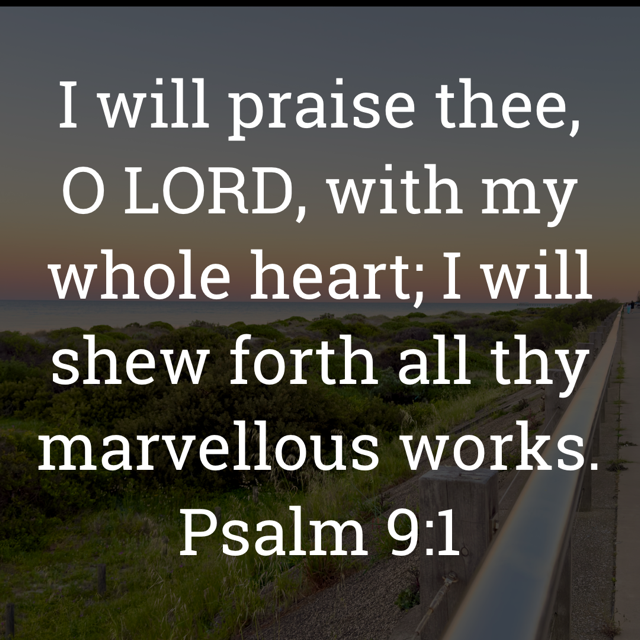
9 I will praise thee, O LORD, with my whole heart; I will shew forth all thy marvellous works.
2 I will be glad and rejoice in thee: I will sing praise to thy name, O thou most High.
3 When mine enemies are turned back, they shall fall and perish at thy presence.
4 For thou hast maintained my right and my cause; thou satest in the throne judging right.
5 Thou hast rebuked the heathen, thou hast destroyed the wicked, thou hast put out their name for ever and ever.
6 O thou enemy, destructions are come to a perpetual end: and thou hast destroyed cities; their memorial is perished with them.
7 But the LORD shall endure for ever: he hath prepared his throne for judgment.
8 And he shall judge the world in righteousness, he shall minister judgment to the people in uprightness.
9 The LORD also will be a refuge for the oppressed, a refuge in times of trouble.
10 And they that know thy name will put their trust in thee: for thou, LORD, hast not forsaken them that seek thee.
11 Sing praises to the LORD, which dwelleth in Zion: declare among the people his doings.
12 When he maketh inquisition for blood, he remembereth them: he forgetteth not the cry of the humble.
13 Have mercy upon me, O LORD; consider my trouble which I suffer of them that hate me, thou that liftest me up from the gates of death:
14 That I may shew forth all thy praise in the gates of the daughter of Zion: I will rejoice in thy salvation.
15 The heathen are sunk down in the pit that they made: in the net which they hid is their own foot taken.
16 The LORD is known by the judgment which he executeth: the wicked is snared in the work of his own hands. Higgaion. Selah.
17 The wicked shall be turned into hell, and all the nations that forget God.
18 For the needy shall not always be forgotten: the expectation of the poor shall not perish for ever.
19 Arise, O LORD; let not man prevail: let the heathen be judged in thy sight.
20 Put them in fear, O LORD: that the nations may know themselves to be but men. Selah.
Scripture text
Psalm 9:1. “I will praise thee, O LORD, with my whole heart; I will shew forth all thy marvellous works.”
Psalm 9:2. “I will be glad and rejoice in thee: I will sing praise to thy name, O thou most High.”
Psalm 9:7–10. “But the LORD shall endure for ever: he hath prepared his throne for judgment. And he shall judge the world in righteousness, he shall minister judgment to the people in uprightness. The LORD also will be a refuge for the oppressed, a refuge in times of trouble. And they that know thy name will put their trust in thee: for thou, LORD, hast not forsaken them that seek thee.”
Context in Psalm 9
Psalm 9 is a Davidic psalm of thankful praise, confidence in God’s righteous judgement, and prayer for further mercy. The psalm begins with personal praise, moves to God’s defeat of evil, celebrates the Lord as the enduring Judge and refuge of the oppressed, and ends with a prayer that proud nations would know they are only human.
The opening verse is therefore not an isolated devotional slogan. It is the proper response of faith to the Lord who rules, judges, remembers the needy, and saves his people. Praise is personal, but it is not private; David promises to declare God’s works so that others may know and trust the Lord.
1. Exegesis of Psalm 9:1
“I will praise thee, O LORD.” David begins with deliberate resolve. Praise is not merely a reaction to pleasant circumstances; it is a covenant response to the Lord’s character and deeds. The name “LORD” represents the covenant God who binds himself to his people, keeps his promises, and acts for his own glory.
“With my whole heart.” The “heart” in Scripture is the centre of thought, desire, trust, and will. Wholehearted praise is undivided worship. David does not offer God a leftover corner of his attention; he brings his whole inward life before the Lord.
Deuteronomy 6:5. “And thou shalt love the LORD thy God with all thine heart, and with all thy soul, and with all thy might.”
“I will shew forth.” Praise becomes witness. David intends to recount, declare, and make known what God has done. True thanksgiving does not terminate in the self; it tells the congregation, the family, the neighbour, and the next generation that the Lord is faithful.
“All thy marvellous works.” God’s “marvellous works” are his extraordinary acts of power, mercy, justice, and deliverance. In Psalm 9, these works include God’s judgement against wickedness, his defence of the oppressed, and his remembering of the humble. David’s praise rests on God’s action, not David’s achievement.
2. Theological teaching
- God is worthy of whole-hearted praise. Christian theology begins with God’s glory. The believer praises God because the Lord is holy, sovereign, righteous, and gracious.
- God acts in history. Psalm 9 does not speak of a distant deity. The Lord judges, protects, remembers, and saves.
- God’s justice comforts the oppressed and warns the proud. Divine judgement is not an embarrassing doctrine to soften; it is part of the good news that evil will not have the final word.
- Grace produces testimony. Those who have received mercy should declare God’s works. Christian witness is not self-display; it is God-centred remembrance.
- Christ fulfils the hope of righteous judgement and refuge. The risen Lord Jesus Christ is the appointed Judge and the safe refuge for sinners who repent and trust him.
Acts 17:31. “Because he hath appointed a day, in the which he will judge the world in righteousness by that man whom he hath ordained; whereof he hath given assurance unto all men, in that he hath raised him from the dead.”
3. Practical application for modern Christian living
- Practise deliberate praise. Begin prayer by naming God’s character before listing your needs.
- Bring the whole heart to God. Do not divide worship from work, family, health, suffering, money, or public life. God claims the whole person.
- Keep a record of mercy. Write down specific ways the Lord has sustained, corrected, provided, or delivered you.
- Speak of God’s works plainly. Share testimony without exaggeration, manipulation, or religious performance.
- Praise God while waiting for justice. Psalm 9 teaches believers to sing, trust, and pray while evil still troubles the world.
- Comfort the oppressed. If the Lord is a refuge for the oppressed, his people must not be indifferent to suffering, injustice, loneliness, or fear.
4. Meditation guide
Read slowly. “I will praise thee, O LORD, with my whole heart; I will shew forth all thy marvellous works.” Pause over each phrase: “I will,” “praise thee,” “O LORD,” “with my whole heart,” and “all thy marvellous works.”
- Adoration: Lord, you are worthy of more than distracted words.
- Confession: Father, forgive my half-hearted worship, forgetfulness, and silence about your goodness.
- Thanksgiving: Name three “marvellous works” of God: one from Scripture, one from your salvation in Christ, and one from recent providence.
- Supplication: Ask the Holy Spirit to make your praise sincere, your witness truthful, and your heart undivided.
- Action: Tell one person this week about a specific mercy of God, with humility and clarity.
Discover more from Daily bible verses
Subscribe to get the latest posts sent to your email.


You must be logged in to post a comment.