
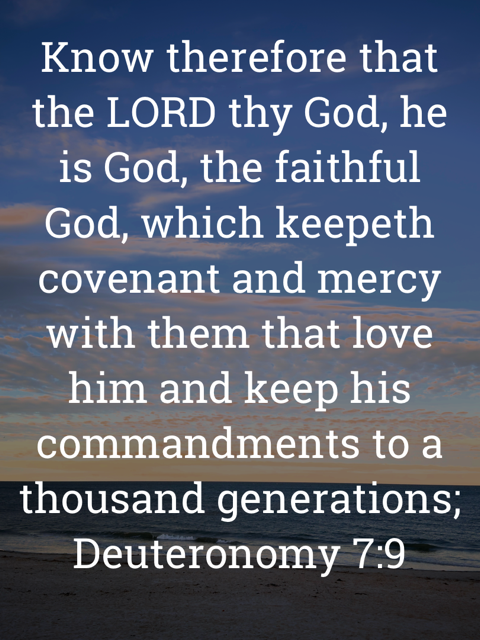
Commentary on Deuteronomy 7:9
Deuteronomy 7
King James Version
7 When the LORD thy God shall bring thee into the land whither thou goest to possess it, and hath cast out many nations before thee, the Hittites, and the Girgashites, and the Amorites, and the Canaanites, and the Perizzites, and the Hivites, and the Jebusites, seven nations greater and mightier than thou;
2 And when the LORD thy God shall deliver them before thee; thou shalt smite them, and utterly destroy them; thou shalt make no covenant with them, nor shew mercy unto them:
3 Neither shalt thou make marriages with them; thy daughter thou shalt not give unto his son, nor his daughter shalt thou take unto thy son.
4 For they will turn away thy son from following me, that they may serve other gods: so will the anger of the LORD be kindled against you, and destroy thee suddenly.
5 But thus shall ye deal with them; ye shall destroy their altars, and break down their images, and cut down their groves, and burn their graven images with fire.
6 For thou art an holy people unto the LORD thy God: the LORD thy God hath chosen thee to be a special people unto himself, above all people that are upon the face of the earth.
7 The LORD did not set his love upon you, nor choose you, because ye were more in number than any people; for ye were the fewest of all people:
8 But because the LORD loved you, and because he would keep the oath which he had sworn unto your fathers, hath the LORD brought you out with a mighty hand, and redeemed you out of the house of bondmen, from the hand of Pharaoh king of Egypt.
9 Know therefore that the LORD thy God, he is God, the faithful God, which keepeth covenant and mercy with them that love him and keep his commandments to a thousand generations;
10 And repayeth them that hate him to their face, to destroy them: he will not be slack to him that hateth him, he will repay him to his face.
11 Thou shalt therefore keep the commandments, and the statutes, and the judgments, which I command thee this day, to do them.
12 Wherefore it shall come to pass, if ye hearken to these judgments, and keep, and do them, that the LORD thy God shall keep unto thee the covenant and the mercy which he sware unto thy fathers:
13 And he will love thee, and bless thee, and multiply thee: he will also bless the fruit of thy womb, and the fruit of thy land, thy corn, and thy wine, and thine oil, the increase of thy kine, and the flocks of thy sheep, in the land which he sware unto thy fathers to give thee.
14 Thou shalt be blessed above all people: there shall not be male or female barren among you, or among your cattle.
15 And the LORD will take away from thee all sickness, and will put none of the evil diseases of Egypt, which thou knowest, upon thee; but will lay them upon all them that hate thee.
16 And thou shalt consume all the people which the LORD thy God shall deliver thee; thine eye shall have no pity upon them: neither shalt thou serve their gods; for that will be a snare unto thee.
17 If thou shalt say in thine heart, These nations are more than I; how can I dispossess them?
18 Thou shalt not be afraid of them: but shalt well remember what the LORD thy God did unto Pharaoh, and unto all Egypt;
19 The great temptations which thine eyes saw, and the signs, and the wonders, and the mighty hand, and the stretched out arm, whereby the LORD thy God brought thee out: so shall the LORD thy God do unto all the people of whom thou art afraid.
20 Moreover the LORD thy God will send the hornet among them, until they that are left, and hide themselves from thee, be destroyed.
21 Thou shalt not be affrighted at them: for the LORD thy God is among you, a mighty God and terrible.
22 And the LORD thy God will put out those nations before thee by little and little: thou mayest not consume them at once, lest the beasts of the field increase upon thee.
23 But the LORD thy God shall deliver them unto thee, and shall destroy them with a mighty destruction, until they be destroyed.
24 And he shall deliver their kings into thine hand, and thou shalt destroy their name from under heaven: there shall no man be able to stand before thee, until thou have destroyed them.
25 The graven images of their gods shall ye burn with fire: thou shalt not desire the silver or gold that is on them, nor take it unto thee, lest thou be snared therin: for it is an abomination to the LORD thy God.
26 Neither shalt thou bring an abomination into thine house, lest thou be a cursed thing like it: but thou shalt utterly detest it, and thou shalt utterly abhor it; for it is a cursed thing.
Text
Deuteronomy 7:9: “Know therefore that the LORD thy God, he is God, the faithful God, which keepeth covenant and mercy with them that love him and keep his commandments to a thousand generations;”
Context in Deuteronomy 7
Deuteronomy 7 stands within Moses’ covenant instruction to Israel before they entered the promised land. The chapter calls Israel to be holy, to reject idolatry, to remember God’s gracious election, and to trust the Lord’s power rather than fear stronger nations. Deuteronomy 7:9 sits between God’s electing love in verses 6 to 8 and the warning of judgment in verses 10 to 11. It teaches that Israel’s obedience is not a way to earn God’s love, but the proper response to God’s prior covenant mercy.
Deuteronomy 7:6: “For thou art an holy people unto the LORD thy God: the LORD thy God hath chosen thee to be a special people unto himself, above all people that are upon the face of the earth.”
Deuteronomy 7:7: “The LORD did not set his love upon you, nor choose you, because ye were more in number than any people; for ye were the fewest of all people:”
Deuteronomy 7:8: “But because the LORD loved you, and because he would keep the oath which he had sworn unto your fathers, hath the LORD brought you out with a mighty hand, and redeemed you out of the house of bondmen, from the hand of Pharaoh king of Egypt.”
1. Exegesis of Deuteronomy 7:9
“Know therefore” is a pastoral summons to settled conviction. Moses does not invite Israel to guess what God is like. He calls them to know God from what he has revealed and done. The “therefore” looks back to God’s choice, love, oath, redemption, and power in Deuteronomy 7:6–8.
“The LORD thy God, he is God” declares the Lord’s exclusive deity. Israel is not dealing with one tribal god among many. The covenant Lord is the only true God, sovereign over Egypt, Canaan, Israel, history, judgment, and mercy.
“The faithful God” names God’s character. He is reliable, truthful, steadfast, and worthy of trust. His faithfulness is not merely his kindness in the moment; it is his unchanging commitment to keep what he has promised.
“Which keepeth covenant and mercy” joins promise and compassion. God binds himself by covenant, and he keeps that covenant with mercy. Israel’s safety rests not in national strength, moral superiority, or religious performance, but in the Lord’s gracious commitment to his own word.
“With them that love him and keep his commandments” does not teach salvation by works. In the covenant setting, love and obedience are the marks of a people who have received grace. Deuteronomy 7:8 has already grounded Israel’s redemption in God’s love and oath. Obedience is the fruit of covenant grace, not the root of it.
“To a thousand generations” is covenant language for the vast reach of God’s mercy. It contrasts sharply with human frailty and short-lived faithfulness. God’s covenant mercy is larger, longer, and surer than the lifespan of any one generation.
2. Theological Teaching
- God is sovereign and personal. He is “the LORD thy God,” not an abstract force. He rules all things, yet enters covenant relationship with his people.
- Election is gracious. Deuteronomy 7:7–8 denies that Israel was chosen because of size, strength, or merit. This coheres with the Christian emphasis that grace begins in God, not in human deserving.
- Redemption comes before obedience. God redeemed Israel from bondage before calling them to covenant faithfulness. Likewise, Christian obedience flows from grace already given in Christ.
- God’s faithfulness is the ground of assurance. Believers do not finally rest on the strength of their faith, but on the faithfulness of the God who keeps covenant and mercy.
- Love and obedience belong together. Biblical love for God is not sentiment alone. It shows itself in trusting, worshipping, and obeying him.
John 14:15: “If ye love me, keep my commandments.”
2 Timothy 2:13: “If we believe not, yet he abideth faithful: he cannot deny himself.”
1 John 1:9: “If we confess our sins, he is faithful and just to forgive us our sins, and to cleanse us from all unrighteousness.”
3. Practical Application to Modern Christian Living
- Trust God’s character when circumstances are unclear. Deuteronomy 7:9 calls believers to know who God is before they interpret what they face. His faithfulness is steadier than our fears.
- Let grace produce obedience. Christian obedience is not a payment for mercy. It is grateful loyalty to the God who has already acted in redeeming love.
- Reject spiritual compromise. Deuteronomy 7 warns against idolatry. Modern idols may include comfort, approval, control, career success, family status, technology, or self-rule. Anything that takes God’s place must be named and resisted.
- Remember redemption. Israel looked back to the exodus. Christians look to the death and resurrection of Jesus Christ as the decisive proof that God keeps covenant and mercy.
- Live with generational hope. “A thousand generations” encourages prayer, teaching, and patient faithfulness in households, churches, and communities. God’s mercy outlasts our moment.
4. Meditation Guide
Read Deuteronomy 7:6–11 slowly
6 For thou art an holy people unto the LORD thy God: the LORD thy God hath chosen thee to be a special people unto himself, above all people that are upon the face of the earth.
7 The LORD did not set his love upon you, nor choose you, because ye were more in number than any people; for ye were the fewest of all people:
8 But because the LORD loved you, and because he would keep the oath which he had sworn unto your fathers, hath the LORD brought you out with a mighty hand, and redeemed you out of the house of bondmen, from the hand of Pharaoh king of Egypt.
9 Know therefore that the LORD thy God, he is God, the faithful God, which keepeth covenant and mercy with them that love him and keep his commandments to a thousand generations;
10 And repayeth them that hate him to their face, to destroy them: he will not be slack to him that hateth him, he will repay him to his face.
11 Thou shalt therefore keep the commandments, and the statutes, and the judgments, which I command thee this day, to do them.
then read Deuteronomy 7:9 again aloud.
9 Know therefore that the LORD thy God, he is God, the faithful God, which keepeth covenant and mercy with them that love him and keep his commandments to a thousand generations;
Reflect
- What does this verse tell me to know about God?
- Where am I tempted to doubt that God is faithful?
- How does God’s prior grace reshape my view of obedience?
- What idol or compromise is the Lord exposing in my life?
- How can I live today in a way that blesses the next generation?
Pray
Faithful God, teach me to know you as you have revealed yourself. Forgive my unbelief, cleanse me from my idols, and make my obedience a glad response to your covenant mercy. Help me trust your faithfulness in Jesus Christ, and shape my life for the good of those who come after me. Amen.
Practise
- Write one sentence beginning, “Because God is faithful, today I will…”
- Confess one area where fear has been louder than God’s promise.
- Choose one act of obedience that expresses love for God today.
- Pray for one person in the next generation to know the Lord’s covenant mercy.
Discover more from Daily bible verses
Subscribe to get the latest posts sent to your email.


You must be logged in to post a comment.