
Commentary on Proverbs 22:6
Proverbs 22
English Standard Version
22 A good name is to be chosen rather than great riches,
and favour is better than silver or gold.
2 The rich and the poor meet together;
the LORD is the Maker of them all.
3 The prudent sees danger and hides himself,
but the simple go on and suffer for it.
4 The reward for humility and fear of the LORD
is riches and honour and life.
5 Thorns and snares are in the way of the crooked;
whoever guards his soul will keep far from them.
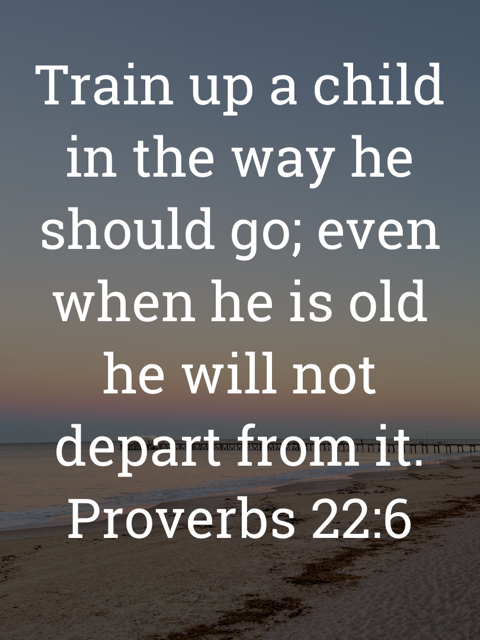
6 Train up a child in the way he should go;
even when he is old he will not depart from it.
7 The rich rules over the poor,
and the borrower is the slave of the lender.
8 Whoever sows injustice will reap calamity,
and the rod of his fury will fail.
9 Whoever has a bountiful eye will be blessed,
for he shares his bread with the poor.
10 Drive out a scoffer, and strife will go out,
and quarrelling and abuse will cease.
11 He who loves purity of heart,
and whose speech is gracious, will have the king as his friend.
12 The eyes of the LORD keep watch over knowledge,
but he overthrows the words of the traitor.
13 The sluggard says, “There is a lion outside!
I shall be killed in the streets!”
14 The mouth of forbidden women is a deep pit;
he with whom the LORD is angry will fall into it.
15 Folly is bound up in the heart of a child,
but the rod of discipline drives it far from him.
16 Whoever oppresses the poor to increase his own wealth,
or gives to the rich, will only come to poverty.
Words of the Wise
17 Incline your ear, and hear the words of the wise,
and apply your heart to my knowledge,
18 for it will be pleasant if you keep them within you,
if all of them are ready on your lips.
19 That your trust may be in the LORD,
I have made them known to you today, even to you.
20 Have I not written for you thirty sayings
of counsel and knowledge,
21 to make you know what is right and true,
that you may give a true answer to those who sent you?
22 Do not rob the poor, because he is poor,
or crush the afflicted at the gate,
23 for the LORD will plead their cause
and rob of life those who rob them.
24 Make no friendship with a man given to anger,
nor go with a wrathful man,
25 lest you learn his ways
and entangle yourself in a snare.
26 Be not one of those who give pledges,
who put up security for debts.
27 If you have nothing with which to pay,
why should your bed be taken from under you?
28 Do not move the ancient landmark
that your fathers have set.
29 Do you see a man skilful in his work?
He will stand before kings;
he will not stand before obscure men.
The ESV® Bible (The Holy Bible, English Standard Version®), © 2001 by Crossway, a publishing ministry of Good News Publishers. ESV Text Edition: 2025.
Proverbs 22:6 begins, “Train up a child in the way he should go.” The verse calls parents and other responsible adults to shape a child’s life deliberately, wisely, and faithfully. It is a proverb, not an unconditional promise that removes personal responsibility or guarantees a particular outcome.
1. Exegesis of Proverbs 22:6
The command translated “train up” carries the sense of dedicating, initiating, or directing. It describes purposeful formation rather than occasional advice. Biblical nurture involves instruction, example, correction, encouragement, and prayer.
The phrase “in the way he should go” may refer to the right path of wisdom, while also recognising the child’s developing character and responsibilities. In the context of Proverbs, “the way” is chiefly moral and spiritual: the path shaped by the fear of the Lord, humility, justice, prudence, diligence, and generosity (Proverbs 1:7; 3:5–7; 22:1–5, 9, 15, 17–21).
The statement about later life expresses the normal pattern that early formation leaves a durable mark. Proverbs presents general truths about God’s ordered world, not mechanical guarantees in every case. Children remain morally accountable before God, and godly parents may endure grief when a child rejects wisdom.
Proverbs 22 places the verse among sayings about character, wealth, oppression, discipline, and wise instruction. The immediate setting therefore resists reducing the verse to academic success, manners, or parental control. Its concern is lifelong formation in wisdom under God.
2. Theological Teaching
- God ordinarily works through means. The Lord uses parents, households, churches, Scripture, discipline, and example to form the young (Deuteronomy 6:4–9; Ephesians 6:4; 2 Timothy 3:14–17).
- Grace, not technique, saves. Careful training cannot regenerate a child. Salvation is God’s merciful work through the gospel, received by faith in Jesus Christ (John 3:3–8; Romans 10:9–17; Ephesians 2:8–10).
- Human nature requires loving correction. Proverbs assumes that folly is present in the human heart. Discipline should therefore be measured, just, restorative, and free from cruelty or exasperation (Proverbs 22:15; Colossians 3:21; Hebrews 12:5–11).
- Covenant responsibility encourages faithful nurture. Believing parents should regard children as entrusted to their care and should raise them within the worship, teaching, and fellowship of God’s people, while calling each child personally to repentance and faith.
- Christ is the true wisdom of God. Christian formation is not mere moralism. Wisdom reaches its centre in Christ, in whom believers receive righteousness, sanctification, and redemption (1 Corinthians 1:24, 30; Colossians 2:2–3).
3. Practical Application to Modern Christian Living
- Make Scripture, prayer, worship, confession, forgiveness, and service part of ordinary household life rather than occasional religious events.
- Teach by example. Children quickly notice whether adults practise truthfulness, humility, generosity, and repentance.
- Give clear, age-appropriate instruction. Explain both what is right and why it reflects God’s character and good design.
- Correct steadily, calmly, and proportionately. Discipline should seek restoration, not humiliation, fear, or the release of adult frustration.
- Know the particular child. Wise nurture is neither indulgent nor rigid; it attends to maturity, strengths, weaknesses, temptations, and circumstances.
- Work with the local church. Parents carry a distinctive responsibility, but they need the preaching, sacraments, fellowship, and mature example of Christ’s people.
- Reject both pride and despair. A child’s faithfulness is not proof of flawless parenting, and a child’s wandering does not necessarily prove parental failure. Pray, remain truthful, keep appropriate boundaries, and entrust the outcome to God.
- Apply the principle beyond parenting. Pastors, teachers, mentors, and older believers should help younger Christians build habits of wisdom and gospel-shaped obedience.
4. Meditation Guide
Read
Read Proverbs 22 slowly, giving particular attention to verses 1–6, 9, 15, and 17–21.
22 A good name is to be chosen rather than great riches,
and favour is better than silver or gold.
2 The rich and the poor meet together;
the LORD is the Maker of them all.
3 The prudent sees danger and hides himself,
but the simple go on and suffer for it.
4 The reward for humility and fear of the LORD
is riches and honour and life.
5 Thorns and snares are in the way of the crooked;
whoever guards his soul will keep far from them.
6 Train up a child in the way he should go;
even when he is old he will not depart from it.
9 Whoever has a bountiful eye will be blessed,
for he shares his bread with the poor.
15 Folly is bound up in the heart of a child,
but the rod of discipline drives it far from him.
Words of the Wise
17 Incline your ear, and hear the words of the wise,
and apply your heart to my knowledge,
18 for it will be pleasant if you keep them within you,
if all of them are ready on your lips.
19 That your trust may be in the LORD,
I have made them known to you today, even to you.
20 Have I not written for you thirty sayings
of counsel and knowledge,
21 to make you know what is right and true,
that you may give a true answer to those who sent you?
Notice the chapter’s contrasts between wisdom and folly, humility and pride, generosity and oppression.
Reflect
- What “way” is my life displaying to those I influence?
- Do I rely on methods and control, or on God’s grace working through faithful means?
- Where does my instruction need greater clarity, patience, consistency, or tenderness?
- Am I confusing a proverbial pattern with an unconditional promise?
Repent
Confess pride, harshness, passivity, inconsistency, fear, or misplaced confidence. Receive afresh the forgiveness promised in Christ (1 John 1:9).
Pray
Ask God for wisdom, self-control, perseverance, and love. Pray that those under your care will fear the Lord, trust Christ, recognise folly, and walk in wisdom.
Act
Choose one concrete practice for this week: a regular family prayer, a calm conversation, an apology, a shared reading of Scripture, encouragement for a child or younger believer, or support for another parent.
Unless otherwise indicated, all Scripture quotations are from the ESV® Bible (The Holy Bible, English Standard Version®), © 2001 by Crossway, a publishing ministry of Good News Publishers. ESV Text Edition: 2025. Used by permission. All rights reserved.
Discover more from Daily bible verses
Subscribe to get the latest posts sent to your email.


You must be logged in to post a comment.