
Commentary on Jeremiah 17:7
Jeremiah 17
English Standard Version
The Sin of Judah
17 “The sin of Judah is written with a pen of iron; with a point of diamond it is engraved on the tablet of their heart, and on the horns of their altars, 2 while their children remember their altars and their Asherim, beside every green tree and on the high hills, 3 on the mountains in the open country. Your wealth and all your treasures I will give for spoil as the price of your high places for sin throughout all your territory. 4 You shall loosen your hand from your heritage that I gave to you, and I will make you serve your enemies in a land that you do not know, for in my anger a fire is kindled that shall burn forever.”
5 Thus says the LORD:
“Cursed is the man who trusts in man
and makes flesh his strength,
whose heart turns away from the LORD.
6 He is like a shrub in the desert,
and shall not see any good come.
He shall dwell in the parched places of the wilderness,
in an uninhabited salt land.
7 “Blessed is the man who trusts in the LORD,
whose trust is the LORD.
8 He is like a tree planted by water,
that sends out its roots by the stream,
and does not fear when heat comes,
for its leaves remain green,
and is not anxious in the year of drought,
for it does not cease to bear fruit.”
9 The heart is deceitful above all things,
and desperately sick;
who can understand it?
10 “I the LORD search the heart
and test the mind,
to give every man according to his ways,
according to the fruit of his deeds.”
11 Like the partridge that gathers a brood that she did not hatch,
so is he who gets riches but not by justice;
in the midst of his days they will leave him,
and at his end he will be a fool.
12 A glorious throne set on high from the beginning
is the place of our sanctuary.
13 O LORD, the hope of Israel,
all who forsake you shall be put to shame;
those who turn away from you shall be written in the earth,
for they have forsaken the LORD, the fountain of living water.
Jeremiah Prays for Deliverance
14 Heal me, O LORD, and I shall be healed;
save me, and I shall be saved,
for you are my praise.
15 Behold, they say to me,
“Where is the word of the LORD?
Let it come!”
16 I have not run away from being your shepherd,
nor have I desired the day of sickness.
You know what came out of my lips;
it was before your face.
17 Be not a terror to me;
you are my refuge in the day of disaster.
18 Let those be put to shame who persecute me,
but let me not be put to shame;
let them be dismayed,
but let me not be dismayed;
bring upon them the day of disaster;
destroy them with double destruction!
Keep the Sabbath Holy
19 Thus said the LORD to me: “Go and stand in the People’s Gate, by which the kings of Judah enter and by which they go out, and in all the gates of Jerusalem, 20 and say: ‘Hear the word of the LORD, you kings of Judah, and all Judah, and all the inhabitants of Jerusalem, who enter by these gates. 21 Thus says the LORD: Take care for the sake of your lives, and do not bear a burden on the Sabbath day or bring it in by the gates of Jerusalem. 22 And do not carry a burden out of your houses on the Sabbath or do any work, but keep the Sabbath day holy, as I commanded your fathers. 23 Yet they did not listen or incline their ear, but stiffened their neck, that they might not hear and receive instruction.
24 “‘But if you listen to me, declares the LORD, and bring in no burden by the gates of this city on the Sabbath day, but keep the Sabbath day holy and do no work on it, 25 then there shall enter by the gates of this city kings and princes who sit on the throne of David, riding in chariots and on horses, they and their officials, the men of Judah and the inhabitants of Jerusalem. And this city shall be inhabited forever. 26 And people shall come from the cities of Judah and the places around Jerusalem, from the land of Benjamin, from the Shephelah, from the hill country, and from the Negeb, bringing burnt offerings and sacrifices, grain offerings and frankincense, and bringing thank offerings to the house of the LORD. 27 But if you do not listen to me, to keep the Sabbath day holy, and not to bear a burden and enter by the gates of Jerusalem on the Sabbath day, then I will kindle a fire in its gates, and it shall devour the palaces of Jerusalem and shall not be quenched.’”
The ESV® Bible (The Holy Bible, English Standard Version®), © 2001 by Crossway, a publishing ministry of Good News Publishers. ESV Text Edition: 2025.
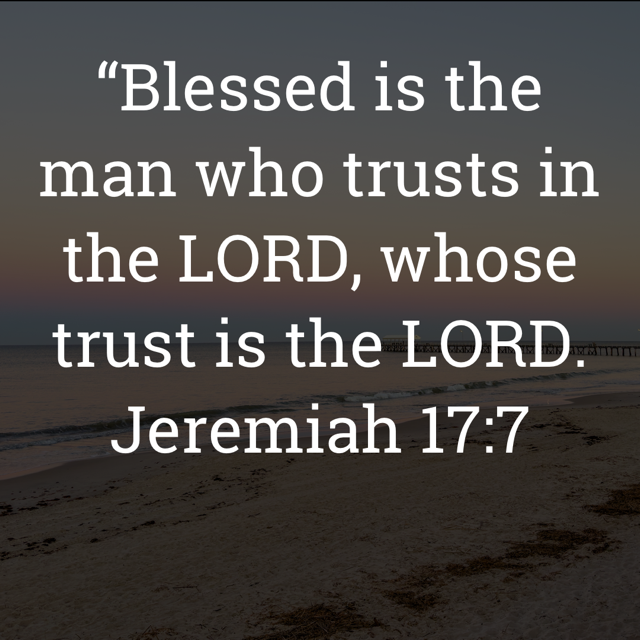
Jeremiah 17:7. “Blessed is the man who trusts in the LORD, whose trust is the LORD.”
1. Exegesis
Jeremiah 17:7 stands within a carefully shaped contrast in Jeremiah 17:5–8. The person who relies on human strength is cursed and pictured as a shrub in an arid wasteland. By contrast, the person who trusts in the Lord is blessed and resembles a tree planted beside water, rooted deeply enough to remain fruitful through heat and drought.
The English Standard Version preserves the verse’s twofold emphasis: the faithful person both trusts in the Lord and has the Lord as the object and ground of that trust. This is not vague optimism or confidence in one’s own faith. It is personal reliance on the covenant Lord, whose character, word, and saving purpose are dependable.
“Blessed” describes the favoured and flourishing condition of the person who rests in God. It does not promise freedom from suffering. Jeremiah 17:8 assumes that heat and drought will come. The blessing is God-given stability, freedom from paralysing fear, and continuing fruitfulness amid hardship.
The wider chapter exposes Judah’s deeply engraved sin, false worship, corrupt gain, and refusal to heed the Lord, while also presenting the Lord as the true hope of Israel and the healer and saviour of his servant. Jeremiah 17:9–10 prevents a sentimental reading: the human heart is deceitful, but the Lord searches it and judges justly. Therefore, true trust requires repentance from self-reliance and a return to God.
2. Theological Teaching
- God alone is the proper object of saving trust. Human power, wisdom, wealth, and moral effort cannot bear the weight of ultimate confidence. See Psalms 1:1–3; Psalms 146:3–5; Proverbs 3:5–6.
- Grace produces a rooted life. The blessed person’s endurance comes from God’s sustaining provision, not from natural toughness. Scripture later presents union with Jesus Christ and the indwelling Holy Spirit as the source of spiritual life and fruit. See John 15:1–5; Galatians 5:22–23; Colossians 2:6–7.
- Faith is tested, not disproved, by affliction. Heat and drought reveal where the roots reach. God may preserve his people through severe trials while forming perseverance and mature hope. See Romans 5:1–5; James 1:2–4; 1 Peter 1:6–9.
- The heart needs sovereign renewal. Jeremiah’s diagnosis of the deceitful heart shows that sinners cannot cure themselves. The book looks towards the new covenant, in which God forgives sin and writes his law on the heart. See Jeremiah 31:31–34; Ezekiel 36:25–27; Hebrews 8:6–13.
- Blessing finds its fulfilment in Jesus Christ. He trusted the Father perfectly, bore the covenant curse for his people, and grants them righteousness and life through faith. See Galatians 3:10–14; Philippians 2:5–11; 1 Peter 2:21–24.
3. Practical Application to Modern Christian Living
- Identify functional saviours. Ask what you rely on for security, identity, approval, or control. Career, money, health, competence, relationships, and institutions are gifts, but they become idols when they take God’s place.
- Use ordinary means of grace. Deep roots grow through Scripture, prayer, gathered worship, the sacraments, and fellowship in a faithful local church. These practices do not earn blessing; God uses them to strengthen faith.
- Interpret hardship through God’s character. When circumstances feel barren, do not conclude that God has abandoned you. Bring fear and grief to him, remember his promises in Jesus Christ, and seek wise pastoral and practical help.
- Pursue fruit, not mere survival. Trust appears in patient obedience, love, integrity, generosity, and service. Ask not only, “How will I get through this?” but also, “How may I honour God and serve my neighbour here?”
- Repent promptly. Because the heart can mislead us, welcome correction from Scripture and mature believers. Confess self-reliance, and return repeatedly to the mercy of God in Jesus Christ.
4. Meditation Guide
- Read: Slowly read Jeremiah 17:5–10
5 Thus says the LORD:
“Cursed is the man who trusts in man
and makes flesh his strength,
whose heart turns away from the LORD.
6 He is like a shrub in the desert,
and shall not see any good come.
He shall dwell in the parched places of the wilderness,
in an uninhabited salt land.
7 “Blessed is the man who trusts in the LORD,
whose trust is the LORD.
8 He is like a tree planted by water,
that sends out its roots by the stream,
and does not fear when heat comes,
for its leaves remain green,
and is not anxious in the year of drought,
for it does not cease to bear fruit.”
9 The heart is deceitful above all things,
and desperately sick;
who can understand it?
10 “I the LORD search the heart
and test the mind,
to give every man according to his ways,
according to the fruit of his deeds.”
then read Jeremiah 17:7–8 again.
7 “Blessed is the man who trusts in the LORD,
whose trust is the LORD.
8 He is like a tree planted by water,
that sends out its roots by the stream,
and does not fear when heat comes,
for its leaves remain green,
and is not anxious in the year of drought,
for it does not cease to bear fruit.”
Notice the two objects of trust, the two landscapes, and the two outcomes. - Observe: What does the verse say about the blessed person? What does the tree image promise, and what does it not promise?
- Examine: Complete this sentence honestly: “When I feel threatened, I instinctively trust in ______.” Consider whether that reliance has displaced trust in the Lord.
- Remember: Reflect on God’s faithfulness in Jesus Christ. Use Jeremiah 31:31–34, John 15:1–5, and Romans 8:31–39 to recall his covenant grace and sustaining presence.
- Pray: “Lord, expose my false refuges. Forgive my self-reliance. Root me in Jesus Christ, steady me in trial, and bear fruit through me for your glory and my neighbour’s good. Amen.”
- Act: Choose one concrete act of trust today: obey a clear command, seek reconciliation, ask for help, give generously, or entrust an unresolved fear to God in prayer.
Unless otherwise indicated, all Scripture quotations are from the ESV® Bible (The Holy Bible, English Standard Version®), © 2001 by Crossway, a publishing ministry of Good News Publishers. ESV Text Edition: 2025. Used by permission. All rights reserved.
Discover more from Daily bible verses
Subscribe to get the latest posts sent to your email.


You must be logged in to post a comment.