
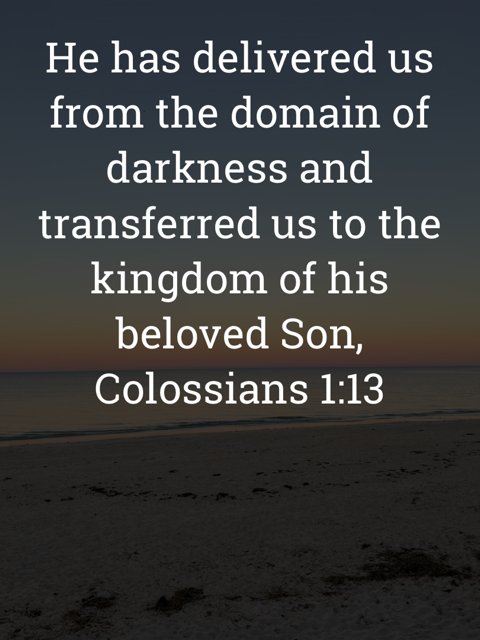
Devotional on Colossians 1:13
Colossians 1
English Standard Version
Greeting
1 Paul, an apostle of Christ Jesus by the will of God, and Timothy our brother,
2 To the saints and faithful brothers[a] in Christ at Colossae:
Grace to you and peace from God our Father.
Thanksgiving and Prayer
3 We always thank God, the Father of our Lord Jesus Christ, when we pray for you, 4 since we heard of your faith in Christ Jesus and of the love that you have for all the saints, 5 because of the hope laid up for you in heaven. Of this you have heard before in the word of the truth, the gospel, 6 which has come to you, as indeed in the whole world it is bearing fruit and increasing—as it also does among you, since the day you heard it and understood the grace of God in truth, 7 just as you learned it from Epaphras our beloved fellow servant.[b] He is a faithful minister of Christ on your[c] behalf 8 and has made known to us your love in the Spirit.
9 And so, from the day we heard, we have not ceased to pray for you, asking that you may be filled with the knowledge of his will in all spiritual wisdom and understanding, 10 so as to walk in a manner worthy of the Lord, fully pleasing to him: bearing fruit in every good work and increasing in the knowledge of God; 11 being strengthened with all power, according to his glorious might, for all endurance and patience with joy; 12 giving thanks[d] to the Father, who has qualified you[e] to share in the inheritance of the saints in light. 13 He has delivered us from the domain of darkness and transferred us to the kingdom of his beloved Son, 14 in whom we have redemption, the forgiveness of sins.
The Preeminence of Christ
15 He is the image of the invisible God, the firstborn of all creation. 16 For by[f] him all things were created, in heaven and on earth, visible and invisible, whether thrones or dominions or rulers or authorities—all things were created through him and for him. 17 And he is before all things, and in him all things hold together. 18 And he is the head of the body, the church. He is the beginning, the firstborn from the dead, that in everything he might be preeminent. 19 For in him all the fullness of God was pleased to dwell, 20 and through him to reconcile to himself all things, whether on earth or in heaven, making peace by the blood of his cross.
21 And you, who once were alienated and hostile in mind, doing evil deeds, 22 he has now reconciled in his body of flesh by his death, in order to present you holy and blameless and above reproach before him, 23 if indeed you continue in the faith, stable and steadfast, not shifting from the hope of the gospel that you heard, which has been proclaimed in all creation[g] under heaven, and of which I, Paul, became a minister.
Paul’s Ministry to the Church
24 Now I rejoice in my sufferings for your sake, and in my flesh I am filling up what is lacking in Christ’s afflictions for the sake of his body, that is, the church, 25 of which I became a minister according to the stewardship from God that was given to me for you, to make the word of God fully known, 26 the mystery hidden for ages and generations but now revealed to his saints. 27 To them God chose to make known how great among the Gentiles are the riches of the glory of this mystery, which is Christ in you, the hope of glory. 28 Him we proclaim, warning everyone and teaching everyone with all wisdom, that we may present everyone mature in Christ. 29 For this I toil, struggling with all his energy that he powerfully works within me.
- Colossians 1:2 Or brothers and sisters. In New Testament usage, depending on the context, the plural Greek word adelphoi (translated “brothers”) may refer either to brothers or to brothers and sisters
- Colossians 1:7 For the contextual rendering of the Greek word sundoulos, see Preface
- Colossians 1:7 Some manuscripts our
- Colossians 1:12 Or patience, with joy giving thanks
- Colossians 1:12 Some manuscripts us
- Colossians 1:16 That is, by means of; or in
- Colossians 1:23 Or to every creature
The ESV® Bible (The Holy Bible, English Standard Version®), © 2001 by Crossway, a publishing ministry of Good News Publishers. ESV Text Edition: 2025.
Colossians 1:13. 13 He has delivered us from the domain of darkness and transferred us to the kingdom of his beloved Son,
Central truth: The Father has rescued believers from the rule of darkness and brought them under the saving reign of his Son. Christian obedience grows from this gracious change of belonging, not from an attempt to earn it.
1. Exegesis of the verse
- The Father acts. The opening pronoun refers back to the Father in Colossians 1:12. Paul is explaining why believers should give thanks: their qualification for the inheritance, rescue, and new citizenship originate in God’s gracious action, not their spiritual achievement.
- Rescue from a ruling power. The English Standard Version’s language of deliverance identifies a rescue, while its use of domain points to authority or dominion. Darkness is not simply sadness or limited knowledge; it describes the realm of sin and opposition to God. Colossians 1:21 and 2:15 connect this condition with human alienation and hostile spiritual powers. Acts 26:18 provides a supporting parallel.
- A decisive transfer. The English Standard Version presents both actions as accomplished. The underlying Greek verbs describe decisive past acts, rather than merely an invitation to escape. The transfer is a change of spiritual allegiance and belonging, not a geographical move. Paul’s plural pronoun includes the believing community; this is shared salvation, not isolated self-improvement.
- The Son’s kingdom. The destination is the saving reign of the Son whom the Father loves. Colossians 1:15–20 establishes his supremacy as Creator, sustainer, head of the church, and reconciler. His kingdom is therefore neither a private feeling nor merely a future destination: believers already belong to him, while awaiting the glory described in Colossians 3:4.
- Rescue through redemption. Colossians 1:14 immediately explains that redemption and forgiveness are found in the Son. The English Standard Version does not include a phrase about Christ’s blood in that verse; the cross and its blood are explicitly identified in Colossians 1:20, and his bodily death in Colossians 1:22. The argument must follow these connections rather than import another translation’s wording.
Contextual conclusion: Paul’s prayer moves from fruitful living and endurance to thanksgiving for salvation (Colossians 1:9–14). Rescue is the foundation of growth, not its reward. The letter’s emphasis on Christ’s sufficiency also challenges teaching that offers spiritual security through additional religious requirements (Colossians 2:8–23).
2. Theological teaching
- Salvation is God’s gracious initiative. The Father is the acting subject; believers receive his rescue. Within a Christian understanding, this fits God’s effective calling: he brings sinners to living faith in Christ. Faith receives salvation; it does not earn it. This broader doctrinal conclusion draws on Ephesians 2:1–10 and Colossians 2:12–13, not on the verb tense alone.
- Christ alone is sufficient. Our release from sin’s dominion and our forgiveness belong together in union with Christ, meaning our saving relationship with him. His death reconciles us to God, and his resurrection grounds our new life (Colossians 1:14, 20–22; 2:12–15). Religious performance cannot supplement his saving work.
- Grace changes both status and conduct. Forgiveness and belonging are gifts; holiness is their necessary fruit, not their purchase price. Believers still resist remaining sin, but no longer belong to its ruling realm (Colossians 3:1–17; Romans 6:11–14).
- Assurance supports perseverance. Christ’s reign is already real, but suffering and temptation remain. Colossians 1:23 calls believers to continue in faith: endurance does not buy reconciliation, but marks genuine faith. God’s preserving grace works through prayer, Scripture, and the encouragement of his people (Colossians 1:9–11; 3:16; 4:2).
3. Practical application to modern Christian living
- Begin with gratitude, not self-assessment. Thank the Father for what he has done before measuring your progress. When conscience exposes sin, confess it and return to Christ’s forgiveness rather than treating a difficult day as proof that he has abandoned you.
- Practise your new allegiance. Identify one pattern that contradicts Christ’s rule: dishonest reporting, harsh speech, resentment, or the need for constant approval. Replace it with a specific act of truthfulness, kindness, forgiveness, or service (Colossians 3:8–17).
- Resist spiritual additions. Do not make extraordinary experiences, rigid rules, or personal success the basis of your acceptance with God. Test teaching by Christ’s sufficiency and the apostolic gospel (Colossians 2:6–23).
- Do not confuse distress with darkness. Grief, exhaustion, and illness do not themselves indicate that you belong to the enemy’s realm. Receive appropriate support and pastoral care. Paul prays for endurance because redeemed people still face hardship (Colossians 1:11).
- Live as part of a rescued people. Join others in worship, receive their encouragement, and speak graciously with those outside the church. Rescue should produce humility and patient witness, not contempt (Colossians 3:12–16; 4:2–6).
4. Meditation Guide
Set aside a few quiet minutes. Christian meditation attends to God’s revealed truth and responds in faith; it does not require emptying your mind.
- Read. Read Colossians 1:13 slowly,
13 He has delivered us from the domain of darkness and transferred us to the kingdom of his beloved Son,
then Colossians 1:9–14.
9 And so, from the day we heard, we have not ceased to pray for you, asking that you may be filled with the knowledge of his will in all spiritual wisdom and understanding, 10 so as to walk in a manner worthy of the Lord, fully pleasing to him: bearing fruit in every good work and increasing in the knowledge of God; 11 being strengthened with all power, according to his glorious might, for all endurance and patience with joy; 12 giving thanks[d] to the Father, who has qualified you[e] to share in the inheritance of the saints in light. 13 He has delivered us from the domain of darkness and transferred us to the kingdom of his beloved Son, 14 in whom we have redemption, the forgiveness of sins.
Notice who acts, what he rescues believers from, and where he brings them. - Consider. What changes when I understand salvation as the Father’s rescue rather than my achievement? What does the Son’s loving, rightful rule mean for today’s concerns?
- Examine. Where am I seeking security apart from Christ? Name one attitude or habit that needs repentance, without making your failure the measure of his faithfulness.
- Pray. Father, thank you for rescuing me through your Son. Forgive my attempts to find security elsewhere. By your Spirit, help me trust Christ, turn from sin, and treat others with kindness. Strengthen me to endure today’s difficulties with gratitude. Amen.
- Respond. Choose one concrete act of obedience today: correct an untruth, speak gently, encourage a discouraged believer, or make time for prayer. Return tonight to give thanks for grace, not to calculate your worth.
Unless otherwise indicated, all Scripture quotations are from the ESV® Bible (The Holy Bible, English Standard Version®), © 2001 by Crossway, a publishing ministry of Good News Publishers. ESV Text Edition: 2025. Used by permission. All rights reserved.
Discover more from Daily bible verses
Subscribe to get the latest posts sent to your email.


You must be logged in to post a comment.