
Devotional on Psalm 139:23
Psalm 139
English Standard Version
Search Me, O God, and Know My Heart
To the choirmaster. A Psalm of David.
139 O LORD, you have searched me and known me!
2 You know when I sit down and when I rise up;
you discern my thoughts from afar.
3 You search out my path and my lying down
and are acquainted with all my ways.
4 Even before a word is on my tongue,
behold, O LORD, you know it altogether.
5 You hem me in, behind and before,
and lay your hand upon me.
6 Such knowledge is too wonderful for me;
it is high; I cannot attain it.
7 Where shall I go from your Spirit?
Or where shall I flee from your presence?
8 If I ascend to heaven, you are there!
If I make my bed in Sheol, you are there!
9 If I take the wings of the morning
and dwell in the uttermost parts of the sea,
10 even there your hand shall lead me,
and your right hand shall hold me.
11 If I say, “Surely the darkness shall cover me,
and the light about me be night,”
12 even the darkness is not dark to you;
the night is bright as the day,
for darkness is as light with you.
13 For you formed my inward parts;
you knitted me together in my mother’s womb.
14 I praise you, for I am fearfully and wonderfully made.[a]
Wonderful are your works;
my soul knows it very well.
15 My frame was not hidden from you,
when I was being made in secret,
intricately woven in the depths of the earth.
16 Your eyes saw my unformed substance;
in your book were written, every one of them,
the days that were formed for me,
when as yet there was none of them.
17 How precious to me are your thoughts, O God!
How vast is the sum of them!
18 If I would count them, they are more than the sand.
I awake, and I am still with you.
19 Oh that you would slay the wicked, O God!
O men of blood, depart from me!
20 They speak against you with malicious intent;
your enemies take your name in vain.[b]
21 Do I not hate those who hate you, O LORD?
And do I not loathe those who rise up against you?
22 I hate them with complete hatred;
I count them my enemies.
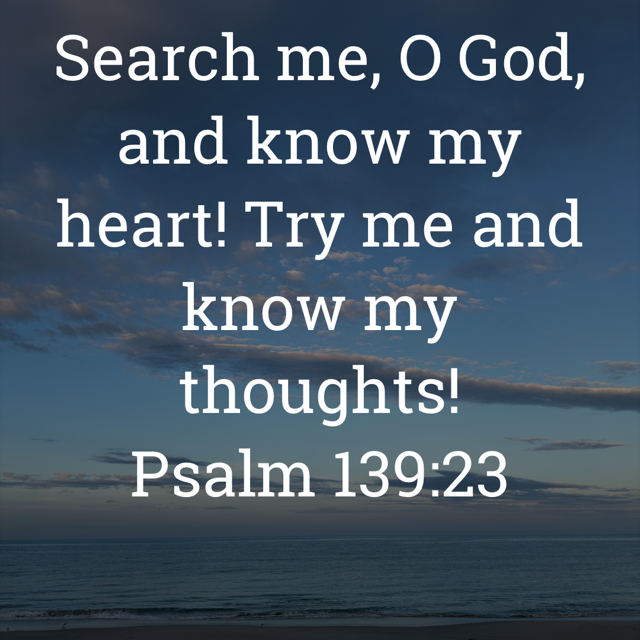
23 Search me, O God, and know my heart!
Try me and know my thoughts![c]
24 And see if there be any grievous way in me,
and lead me in the way everlasting![d]
- Psalm 139:14 Or for I am fearfully set apart
- Psalm 139:20 Hebrew lacks your name
- Psalm 139:23 Or cares
- Psalm 139:24 Or in the ancient way (compare Jeremiah 6:16)
The ESV® Bible (The Holy Bible, English Standard Version®), © 2001 by Crossway, a publishing ministry of Good News Publishers. ESV Text Edition: 2025.
Psalm 139:23. 23 Search me, O God, and know my heart! Try me and know my thoughts!
1. Exegesis
- The setting: The superscription identifies this as a psalm of David. Within Book Five of Psalms, it brings personal prayer into the worshipping community. Its movement is from God’s complete knowledge (Psalm 139:1–6), through his inescapable presence (Psalm 139:7–12) and creative care (Psalm 139:13–18), to opposition to wickedness and an appeal for examination (Psalm 139:19–24).
- The opening becomes a prayer: Psalm 139:23 returns to the divine searching and knowing already affirmed in Psalm 139:1. David is not supplying information God lacks. He willingly submits his inner life to the God who already knows him completely.
- The whole inner person: The paired petitions concern the heart and the thoughts. In biblical usage, the heart includes desires, judgements, commitments, and motives, not simply emotions. The English Standard Version presents thoughts broadly, while its footnote recognises the dimension of cares. The verse therefore concerns the whole inner life, not anxiety alone.
- Testing rather than temptation: The appeal for divine examination invites God to assess the sincerity of David’s allegiance. It does not ask God to entice him into evil or imply that God must experiment to discover what he is like. Psalm 26:2 provides a closely related prayer. “Try me” means to test or examine to reveal what is truly in the heart.
- Integrity without sinless perfection: Following Psalm 139:19–22, David places his own loyalty under scrutiny rather than examining only others. Distinguish sincere devotion from freedom from all sin: the believer’s confidence remains dependent on grace.
- The destination: Psalm 139:24 completes the thought with a request for exposure of wrongdoing and divine guidance. Examination is directed towards faithful living, not endless inward analysis. This fits the contrast between ways of life established in Psalm 1.
2. Theological teaching
- God knows us completely: His knowledge is neither partial nor dependent on our disclosure. Prayer acknowledges this reality and expresses trust in his personal care (Psalm 139:1–18).
- Grace makes honesty possible: Read within the whole Bible, this prayer leads Christians to approach God through Jesus Christ. Justification means that God accepts believers because of Christ’s righteousness, received through faith, not because their self-examination is thorough enough (Romans 3:21–26; Romans 8:1; Hebrews 4:14–16).
- Grace also produces holiness: Sanctification is the Spirit’s work of renewing believers, involving their active repentance and obedience. Asking God to examine us is a response to grace, not a technique for earning it (Philippians 2:12–13; Romans 8:13).
- Scripture governs discernment: Our motives can deceive us. God’s written Word, rather than an inward impression alone, provides the standard for recognising sin and growing in obedience (Jeremiah 17:9–10; Hebrews 4:12–13; 2 Timothy 3:16–17).
You need not hide from the God who knows you. In Christ, you may bring him both what troubles you and what needs changing. His examination is not permission for self-condemnation; it invites truthful repentance and renewed dependence on grace.
3. Practical application
- Examine motives, not appearances alone: Before posting online, entering an argument, or making a decision, ask whether love and truth are guiding you, or whether approval, resentment, or control is taking over.
- Apply the prayer to yourself first: Concern about another person’s wrongdoing should not excuse pride or harshness in your own response. Seek humility alongside moral clarity (Matthew 7:3–5).
- Let repentance become concrete: Name a specific fault, confess it to God, and take an appropriate step: apologise, correct a misleading statement, or change a harmful habit (1 John 1:9; James 1:22).
- Bring worries without treating distress as proof of sin: A troubling thought or persistent anxiety does not by itself demonstrate moral failure. Pray honestly, receive support from trusted Christians, and seek qualified care when needed (1 Peter 5:7).
- Finish with trust: After a brief, Scripture-guided examination, turn towards Christ and the next faithful action. Do not make emotional relief or exhaustive certainty the condition of accepting God’s promise (Romans 8:1; Hebrews 4:14–16).
4. Meditation Guide
Set aside five to ten minutes. Keep your Bible open, and move from attention to prayer and action.
- Read: Read Psalm 139:1–6
139 O LORD, you have searched me and known me!
2 You know when I sit down and when I rise up;
you discern my thoughts from afar.
3 You search out my path and my lying down
and are acquainted with all my ways.
4 Even before a word is on my tongue,
behold, O LORD, you know it altogether.
5 You hem me in, behind and before,
and lay your hand upon me.
6 Such knowledge is too wonderful for me;
it is high; I cannot attain it.
and Psalm 139:23–24
23 Search me, O God, and know my heart!
Try me and know my thoughts!
24 And see if there be any grievous way in me,
and lead me in the way everlasting!
Notice how the ending responds to the opening. - Consider: God already knows what you struggle to explain. What difference does that make to the honesty of your prayer?
- Reflect: Choose one recent interaction. What did you want most? Was your response shaped by love, pride, fear, or a desire for control? Let Scripture, not speculation, guide your answer.
- Confess and receive: Confess any clear sin without making excuses. Then consider Romans 8:1 and Hebrews 4:14–16. Rest your assurance in Christ, not in the quality of your reflection.
- Respond: Choose one small act of obedience for today. If no specific fault is clear, do not invent one; thank God and continue faithfully.
Suggested prayer: Father, you know me more fully than I know myself. By your Word and Spirit, expose what needs repentance, steady me in your grace, and renew my desires. Keep me from pride and fruitless self-accusation. Help me trust Jesus Christ and take the next faithful step. Amen.
Unless otherwise indicated, all Scripture quotations are from the ESV® Bible (The Holy Bible, English Standard Version®), © 2001 by Crossway, a publishing ministry of Good News Publishers. ESV Text Edition: 2025. Used by permission. All rights reserved.
Discover more from Daily bible verses
Subscribe to get the latest posts sent to your email.


You must be logged in to post a comment.